
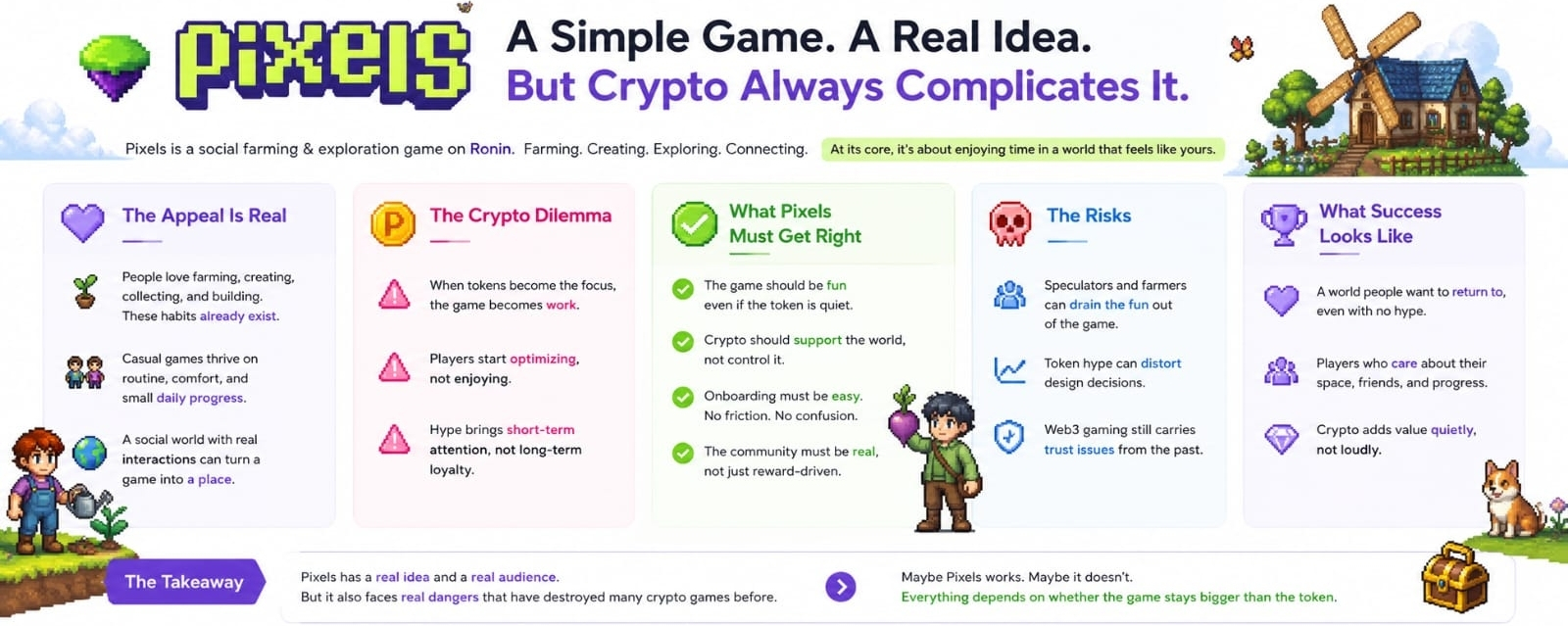

Pixels is one of those projects I don’t want to over-explain, because the moment you over-explain a crypto game, it starts sounding fake.
Look, we’ve all seen this before.
A game shows up. A token shows up. A community forms around it. Everyone says they are “playing.” But half the room is really farming rewards, watching emissions, checking unlocks, and pretending the chart is not the main character.
That is the mess crypto gaming created for itself.
So when I look at Pixels, I don’t come in clean. I come in with baggage. A lot of it. Bad play-to-earn loops. Empty NFT worlds. Land sales that felt more important than the actual game. Discords full of people asking “wen listing” like that was gameplay.
Honestly, it makes you tired.
Pixels is simple on the surface. A casual farming and social game built on Ronin. You farm, explore, create, interact, build out your little space. Nothing too dramatic. Nothing that needs a founder to stand on a stage and explain the future of mankind.
And that’s probably why it catches my attention a bit.
Because the problem it touches is real. People do want digital spaces that feel like they belong to them. People do want routines. They want to log in, do a few tasks, see progress, maybe talk to someone, maybe build something that feels slightly personal.
That part isn’t fake.
The question is whether crypto makes that better, or just drags the usual mess into it.
That’s always the question.
The thing is, traditional games already have a problem under the hood. You spend hundreds of hours building, collecting, decorating, grinding, and at the end of the day, you own almost nothing. The company controls the servers, the items, the rules, the economy, the account. One ban, one shutdown, one update, and your “ownership” starts looking very imaginary.
Crypto people are not wrong to notice that.
But crypto people are also very good at ruining the thing they notice.
Instead of making ownership feel natural, they often turn everything into a market. Instead of making the game better, they make every player think like a trader. Suddenly the question is not “is this fun?” It’s “what’s the ROI on my time?”
That is where Pixels has to be careful.
Very careful.
Because the farming part is supposed to feel calm. The social part is supposed to feel human. The world is supposed to feel like somewhere you might actually want to hang around.
But if PIXEL becomes the whole point, then the game gets thinner.
It becomes another reward machine.
And we’ve had enough reward machines with cute graphics.
I’m not saying the token has no purpose. Maybe it does. Maybe it helps power the economy. Maybe it gives players more control. Maybe it lets the game feel more open than the usual closed gaming model where everything sits inside a company’s private box.
Fine.
But the token cannot be the soul of the game.
That’s the line.
If people are in Pixels because they like the world, that’s interesting. If they are there only because they think the token might go up, then we already know how fragile that is. Crypto attention is not loyalty. It leaves the second the rewards dry up or the chart gets boring.
And that’s the trauma, really.
We’ve watched projects confuse activity with belief. We’ve watched fake users farm systems until the numbers looked good. We’ve watched bots turn communities into noise. We’ve watched people call it adoption when it was really just extraction with a login screen.
So Pixels has to prove something uncomfortable.
It has to prove people want to stay when there is no obvious financial reason to stay.
That is hard to build.
Probably harder than most people admit.
A casual game needs rhythm. It needs reasons to return that don’t feel like chores. It needs enough depth to keep people around, but not so much friction that normal players bounce. It needs events, progression, social texture, small surprises, and a world that does not feel dead after the first wave of hype moves on.
Then you add crypto on top.
Now every design choice has market pressure attached to it.
That is not easy.
Ronin helps in the sense that it is already known for Web3 gaming. There is some infrastructure there. Some plumbing. Some audience that understands wallets and assets and the weird emotional weather of crypto games.
But let’s be honest, normal players do not care about chain branding.
They care if the game works.
They care if onboarding is not painful.
They care if they can play without feeling like they accidentally signed up for a finance course.
That’s where Pixels has to keep things clean. Not polished in the corporate sense. Clean in the practical sense. Less friction. Less confusion. Less “connect these five things before you can enjoy yourself.”
Infrastructure should stay under the hood.
Nobody wants to admire the pipes while trying to play a farming game.
The social side is probably the most important part, and also the easiest to fake. Crypto loves saying “community.” Usually that means a group chat full of people trying to stay optimistic about their bags.
That is not the same thing as a real social world.
A real social world has memory. People recognize each other. They build habits. They have dumb little moments that don’t show up in a token dashboard. They care about the space because they have spent time there, not because an incentive program told them to.
Pixels needs that.
Without it, farming becomes repetitive. Creation becomes cosmetic. Exploration becomes a checklist. And the token becomes louder than everything else.
That’s the part that worries me.
Crypto users optimize the fun out of things. I know because I’ve done it. We turn simple mechanics into spreadsheets. We chase efficiency. We complain when rewards drop. We call ourselves users, but sometimes we behave more like temporary contractors extracting value from a system.
Pixels has to survive that type of user.
And attract a different type too.
That is a weird balance. Crypto-native players want ownership, upside, rewards, liquidity. Casual gamers want ease, charm, safety, and a reason to care. These two groups do not always want the same thing.
Sometimes they barely speak the same language.
So when people talk about Pixels onboarding normal gamers, I get skeptical. Not because it is impossible. Because it is harder than crypto people make it sound. Most normal gamers are not waiting around for blockchain to save them. They already have games that work. They already have places to spend time.
Pixels has to earn its place.
Not with slogans.
With actual experience.
The best version of Pixels is not some dramatic “future of gaming” thing. I don’t trust that kind of language anymore. The best version is quieter. A game where ownership adds something useful, but does not dominate the room. A world where the crypto parts work in the background. A place where players return because the routine feels good, the social layer feels alive, and the progress feels worth keeping.
That would be enough.
Honestly, that would be more than most Web3 games have managed.
But it might take time. It might be messy. The economy might need adjustments. Players might push the system in ways the team did not expect. Bots and farmers might show up. The token might distort behavior. The community might get impatient when the market slows down.
All of that is real.
Ignoring it would be dishonest.
Pixels has a real idea underneath it, though. That is why I don’t dismiss it. The idea that players should have more connection to the worlds they spend time in makes sense. The idea that digital spaces can feel owned, lived in, and shared makes sense. The idea that casual gaming and Web3 might overlap in a more natural way than forced play-to-earn farming also makes sense.
But the execution is everything.
Always.
A token does not make a boring game good. Ownership does not make an empty world meaningful. A chain does not create culture by itself. And a community is not real just because people are loud during a market cycle.
Pixels still has to do the boring work.
Keep the game alive.
Make the world worth returning to.
Keep the crypto layer useful but not suffocating.
Stop the token from becoming the only thing anyone talks about.
That is not flashy.
It is just necessary.
Maybe Pixels manages that. Maybe it doesn’t. I don’t know. Nobody does, no matter how confident they sound online.
For now, I see it as a project sitting in a difficult but interesting spot. It has the shape of a real game, not just a financial product wearing a costume. But it also carries all the old crypto gaming risks: speculation, extraction, fake loyalty, fragile economies, and users who disappear when the incentives cool off.
That tension is the whole story.
Pixels does not need to change gaming. It just needs to prove it can be a game people actually want to play when the hype is quiet.