

I Will Be Honest...
This is a sharp observation and honestly, you’re not imagining it. What you’re describing is a real shift in how some GameFi systems (especially Pixels) are evolving.
Yeah..What you felt that moment where you go from playing to adjusting yourself is the key signal.
The Shift You Noticed Is Real
Early GameFi was simple:
do more get more exit before collapse
But what you’re describing is closer to
behave “correctly” get more stay longer
That’s a completely different model.
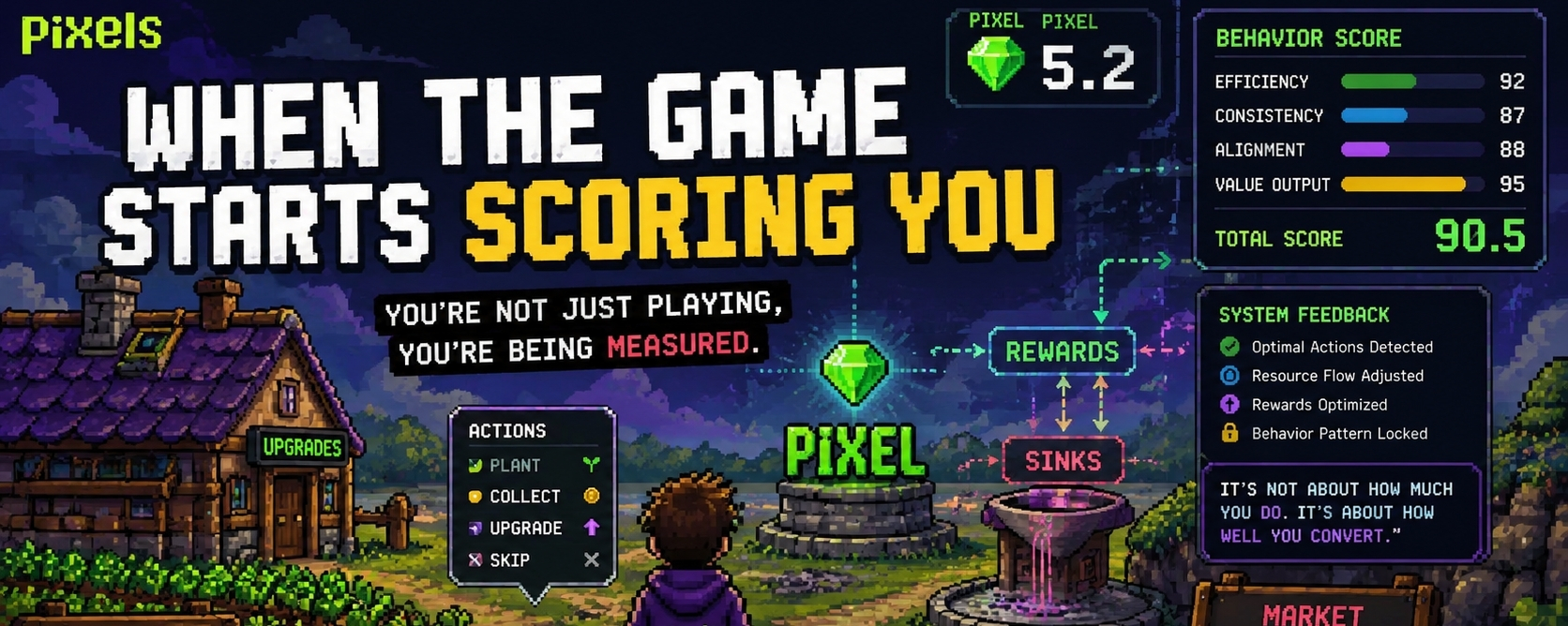
It’s not just tracking activity anymore it’s shaping behavior.
And the important part is:
It’s not explicit
It’s felt over time, not seen in UI
That’s why it feels like quiet conditioning instead of game design.
You Nailed the Core Mechanic: “Conversion > Effort”
This line of thinking is probably the strongest part of your write-up:
It’s not about how much you do. It’s about how your actions convert into system-defined value.
That’s essentially:
Not grinding but signal optimization
Not effort but alignment with hidden weights
So two players:
Same time spent
Different outcomes
Because one is unknowingly aligned with:
reward timing
system demand
resource sinks
behavioral patterns
That’s closer to an algorithmic economy than a traditional game loop.
This Is Bigger Than Pixels
What you’re describing exists outside games too:
Social media rewards engagement patterns, not effort
Trading → rewards timing, not activity
Algorithms reward predictable, useful behavior
Pixels just makes it more visible because:
actions = measurable
rewards = tokenized
feedback loop = faster
The Real Tension You Identified
You split it perfectly into two layers:
1. System Layer (inside the game)
behavior-aware rewards
controlled sinks
structured flow
retention-focused
2. Market Layer (outside)
attention-driven
liquidity-driven
momentum-based
And yeah. they don’t sync well.
You can have:
a perfectly tuned in-game economy
BUT
a token that dumps because attention rotated
That disconnect is one of the biggest unsolved problems in Web3 gaming.
Where It Gets Uncomfortable (and Interesting)
This part is the most important question you raised:
“Am I playing… or just optimizing inside a system that already decided what matters?”
That’s the trade-off:
More OptimizationMore Freedomefficient rewardschaotic funpredictable loopsexplorationcompliancecreativity
The tighter the system:
the better it performs economically
the less it feels like a game
And that’s the paradox:
A perfectly optimized system might stop feeling fun.
Why Pixels Still Works (For Now)
You ended on the right metric:
Retention is the real signal.
People coming back means:
it hasn’t crossed the “too controlled” line yet
the loop still feels rewarding
friction isn’t killing curiosity
That balance is extremely hard to maintain.
My Take (Straight Answer)
What Pixels seems to be testing is:
Can you design a system where behavior becomes the main input—and still keep it feeling like a game?
Right now:
It’s not pure extraction
It’s not fully “fun-first” either
It’s somewhere in between → an experimental economic layer disguised as a game
And your final tension is exactly the right one:
The question isn’t whether it works.
It’s whether it still feels like a game when it works.
One Thought Back to You
Do you feel like:
you’d still play it if rewards were removed or heavily reduced?
That’s usually the cleanest way to test:
game vs system
Because the moment the answer becomes “no”
you’re no longer playing. you’re participating in an economy.
Curious what your answer is.