
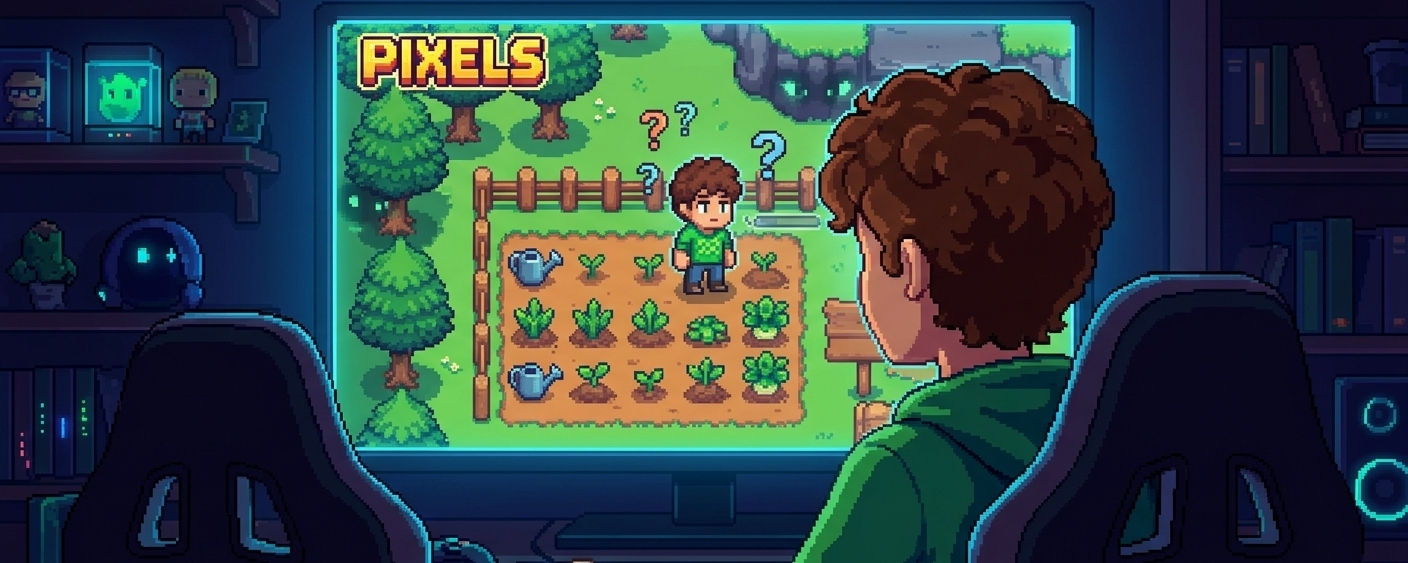
I didn’t really notice it at first.
Pixels just felt… light. Simple loop, low pressure, nothing too serious. You log in, do a few actions, leave. That’s it. No stress, no urgency. Honestly, I liked that part more than I expected.
But after a few days, something started feeling slightly off. Not in a bad way—just unfamiliar.
There was this one session I remember pretty clearly. I logged in, did basically the same routine I had done the day before—same crops, same movement pattern, same general flow. I didn’t think much of it at the time. It felt automatic.
And then I logged out thinking I had understood the system.
Except I hadn’t.
Because the outcome didn’t match what I expected. It wasn’t dramatically different, but it was enough to make me pause for a second. Like… wait, why did that feel less “effective” than yesterday?
That small moment is where Pixels starts to shift on you.
It doesn’t announce anything. It doesn’t explain itself. It just quietly refuses to behave like a fixed loop.
And that’s the thing—you go in thinking it’s a standard time-for-reward system, but it slowly stops cooperating with that idea. Not completely. Just enough to make you unsure if you’re actually optimizing anything at all.
At first I thought it was random. Maybe even just my imagination filling gaps where there weren’t any. That’s the easy explanation, right?
But the more I played, the more I started noticing patterns that didn’t sit comfortably with that assumption.
Some sessions felt “heavier” even when I did less. Others felt flat even when I spent more time. And it wasn’t consistent enough to map cleanly onto effort or duration.
That’s where things get interesting.
Because Pixels doesn’t really reward time in a straight line. It reacts more like… context. Timing. Behavior patterns. The way you engage, not just how long you stay engaged.
And that changes how you think inside the game without you even noticing it happening.
You stop asking “how long should I play?”
And start asking something more uncertain.
“Is this even one of those moments that matters?”
It sounds small, but it shifts everything.
There’s also something slightly uncomfortable about it, if I’m honest. Not in a frustrating way—more like you can’t fully relax into autopilot anymore. The game doesn’t punish you for that, but it also doesn’t reward it consistently.
So you start paying attention in a different way. Not grinding harder. Just… noticing more.
And weirdly, that’s where the engagement deepens.
Because once you stop assuming every action has equal weight, you start treating decisions differently. You hesitate a bit more. You experiment without fully realizing you’re experimenting. You leave sessions earlier sometimes, not because you’re bored, but because it “feels done” in a way you can’t quite explain.
This is where Smart Reward Targeting shows itself, even if you don’t think in those terms while playing.
It’s not just about what you do. It’s about how your behavior fits into a wider system of behavior. And that system isn’t static—it shifts based on how people are interacting with it overall.
So the game you’re playing today isn’t exactly the same version someone was optimizing last week.
That’s probably why traditional “grind logic” feels slightly unreliable here.
Grind assumes stability.
Pixels doesn’t fully commit to stability.
And that creates this strange middle space where you can’t fully brute-force progress, but you also can’t ignore effort entirely. You end up somewhere in between—trying things, adjusting, sometimes overthinking, sometimes just going with instinct.
I didn’t expect that part to stick with me.
Especially because on the surface, nothing about the game screams complexity. It still looks like a simple loop. It still feels relaxed. You can leave anytime and nothing collapses without you.
But that’s also part of it.
The world doesn’t stop when you leave. When you come back, something has moved forward slightly. Not in a dramatic “you missed out” way, just enough to remind you that it exists independently of your attention.
That creates a different kind of attachment. Less pressure, more curiosity.
And over time, that curiosity becomes the main reason you return.
Not rewards. Not optimization.
Just the sense that the system might feel a little different today—and you won’t know until you step back in.