

Crypto Regulation in America May Finally Be Changing
After years of confusion, lawsuits, and uncertainty, the crypto industry in the United States may finally be moving toward a clearer future. The CLARITY Act has officially advanced in the Senate Banking Committee, marking one of the biggest regulatory developments the digital asset industry has seen in years.
The bill is designed to create a proper legal framework for cryptocurrencies, blockchain networks, stablecoins, and decentralized finance. For many in the industry, this is more than just another crypto bill. It is being viewed as a potential turning point that could decide how blockchain innovation develops in the United States over the next decade.
What makes the latest version especially important is its approach toward DeFi. The updated language appears far more supportive of decentralized infrastructure, software developers, validators, and blockchain participants than earlier proposals.
That alone has already created strong discussion across the crypto market.
Why the CLARITY Act Matters So Much
For a long time, one of the biggest problems in crypto has been the lack of clear rules.
Many blockchain companies never fully knew whether their tokens would be treated as securities or commodities. Regulators often disagreed with each other, while crypto firms faced enforcement actions without having clear guidelines to follow.
This uncertainty slowed investment, pushed startups offshore, and made many developers hesitant to build inside the United States.
The CLARITY Act is meant to change that.
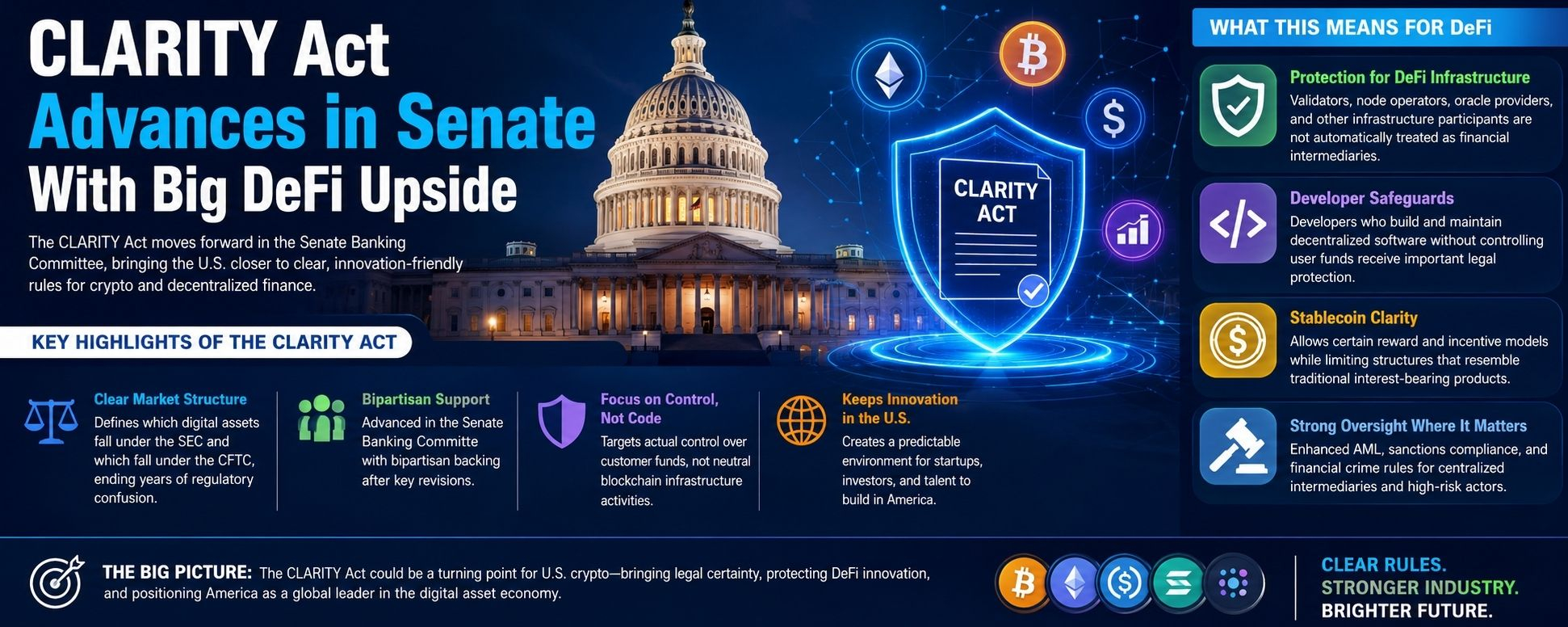
The legislation attempts to define which digital assets fall under the authority of the SEC and which belong under the CFTC. Supporters believe this would finally create predictable rules for crypto companies instead of leaving the industry trapped in legal gray areas.
For the market, clarity itself may become one of the biggest catalysts.
Senate Progress Signals a Major Shift
The bill’s advancement through the Senate Banking Committee is significant because crypto legislation has repeatedly stalled in Washington over the past few years.
Several earlier proposals failed due to disagreements involving investor protection, stablecoin oversight, banking concerns, and anti-money-laundering rules.
This time, lawmakers introduced a revised version containing multiple changes aimed at gaining broader political support. The updated text includes stronger financial crime provisions while also offering clearer protections for decentralized technology participants.
The bipartisan support behind the committee vote surprised many analysts and immediately increased speculation that the United States may finally be ready to establish formal crypto market structure laws.
DeFi Could Be One of the Biggest Winners
The strongest reaction from the crypto industry came from the bill’s DeFi-related language.
Under the revised framework, activities such as validating transactions, running nodes, providing oracle services, or helping secure blockchain networks would not automatically classify a participant as a financial intermediary.
That distinction is extremely important.
For years, many people involved in decentralized finance worried that regulators could eventually treat validators, infrastructure operators, and developers like traditional financial institutions. The latest version of the CLARITY Act appears to reduce that risk significantly.
The bill focuses more on actual control over customer funds and centralized operations rather than simply participating in blockchain infrastructure.
For DeFi builders, this creates a much more workable environment.
Developers Receive Important Protection
Another major part of the updated legislation involves software developers.
The bill includes language designed to protect developers who create or maintain decentralized software without directly controlling user assets.
This issue became increasingly important after several enforcement actions across the crypto industry created fears that simply writing code could expose developers to legal liability.
Supporters of the bill argue that publishing open-source software should not automatically be treated the same as operating a centralized financial platform.
The revised language appears to acknowledge that difference more clearly than previous crypto proposals.
For developers building wallets, decentralized applications, smart contracts, and blockchain infrastructure tools, this could become one of the most meaningful aspects of the legislation.
Stablecoin Rules Were a Major Negotiation Point
Stablecoins became one of the biggest obstacles during negotiations surrounding the bill.
Some banking groups raised concerns that yield-generating stablecoin products could compete with traditional deposits while operating under different rules.
Lawmakers eventually revised portions of the legislation involving rewards and yield structures tied to stablecoins. The compromise reportedly allows certain blockchain-based incentive models while restricting structures that function too closely to traditional interest-bearing bank accounts.
These revisions helped the bill gain more support without completely limiting innovation in the stablecoin sector.
Many analysts believe this compromise played a major role in helping the legislation move forward.
The Bill Still Includes Strong Oversight Measures
Despite industry optimism, the CLARITY Act is not a completely hands-off approach to crypto regulation.
The legislation expands anti-money-laundering requirements for certain digital asset businesses and strengthens compliance expectations involving sanctions and suspicious financial activity.
However, lawmakers appear to be trying to separate centralized intermediaries from decentralized infrastructure providers that do not directly hold customer assets.
That balance is becoming one of the defining themes of the bill.
Instead of broadly targeting all blockchain activity, the legislation attempts to focus regulation on areas where actual financial control exists.
Markets Reacted Quickly
Crypto markets responded positively after news of the Senate advancement became public.
Investors viewed the development as a sign that the United States could finally be moving toward a more stable and predictable regulatory environment for digital assets.
Several crypto-related stocks and DeFi tokens saw increased attention as traders began speculating about how clearer regulation could benefit the industry long term.
At the same time, analysts warned that the bill still faces political challenges before becoming law. Some lawmakers continue pushing for stricter rules involving stablecoins, financial crime enforcement, and crypto-related conflicts of interest.
The legislation still needs approval from the full Senate before additional negotiations can take place.
Why This Moment Could Matter for the Entire Crypto Industry
The importance of the CLARITY Act goes beyond regulation alone.
For years, crypto companies argued that uncertainty was driving innovation away from the United States. Many startups chose overseas jurisdictions simply because the rules were easier to understand.
If the CLARITY Act eventually becomes law, it could change that trend.
Blockchain companies may finally gain a framework that allows them to build with more confidence. Developers could receive stronger legal clarity. Institutional investors may also feel more comfortable entering the digital asset market once regulatory boundaries become easier to understand.
Most importantly, the bill signals that lawmakers are beginning to recognize that decentralized finance cannot be treated exactly like the traditional banking system.
That shift in thinking could reshape the future of crypto in the United States for years to come.