
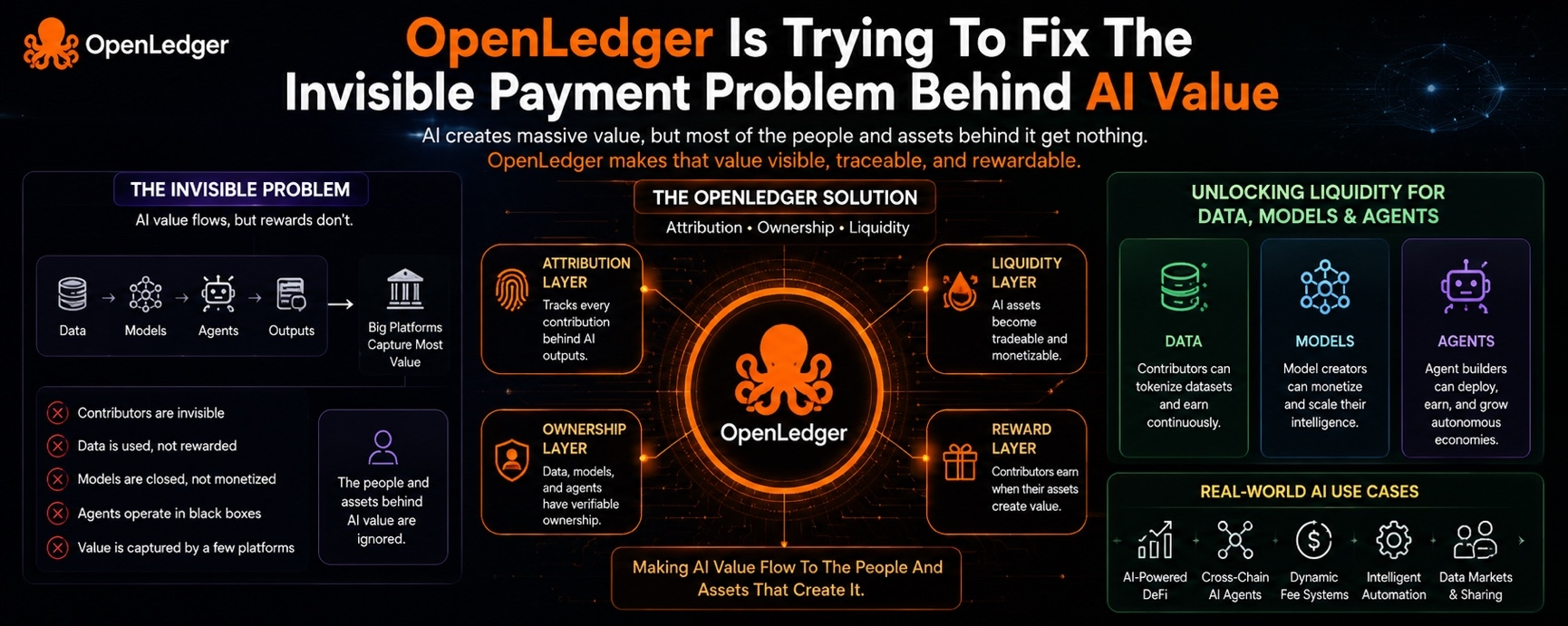
OpenLedger is one of those projects I don’t want to judge from the label alone.
Because honestly, the market has drained that label to death.
“AI blockchain” has been recycled so many times now that I almost switch off the moment I see it. Same words. Same pitch. Same clean diagrams pretending the messy parts don’t exist. I’ve watched enough projects wrap a weak idea in AI branding and then disappear when the noise fades.
OpenLedger at least seems to be looking at a real problem.
Not the shiny part of AI.
The ugly part.
Who owns the data? Who gets paid when that data becomes useful? Who tracks the model’s value after it leaves the lab? Who knows what an agent used before it made a decision? These are not easy questions. Most projects avoid them because they are full of friction, and friction is bad for marketing.
But friction is where the real infrastructure usually gets built.
OpenLedger is focused on data, models, and agents. That sounds simple on paper, but there is a lot sitting underneath it. AI does not create value from nothing. There is always a trail behind the output : data, training, feedback, model design, agent logic, human input, and execution.
Most of that trail gets buried.
A model gives an answer and everyone claps. Nobody asks where the useful part came from. Nobody asks who should be rewarded. Nobody asks if the original contributor even has a seat at the table.
That is the gap OpenLedger is trying to work inside.
I like that angle because it is not just another “AI will change everything” pitch. I’ve heard that line too many times. It means nothing anymore. The stronger idea here is that AI value needs attribution. It needs a way to show where value came from and how it should move.
That is much harder than launching a token with a loud narrative.
Data is messy. Models are messy. Agent behavior is messy. Attribution in AI is not clean, because outputs are built from layers of influence, not one straight line. Anyone pretending this is easy is either selling too hard or not paying attention.
OpenLedger is stepping into that mess.
And that is why I’m watching it.
The project wants data, models, and agents to become monetizable assets. Not just things sitting inside closed systems, but assets that can be tracked, used, rewarded, and possibly traded with actual liquidity behind them.
That idea has weight.
If a dataset helps train something useful, why should it vanish into the background? If a model keeps producing value, why should the people behind it only benefit once? If an agent uses certain data or logic to complete work, why should that value chain stay invisible?
These questions matter more as AI agents become more active.
Right now, most people still think of AI as something that answers prompts. That is already old thinking. The next grind is agents that execute. Agents that automate workflows. Agents that monitor markets. Agents that interact with on-chain systems. Agents that make decisions faster than humans can even review them properly.
That sounds exciting until money is involved.
Then it gets uncomfortable.
If an agent makes a bad decision, people will ask why. If it moves funds, people will ask what data it used. If it creates value, people will ask who deserves payment. And if nobody can answer, trust breaks.
This is where OpenLedger’s focus starts to make sense.
It is trying to build around attribution and ownership before the agent economy gets too chaotic. That does not mean it automatically wins. Crypto is full of good ideas that never found real demand. I’ve seen beautiful infrastructure sit empty for years because builders had no reason to use it.
That is still the risk here.
OpenLedger can have a strong concept, but concept alone is not enough. The real test is whether developers actually build with it. Whether data contributors see a reason to join. Whether agents become useful beyond demo videos. Whether the token has a real role inside the system instead of just floating on narrative.
I’m not looking for perfect language from the team.
I’m looking for usage.
That is always where the market separates signal from noise.
The interesting part is that OpenLedger is not trying to sell only one layer. It is looking at the full AI value chain. Data feeds models. Models power agents. Agents create outputs. Outputs generate value. That value should somehow flow back to the right places.
Simple idea.
Hard execution.
And maybe that is why it feels more grounded than the average AI crypto pitch. It does not pretend AI is magic. It treats AI like an economy with missing payment rails.
That is a better way to think about it.
Because the current AI system is heavily tilted toward platforms. People contribute data, feedback, ideas, and behavior, but most of the upside gets captured somewhere else. OpenLedger is trying to build a system where contribution can be seen and monetized.
That is not a small ambition.
It also means the project has to deal with all the annoying parts nobody likes to talk about : data quality, verification, reward design, model usage, agent accountability, developer adoption, liquidity depth, and actual demand.
This is where the grind starts.
The market loves clean stories, but infrastructure is never clean. It is slow. It is boring at times. It breaks. It needs builders. It needs users who come back after the hype cycle moves somewhere else.
OPEN will need that.
A strong narrative can bring attention for a while, especially with AI still being one of the loudest sectors in crypto. But attention is cheap now. Every cycle produces hundreds of projects fighting for the same few seconds of mindshare.
What matters is whether OpenLedger can become useful enough that people stop treating it like a ticker and start treating it like a layer they need.
That is the part I’m waiting to see.
I do think the timing is interesting. AI is moving toward specialized models and autonomous agents. Not every useful AI system needs to be massive. Some of the most valuable ones may be narrow, trained on specific data, and built for specific tasks.
Market agents.
Research agents.
Gaming agents.
Workflow agents.
Industry-specific models.
Those systems need more than hype. They need ownership, traceability, and ways to earn. OpenLedger fits that direction if it can make the experience smooth enough for builders and valuable enough for contributors.
But again, “if” is doing a lot of work here.
I’ve learned not to fall in love with infrastructure too early. The graveyard is full of projects that sounded important but never became necessary. OpenLedger has a serious lane, but now it needs proof. Real activity. Real assets. Real agents. Real rewards. Not just polished explanations.
That is why I would not frame OPEN as some easy AI play.
It is more like a bet on whether AI value becomes financialized in an open way.
If that happens, OpenLedger has a clear reason to exist. If it does not, then it becomes another project with a smart thesis waiting for a market that never fully arrives.
For now, I see the appeal.
OpenLedger is asking a question the AI market keeps avoiding : when intelligence creates value, who actually gets paid?
And maybe that question is where the whole thing starts to get interesting.