

I spent two years building a prediction model that worked beautifully in backtests and fell apart the moment it touched real liquidity. That is when I stopped obsessing over where price would go and started watching how orders actually land.
Most AI trading discussions still orbit prediction like it is the sun of the solar system. But in fragmented onchain markets, prediction without execution is just educated hoping. The real differentiator has quietly become something else: getting the trade done at the price you thought you were getting, across venues that do not talk to each other, before someone else snipes the gap.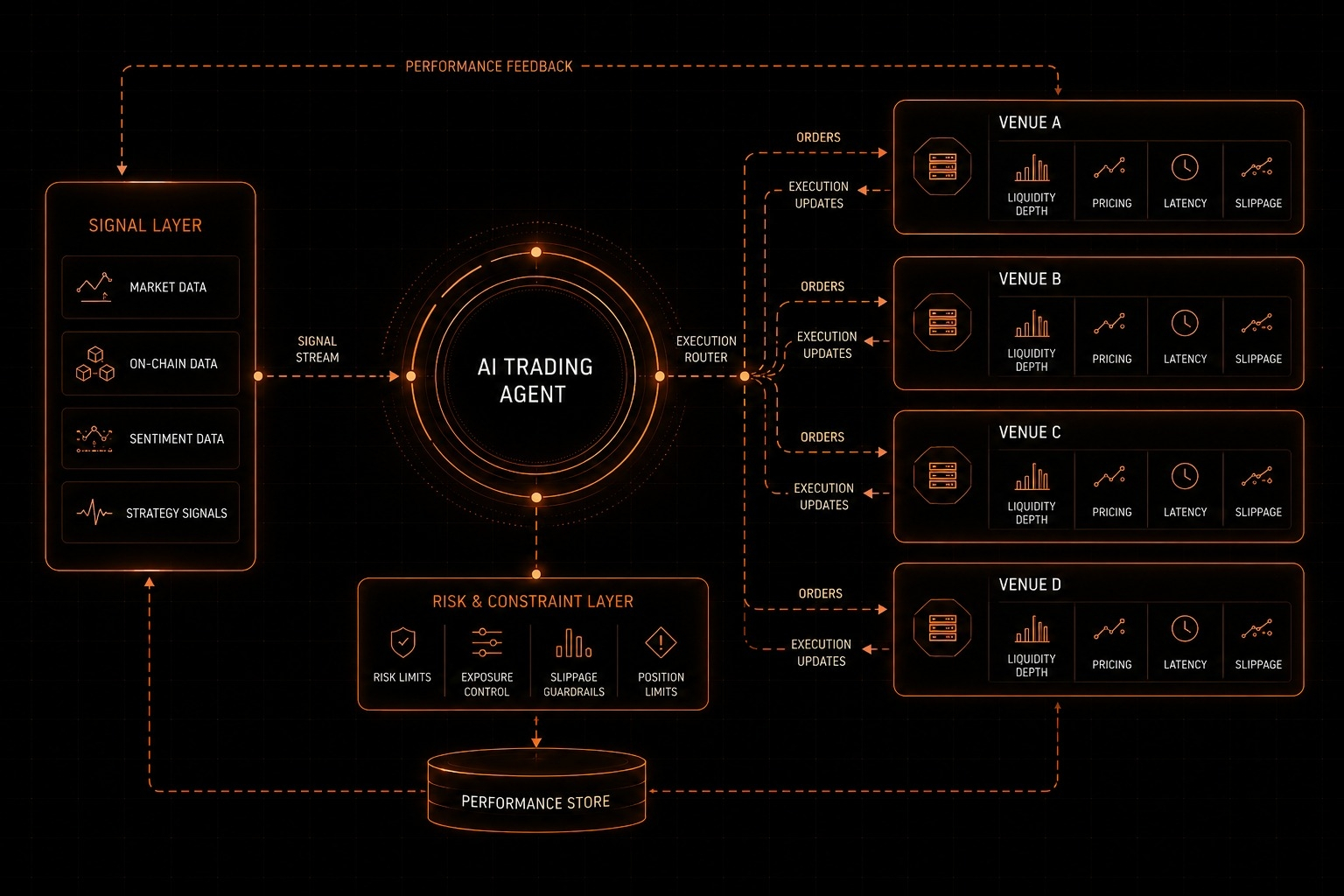
Here is what changed. A year ago, most onchain execution meant sending a transaction to Uniswap and praying. Now we have dozens of venues, each with its own liquidity profile, block timing, and fee structure. A single trade might route through Ethereum mainnet, a few rollups, and a purpose-built order flow provider you never heard of. Surface level, this looks like fragmentation. Underneath, it is an optimization problem that prediction models cannot solve alone.
That momentum creates another effect. When I look at data from the past six months, the spread between best available price and what a naive swap actually gets has widened to 15 to 20 basis points on volatile pairs, and sometimes double that during congestion. A prediction model might guess direction with 55 percent accuracy, but poor execution can eat an entire year of that edge in one trade. I have seen strategies with positive expected value go bankrupt because they kept crossing spreads they did not account for.
So the stack is shifting. Where people used to ask what comes next, they now ask how to route. Signal ingestion still matters, but it feeds directly into risk controls, then routing logic, then cross-venue coordination, then continuous feedback. That feedback loop is the part nobody talks about enough. A good execution system learns from every fill. It notices that Venue A consistently gives better price on blocks that land in the second half of each minute, while Venue B works better when mempool congestion passes a certain threshold. Prediction might tell you to buy. Execution tells you how, when, and where.
Understanding that helps explain why the most interesting work in onchain trading is no longer happening inside price models. It is happening inside order splitters, latency arbitrage detectors, and adaptive slippage engines. One hedge fund I follow recently published a breakdown showing that across their onchain strategies, execution improvements contributed roughly two thirds of total alpha last quarter. Prediction contributed the rest. That is a reversal from two years ago, when the split was the opposite.
Of course, the counterargument is obvious. If everyone focuses on execution, prediction becomes the new edge again. That might happen eventually. But right now, execution is underbuilt because it is harder, messier, and less glamorous. Prediction works cleanly in a Jupyter notebook. Execution forces you to deal with revert risks, gas estimation, and the ugly reality that your transaction might land three blocks later than you expected.
I have watched teams solve this in different ways. One approach is to build smart order routers that simulate across twenty venues in under a hundred milliseconds, then split a single trade based on current depth and recent fill history. Another is to use reinforcement learning on past execution data to learn which venues tend to front-run or delay orders. That last one is delicate. You are not trying to predict the market, just the behavior of the execution environment itself. Early signs suggest it works, if this holds for another six months.
Meanwhile, the retail experience remains stuck in the old mindset. Most traders still hit swap and accept whatever output appears. But the sophisticated end of the market is already moving toward execution as a service. Protocols like Krypton and Titan are building what amounts to operating systems for onchain trading, where prediction is one module among many, not the central brain. When I first looked at those systems, I thought they were overengineered. Then I watched them eat the spread on a series of small trades while my manual execution bled value.
This reveals something bigger about where things are heading. The era of standalone predictive models is ending. We are entering the era of integrated trading stacks that treat prediction as a signal input, not the output. The real intelligence will live in the execution layer, because that is where the friction actually exists. Onchain markets are not continuous. They are discrete, adversarial, and deeply fragmented. Prediction smooths over that reality. Execution navigates it.
What strikes me now is how many teams still build from the top down. They train a model, then bolt on a simple execution heuristic at the end. That is backwards. The right foundation is execution first, with prediction layered on top as one of many signals. One of the quietest shifts I have observed is that the most profitable onchain strategies today are not the ones with the best price forecasts. They are the ones that lose the least to execution inefficiency.
That is an uncomfortable truth for anyone who fell in love with machine learning. But the numbers do not lie. On a typical Ethereum block, the difference between optimal execution and naive execution can exceed the total predictive edge of most models. Add in cross-venue coordination, and the gap widens further.
The risk, and I want to be honest about this, is that execution optimization becomes an arms race with diminishing returns. The first few basis points are easy. The last few require co-location, custom RPC infrastructure, and relationships with block builders. That game favors the largest players. So the next wave of innovation might not just be better execution, but execution that stays good for smaller participants without their own internalized order flow.
I do not know who solves that. But I know the question is changing. It is no longer can you predict the price. It is can you capture the price that exists, right now, across this fragmented mess of liquidity. Prediction tells you where value might be. Execution tells you whether you get to keep it.