
Some of the best trading ideas I’ve ever had never became real. Not because they lacked potential, but because there was always this frustrating wall sitting between the idea itself and the actual process of building it into something usable. I’ve spent years around markets, charts, positioning, sentiment shifts, funding rates, and all the little things traders notice before the crowd does. But turning those observations into functioning tools always felt like entering a completely different world. A world full of APIs, backend logic, hosting issues, wallet integrations, broken feeds, debugging sessions, and technical problems that had nothing to do with the original idea. That gap kills more ideas than people realize. Not every trader is a developer, and honestly, most traders do not want to become one. We just want our systems, alerts, workflows, and setups to exist outside our notes app before the market moves on without us.
That’s why the whole vibecoding direction around @OpenLedger caught my attention differently than most AI narratives floating around crypto right now. A lot of projects talk about AI as if generating a few lines of code suddenly changes everything. But anyone who has actually tried to build something useful knows the hard part isn’t writing random snippets. The hard part is creating something that survives real conditions. Markets are messy. Data breaks. APIs fail. Chains get congested. One small mistake in logic can ruin the entire usefulness of a tool. Most “AI coding” products still feel like they solve the easiest 20% of the process while leaving the difficult 80% sitting on your desk. Vibecoding feels interesting because it is trying to attack the part where most non-technical people give up entirely.
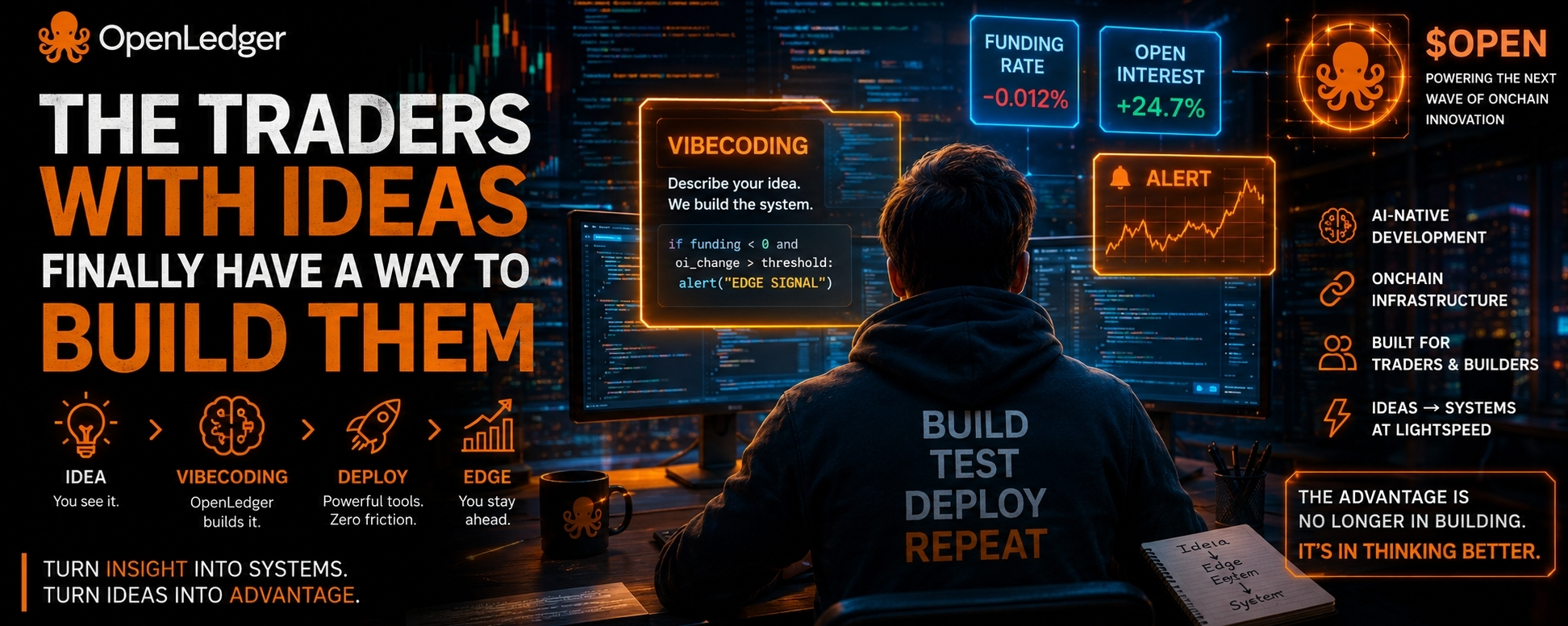
I keep thinking about one idea I shelved months ago. I wanted a simple alert system that would ping me whenever funding flipped negative while open interest increased aggressively across multiple venues at the same time. In my head the logic was already finished. I knew exactly why the signal mattered, what conditions I wanted, and how I would use it. But actually building it meant dealing with exchange APIs, syncing data from different sources, managing delays, avoiding rate limits, hosting the service somewhere stable, and maintaining the entire thing when one provider inevitably changed something. Suddenly a relatively simple trading concept turned into a technical project that demanded far more time than the edge itself was worth. So the idea stayed in my notes like dozens of others. That’s the part people outside trading rarely understand. Most traders are not lacking ideas. They are lacking the ability to turn ideas into functioning systems quickly enough before conditions change.
And honestly, this probably was not even possible at scale a couple years ago. Crypto infrastructure itself was still too fragmented, too unstable, and too inconsistent. AI models also weren’t reliable enough to trust with anything meaningful. Back then it felt like asking an intern to assemble a machine using instructions it barely understood. But now things are different. Frameworks are more standardized, tooling across chains is improving, and the models themselves are becoming capable enough to act less like autocomplete and more like actual collaborators. It feels like both sides matured at the same time. Crypto became more buildable while AI became more usable. Vibecoding only starts making sense because those two curves finally met in the middle.
At the same time, I don’t think easier building automatically means safer systems. Markets punish carelessness instantly. If an AI helps someone build a strategy and quietly misunderstands how a contract works or mishandles live market conditions, the consequences are still very real. There’s a danger in how smooth these systems can make things feel. Fast building can create false confidence. A clean interface does not guarantee sound logic underneath it. Personally, anything I build through a process like this would still go through the same treatment as any other trading system. Small sizing first. Testing under live conditions. Verifying every assumption manually. Watching how it behaves during volatility instead of trusting screenshots and backtests. The market doesn’t care whether something was AI-generated or hand-coded. If the logic is weak, it gets exposed eventually.
What interests me most is the broader shift this could create. When the cost and difficulty of building drops, the advantage changes completely. For years, a big edge belonged to people who could actually execute technically. Many traders had ideas, but only a small percentage could transform them into functioning products or automated systems. If vibecoding reduces that barrier significantly, then the real advantage moves away from “who can build” and toward “who can think better.” The value starts coming from insight, creativity, timing, discipline, and understanding markets deeply enough to know what deserves to exist in the first place. And ironically, that probably makes originality even more important because simple strategies and obvious edges will get copied and deployed much faster than before.
For $OPEN specifically, I think the important question is whether this becomes an ecosystem where people consistently build things that survive real usage. Hype is easy in crypto. Demo products are easy too. But tools that traders, builders, and users continue relying on months later are much harder to create. That’s where the real test is. I’d want to see whether vibecoding actually leads to useful systems people keep running, whether developers continue building around it, and whether there’s a meaningful reason value flows back into the network itself instead of the feature becoming disposable. If OpenLedger manages to become a serious layer for turning ideas into usable systems at scale, then the use case becomes difficult to ignore. If not, the market eventually treats it like every other short-lived narrative cycle.
Right now I’m watching this less as a direct trade and more as a shift in the environment traders operate inside. The tools available to people always reshape the market eventually. If building becomes dramatically easier, then more ideas get tested faster, more systems come online quicker, and competition around small edges becomes far more intense. That changes behavior. It changes how fast strategies evolve. It changes who gets to participate. Whether or not I ever touch $OPEN itself, that larger shift feels important enough to pay attention to early rather than pretending it appeared overnight once everyone else starts talking about it.
