
Last night, after hours of scrolling through timelines filled with AI-generated art, automated predictions, and algorithm-shaped opinions, I caught myself thinking about how naturally we’ve started trusting machines to decide what deserves our attention. Nobody forced this shift on us. It happened slowly, through convenience. Recommendations became habits, automation became comfort, and before we noticed, systems built on artificial intelligence started influencing the way we process information, consume content, and even form opinions. That thought stayed in my head when I later opened Binance Square to complete the CreatorPad campaign task for OpenLedger. While going through the submission process and reading about how blockchain verification interacts with AI-driven data systems, something suddenly felt more real than theoretical. We always talk about blockchain and AI as if they are destined to create the perfect future together — blockchain bringing transparency and trust, AI bringing intelligence and efficiency — but the deeper I looked, the more I realized the relationship between them is not built on harmony alone. It is built on tension, compromise, and a quiet understanding that pure transparency may not always work in systems designed to think, adapt, and evolve. @OpenLedger $OPEN
Crypto culture has spent years convincing itself that maximum openness automatically creates maximum freedom. Every transaction visible, every record immutable, every process verifiable by anyone at any time. It sounds powerful in theory because blockchain was born as a response to hidden systems and centralized control. But AI operates differently. Intelligence, whether human or artificial, doesn’t function well when every layer is exposed equally. It depends on filtering signals from noise, identifying patterns, prioritizing context, and sometimes protecting certain processes from manipulation or overload. That is where the collision between blockchain ideals and AI realities becomes impossible to ignore. The more advanced AI becomes, the clearer it feels that fully transparent systems can also become vulnerable systems — easier to exploit, easier to manipulate, and harder to scale efficiently. OpenLedger made me think about this in a completely different way because it doesn’t present blockchain and AI as two perfect puzzle pieces. Instead, it shows that the real value comes from understanding the limits of both technologies and building a bridge where each compensates for what the other lacks.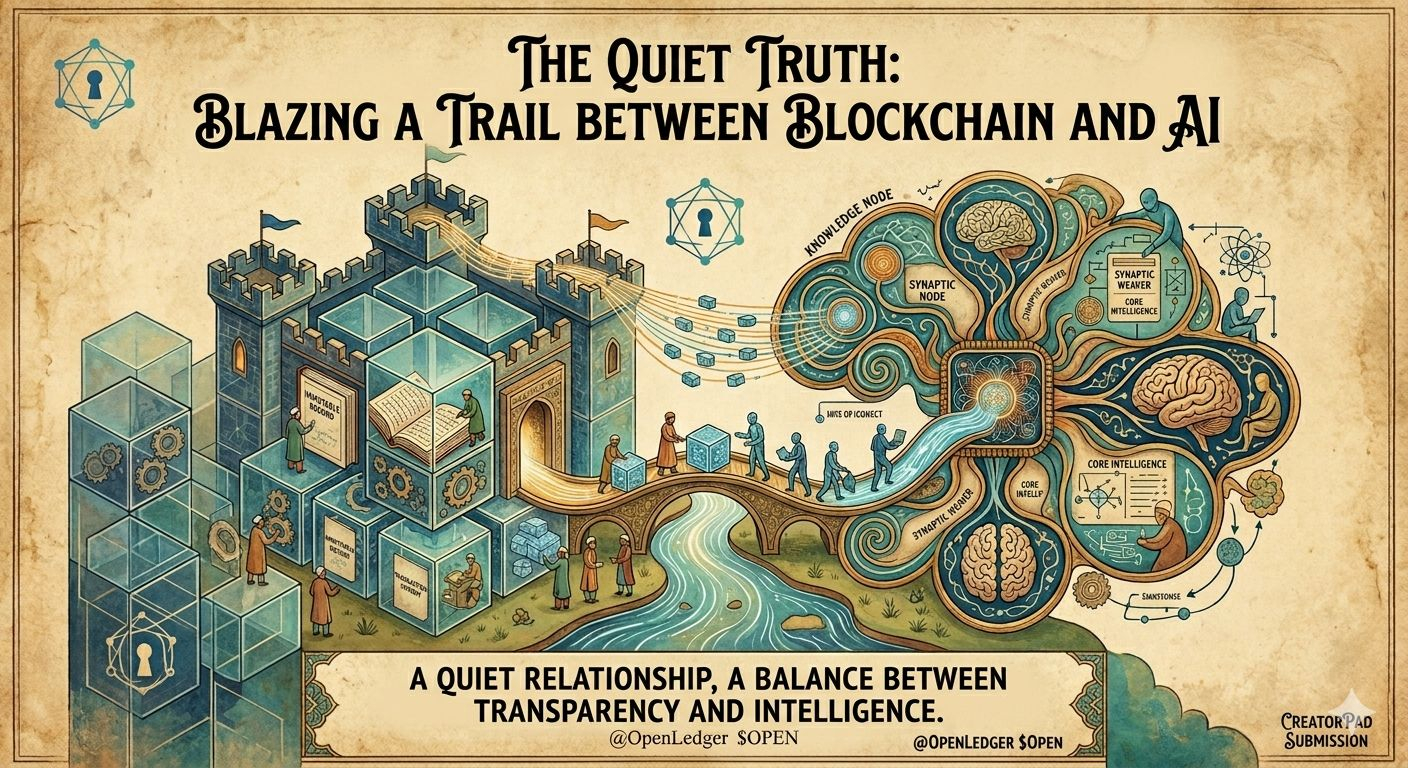
Blockchain alone is exceptional at preserving truth, but raw truth without interpretation can become overwhelming. Massive amounts of open data do not automatically create intelligence. AI, on the other hand, excels at transforming information into decisions, predictions, and automation, but without accountability it risks becoming another opaque system people blindly trust. What OpenLedger seems to understand is that the future is not about choosing one side over the other. It is about balance. Blockchain becomes the foundation that keeps history verifiable, while AI becomes the layer that makes that history useful in real time. But achieving that balance means accepting uncomfortable realities that many people in crypto still resist. Sometimes systems work better when every internal process is not fully exposed. Sometimes selective structure creates stronger security than absolute openness. And sometimes the obsession with ideological purity can slow down practical innovation.
That realization stayed with me long after I finished the campaign task because it forced me to question the way decentralization is usually discussed in this space. We often romanticize it as if transparency alone solves human problems, but transparency without intelligent organization can create chaos just as easily as it creates trust. AI introduces a different philosophy — one focused on probabilities, adaptive learning, and dynamic decision-making rather than static public records alone. Bringing these two worlds together requires more than technology; it requires redefining what trust actually means in the digital age. Maybe trust is not about exposing every single layer to everyone all the time. Maybe true trust is about creating systems that can prove integrity while still protecting the processes necessary for intelligence to function effectively.
The more I think about OpenLedger, the more it feels less like a project trying to combine two trends and more like an early sign of where technology itself is heading. The future probably will not belong to systems that are completely closed, nor to systems that expose everything endlessly in the name of decentralization. It will belong to platforms capable of balancing transparency with intelligent structure, verification with adaptability, and openness with protection. That balance is uncomfortable because it forces people to move beyond simplified narratives about blockchain saving the world through visibility alone. But maybe discomfort is necessary whenever technology evolves into something more mature than the ideals that originally created it. OpenLedger quietly reflects that shift. Not through loud promises or exaggerated revolution, but through the simple reality that when blockchain and AI meet, both sides are forced to change — and the bridge between them becomes far more important than the slogans surrounding them.