
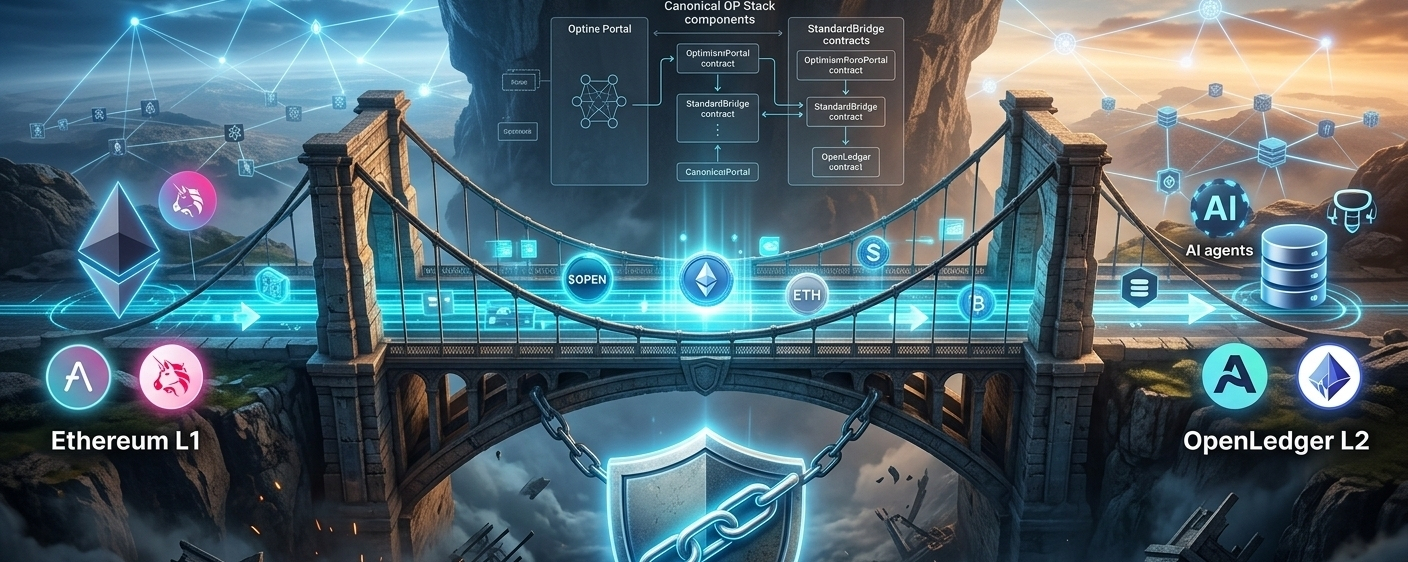
In 2022, roughly $2 billion left the crypto ecosystem through bridge exploits. Ronin, Wormhole, Nomad, Harmony. Each incident followed a recognizable pattern: novel architecture, insufficient adversarial testing, and trust extended to mechanisms that had not been proven under real conditions. The bridges existed. The security did not match the ambition.
That history is the correct starting point for understanding what @OpenLedger has done with its EVM bridge, and more importantly, what it chose not to do.
The Decision That Does Not Get Discussed
Most infrastructure announcements lead with what was built. OpenLedger bridge story is more interesting in what was not built from scratch.
The protocol uses the OP Stack Standard Bridge, deployed by AltLayer as its Rollup-as-a-Service partner. The underlying contracts, including OptimismPortal, L1StandardBridge, L2StandardBridge, and CrossDomainMessenger, are canonical components shared by Base, Mode, Zora, and a growing cluster of rollups collectively holding tens of billions in on-chain value. No custom modifications were made to the bridge architecture.
That last sentence carries more weight than it appears to. Every custom modification to a bridge is a new attack surface. Every novel relay mechanism is an untested assumption. OpenLedger's decision to inherit a battle-tested, open-source architecture rather than engineer a proprietary one is not a lack of ambition. It is engineering discipline, and the distinction matters enormously when real capital eventually flows through.
The bridge contracts have been audited by OpenZeppelin and Trail of Bits. Two firms whose coverage is treated as a baseline requirement by serious protocols and institutional integrators. AltLayer, the RaaS partner managing deployment, also achieved ISO/IEC 27001:2022 certification in January 2026, adding a layer of operational security credibility that most rollup infrastructure providers have not yet reached.
How This Connects to Everything Built Before
Previous pieces in this series covered OctoClaw executing across ERC-4626 vaults and LayerZero carrying agent signals across 130+ blockchains. Both capabilities rest on the bridge layer functioning cleanly and predictably beneath them.
An AI agent running automated yield strategies across Aave v3 and Morpho Blue is only as reliable as the transport layer moving $OPEN between L1 and L2. Open is locked via OptimismPortal on L1 and minted on L2 on deposit, then burned on L2 and unlocked on L1 on withdrawal. A clean mint-and-burn flow with full compatibility across MetaMask, Ledger, Hardhat, and viem without modification.
No synthetic wrapping. No proprietary relay sitting between the user and the ledger. The agent layer does not inherit bridge counterparty risk at every execution step. That is the practical outcome of the architecture choice.
What This Means for OPEN
#OpenLedger ecosystem partners span decentralized compute platforms including Aethir, Ionet, and 0G, alongside AVS infrastructure from AltLayer, EigenLayer, and Etherfi, with AI model and agent partners including Giza, Gaib, FractionAI, and NetMind. Every one of those integrations eventually touches the bridge when assets or attribution data move between environments. As that partner ecosystem expands, the bridge becomes load-bearing infrastructure rather than a peripheral feature.
Load-bearing infrastructure that works reliably attracts serious capital. Serious capital drives recurring Open fee demand. That demand is structurally different from speculative volume, and it compounds differently over time.
My Open position has remained in profit across this build-out period. The bridge architecture was part of the original reasoning. Reliable foundations tend to matter more than people account for when they price infrastructure tokens in early cycles.
Build quality shows up in the data eventually. Watch the bridge volume as the partner ecosystem activates.