A strange thing is happening in the AI industry right now.
Most people are celebrating the intelligence of machines while quietly ignoring who actually owns the intelligence itself.
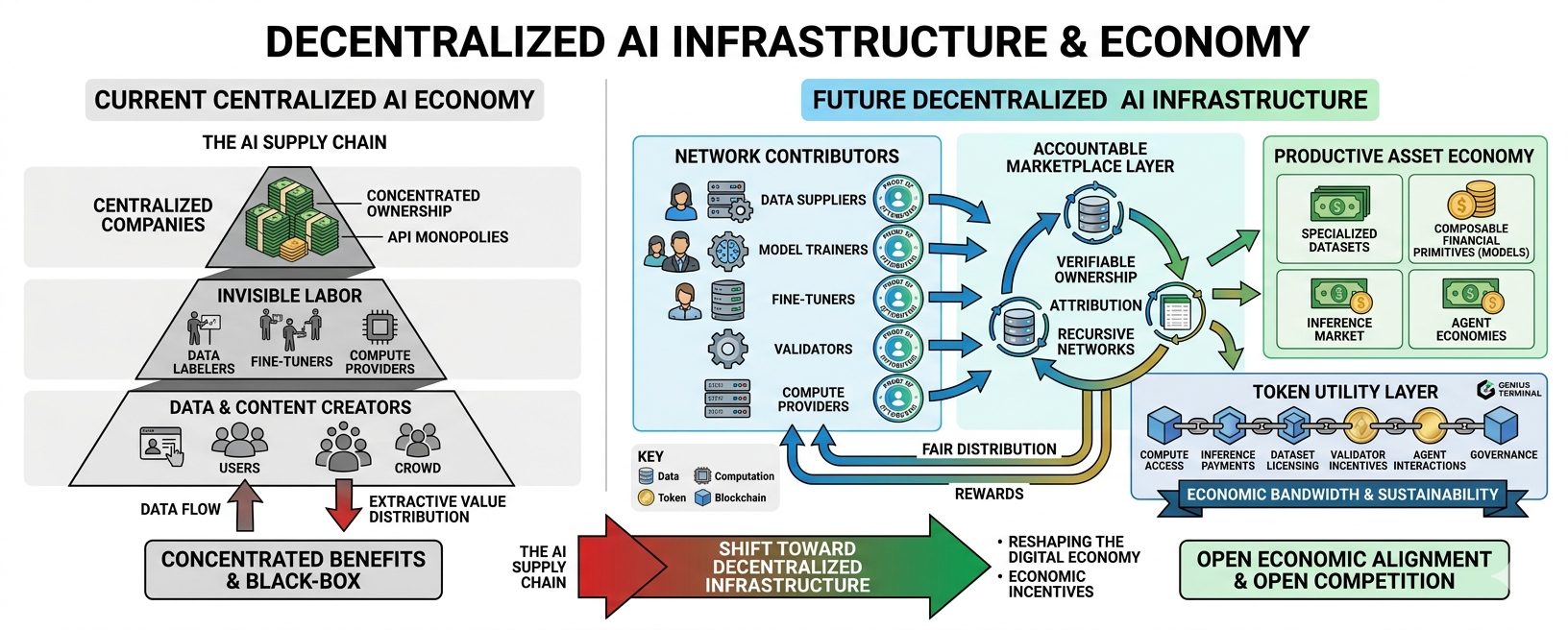
Every viral AI model, every polished chatbot, every image generator we interact with daily is built on an invisible supply chain of data, computation, labeling, fine-tuning, and human feedback. Yet the economic rewards flow almost entirely toward a small cluster of centralized companies.
The users create.
The crowd trains.
The network contributes.
But the ownership remains concentrated.
That imbalance is becoming harder to ignore.
This is why decentralized AI infrastructure is starting to matter far beyond crypto speculation.
And honestly, the deeper I study projects building in this sector, the more I realize the real opportunity isn’t another chatbot.
It’s the infrastructure underneath intelligence itself.
That’s where Genius Terminal caught my attention.
Not because it markets itself loudly.
Not because of influencer excitement.
But because the architecture reflects a very different thesis about where AI is heading.
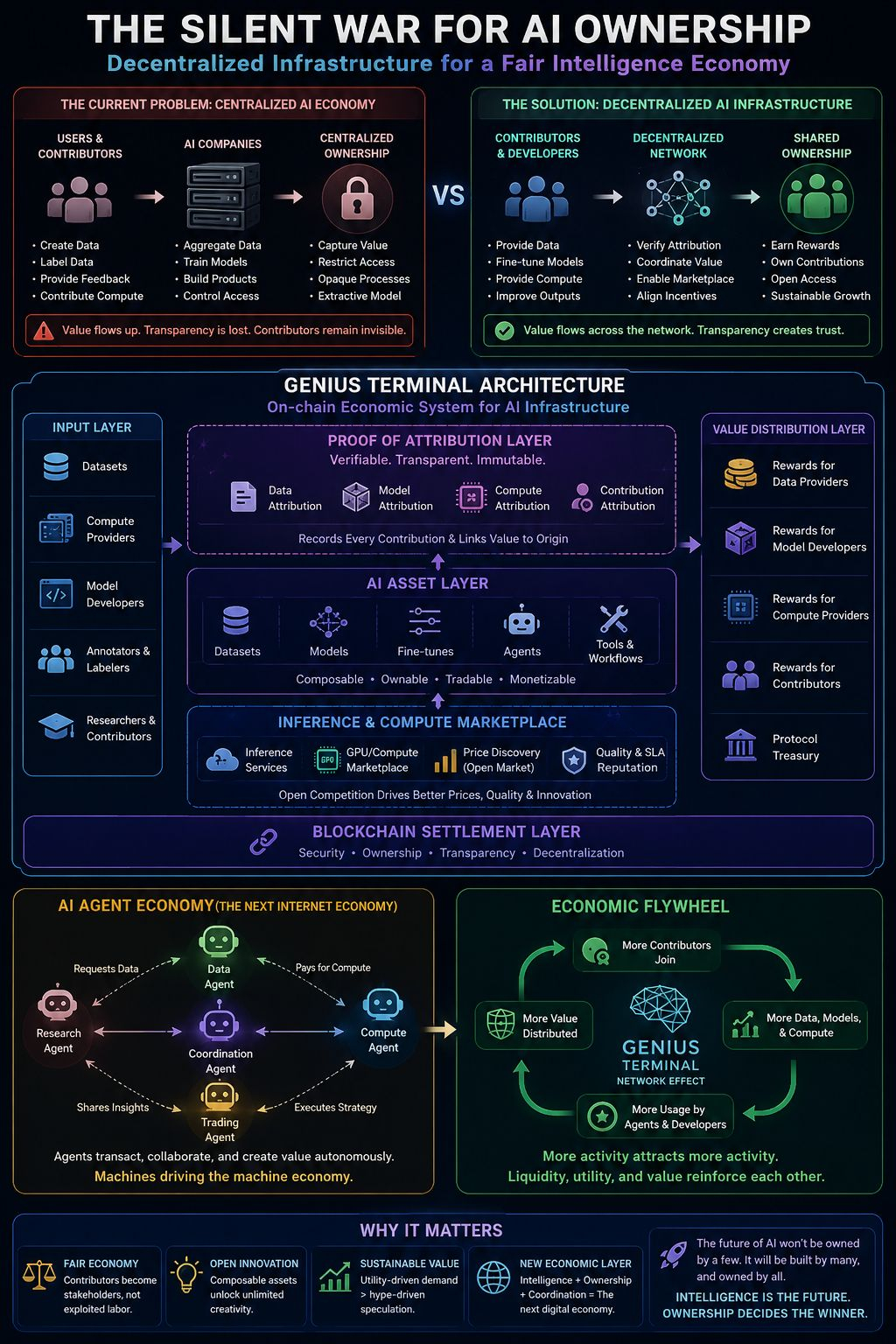
Genius Terminal approaches AI infrastructure as an on-chain economic system rather than a closed corporate product.
That distinction changes everything.
Instead of treating data like a hidden asset locked inside private servers, the protocol leans into verifiable ownership, attribution, and monetization. In centralized AI systems today, contributors rarely know how their data is used, how models are trained, or how value is distributed afterward.
The result is an ecosystem built on extraction.
Decentralized AI networks attempt to reverse that dynamic.
And the most important concept here is something many people still underestimate:
Proof of Attribution.
At first glance, it sounds technical.
But economically, it’s incredibly powerful.
Proof of Attribution creates a transparent mechanism showing where intelligence originated — who supplied data, who fine-tuned models, who contributed compute, who improved outputs, and how rewards should flow across the network.
That changes AI from a black-box industry into an accountable marketplace.
Suddenly, datasets become productive assets.
Models become composable financial primitives.
Inference becomes an open service economy.
And contributors become stakeholders instead of invisible labor.
This is where the infrastructure layer becomes more interesting than the applications themselves.
Because applications come and go.
Infrastructure compounds.
Genius Terminal seems to understand this deeply.
The protocol’s design revolves around creating a decentralized environment where AI agents, datasets, models, and inference systems interact economically on-chain rather than through centralized API monopolies.
That may sound abstract initially, but the implications are very real.
Imagine independent developers being able to monetize specialized datasets without selling them outright.
Imagine AI agents paying other agents for services autonomously.
Imagine fine-tuned models becoming tradable productive assets.
Imagine inference markets where pricing is determined by open competition instead of a few dominant providers.
That creates an entirely different internet economy.
One of the more overlooked aspects here is decentralized fine-tuning infrastructure.
Most people think AI dominance comes purely from giant frontier models.
But in reality, the next phase of adoption will likely depend on specialized intelligence — localized models trained for finance, medicine, law, gaming, logistics, research, or enterprise workflows.
And specialized models require massive amounts of fine-tuning.
Centralized systems gatekeep that process heavily.
Decentralized infrastructure opens participation.
That shift matters because the AI economy is slowly fragmenting into thousands of micro-intelligence markets rather than a single universal model dominating everything forever.
This is also where token utility either becomes logical or completely meaningless.
In many crypto projects, tokens exist mainly for speculation wrapped in storytelling.
But infrastructure protocols operate differently.
If a token is integrated into compute access, inference payments, dataset licensing, validator incentives, agent interactions, governance coordination, or attribution rewards, then the token begins functioning as economic bandwidth rather than narrative fuel.
That distinction matters enormously for long-term sustainability.
Because eventually markets stop rewarding promises and start rewarding utility density.
The protocols that survive will likely be the ones where economic activity naturally reinforces network demand.
Not artificially.
Not emotionally.
Structurally.
Another fascinating angle is the emergence of agent economies.
This idea still feels underappreciated.
We are moving toward a world where autonomous AI agents will transact with each other continuously — purchasing data access, leasing compute, requesting inference, executing tasks, optimizing strategies, and distributing rewards without direct human coordination every second.
Traditional financial systems are not designed for machine-native economies.
Blockchains are.
That’s why decentralized AI and crypto increasingly feel less like separate sectors and more like complementary layers of the same technological stack.
One provides intelligence.
The other provides coordination and ownership.
And when those layers merge correctly, entirely new economic behaviors become possible.
What makes this sector difficult, though, is that most people still evaluate AI projects using old crypto frameworks.
Price action.
Narratives.
Exchange listings.
Temporary attention cycles.
But infrastructure adoption moves differently.
Quietly at first.
Then all at once.
Roadmaps become especially important here because they reveal whether a protocol is building temporary visibility or long-term infrastructure depth.
When I study projects like Genius Terminal, I pay less attention to marketing velocity and more attention to ecosystem architecture:
Are developers incentivized to build?
Can contributors monetize participation sustainably?
Does the attribution layer scale?
Can inference remain economically competitive?
Do agents create recursive network activity?
Can datasets become reusable productive assets?
Those questions matter far more than short-term excitement.
Because if decentralized AI infrastructure succeeds even partially, it changes the economics of intelligence itself.
And honestly, that may become one of the defining technological shifts of this decade.
Not because centralized AI disappears.
It won’t.
Centralized systems will remain dominant in many areas due to capital, distribution, and computational scale.
But decentralized networks introduce something centralized systems fundamentally struggle with:
open economic alignment.
That changes incentives.
And incentives shape industries more than technology alone ever does.
After spending months studying AI infrastructure and crypto markets side by side, I keep coming back to the same conclusion:
The biggest opportunity may not be building the smartest AI.
It may be building the fairest economic system around intelligence creation.
That’s a much harder problem.
But it’s also the one that could matter longer than any single model release or market cycle.
And that’s why projects building quietly at the infrastructure layer deserve far more attention than most people currently give them.
#genius @GeniusOfficial $GENIUS