
OpenLedger keeps sitting in the back of my mind in a way most crypto projects do not. Not because it is loud. Not because people are constantly forcing it into every conversation. Honestly, most days it barely feels present at all. But maybe that is exactly why I keep returning to it. It feels unfinished in a very human way. Like a system still exposing its doubts instead of hiding them behind polished certainty.
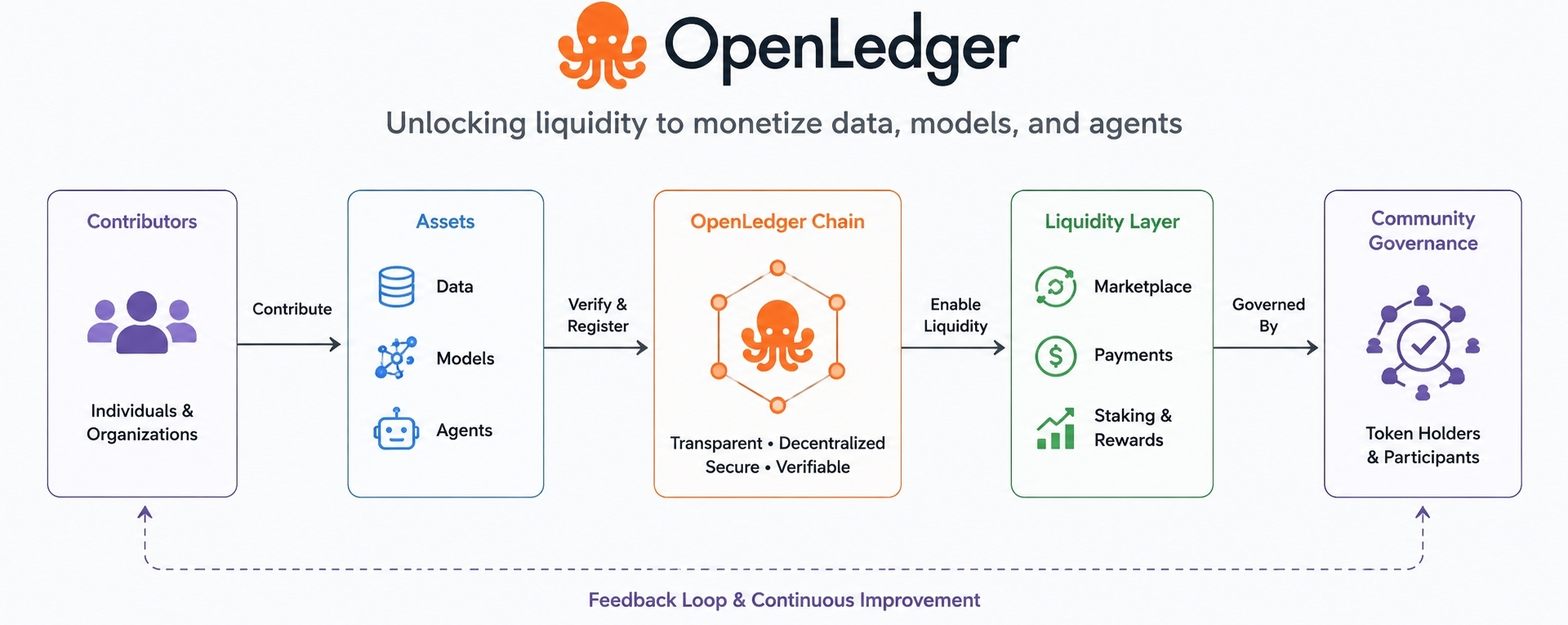
The project talks about turning data, models, and AI agents into economic layers people can actually participate in instead of leaving everything trapped inside a handful of companies. At first glance that sounds reasonable. Maybe even necessary. The internet already runs on extraction anyway. Most people contribute value constantly without ever owning any part of the systems learning from them. OpenLedger seems to be asking whether that arrangement can be reversed.
But the more I think about it, the less I see it as a technology problem.
It feels more like a behavioral problem disguised as infrastructure.
Because once intelligence becomes financialized, people stop interacting with information the same way. The incentives begin shaping the behavior underneath the system itself. That shift is subtle at first. Almost invisible. But eventually every network starts bending toward whatever gets rewarded most efficiently.
And I wonder if OpenLedger fully escapes that or simply reorganizes it.
That thought keeps bothering me.
Crypto likes to believe incentives solve coordination problems. Sometimes they do. But incentives also distort things quietly over time. They reshape motivations until nobody really remembers what the original system was trying to protect anymore.
The internet already went through this once.
Social platforms began as places for communication and expression. Then attention became measurable. Attention became monetizable. And slowly people stopped speaking naturally online. Everything drifted toward performance because performance paid better than honesty.
AI systems could inherit a similar problem.
If OpenLedger succeeds in creating open markets around data and models, what happens when contributors start optimizing for profitability instead of usefulness? What happens when certain kinds of information become more valuable simply because models consume them more efficiently? Does the network slowly reward volume over depth? Engagement over truth? Synthetic usefulness over genuine quality?
I do not think these are dramatic risks. I think they are gradual ones.
And gradual changes are usually the hardest to notice while they are happening.
That is another reason the project interests me. It forces uncomfortable questions that most AI discussions avoid because they slow down the excitement.
Everyone likes talking about open intelligence. Fewer people want to talk about what open economic systems eventually do to human behavior.
Because decentralization sounds clean in theory, but in practice power rarely stays distributed for long.
Over time coordination itself becomes valuable. The people running infrastructure become more influential. The groups validating datasets gain leverage. Certain model providers become trusted defaults. Governance participation narrows. Most users stop paying attention unless something breaks.
The network can still look decentralized from the outside while quietly becoming dependent on a much smaller circle internally.
And maybe that is not even corruption. Maybe it is just operational gravity.
That possibility feels important to me because OpenLedger is trying to build something in one of the most difficult areas imaginable. AI naturally rewards scale. Scale naturally rewards coordination. Coordination naturally concentrates influence.
That pressure does not disappear because blockchain exists underneath it.
If anything, crypto sometimes makes the concentration harder to see because decentralization becomes part of the branding before it becomes reality.
I also keep thinking about what happens when attention fades.
Early ecosystems always feel more resilient than they actually are because optimism temporarily fills economic gaps. Contributors stay active because future upside feels possible. Builders tolerate weak conditions because momentum itself creates belief.
But systems reveal their real structure during quieter periods.
Would people still contribute meaningful data if rewards shrink?
Would operators continue behaving neutrally once financial pressure increases?
Would governance remain active once speculation disappears and participation starts feeling like unpaid labor?
I do not know.
And honestly, I trust projects more when the answer is uncertain instead of packaged into clean certainty.
There is something else underneath all this that feels unresolved too. OpenLedger is trying to combine two worlds that fundamentally see transparency differently.
Crypto wants visibility. Auditability. Public coordination.
AI increasingly operates through abstraction. Systems become harder to interpret the more powerful they get. Even the people building models sometimes struggle to fully explain the behavior emerging from them.
So I keep wondering what decentralization even means in that environment.
Maybe ownership becomes distributed while understanding remains centralized. Maybe people can participate economically without truly understanding how influence inside the intelligence layer is being shaped. That tension feels very real to me, and I do not think the industry has fully processed it yet.
Still, despite all my skepticism, I cannot dismiss OpenLedger.
The current AI landscape already feels unstable in its own way. A small number of companies controlling models, compute, distribution, and user behavior simultaneously does not feel particularly healthy either. Open systems may introduce different risks, but closed systems accumulate power quietly until dependency becomes unavoidable.
So projects like OpenLedger end up existing in this strange middle space for me.
Necessary enough to pay attention to.
Uncertain enough to remain cautious about.
And maybe that is why the project feels interesting. Not because it already solved something important, but because it exposes how unresolved the entire relationship between AI, ownership, incentives, and coordination still is.
The more I think about it, the less I care about whether the system grows quickly.
I care more about whether it still functions honestly once growth stops being enough to hold everything together.
Because that is usually the moment when systems reveal what they actually are underneath the narrative.