@OpenLedger Most of what’s being marketed as “AI innovation” right now feels recycled, just dressed up with new branding and louder claims. Every project talks about decentralization, intelligence, or some kind of revolutionary shift, but when you look closer it’s usually the same pattern repeating itself. Meanwhile, regular users continue feeding these systems nonstop without realizing the scale of what they’re contributing. Every search, every post, every random comment or argument quietly becomes part of training data somewhere. And in return, people mostly get ads, subscriptions, or tools that still struggle to be reliable. The imbalance is obvious, but it’s also something most people have just gotten used to.
That’s where the frustration really comes from. There’s a massive value exchange happening, but it’s mostly one-sided. A handful of companies are building extremely powerful systems on top of user-generated data, and the users themselves don’t really participate in that upside. It’s not even hidden anymore—it’s just normalized. And even when people do notice it, convenience tends to win. If the product works smoothly enough, questions about ownership and control get pushed aside. That’s exactly how centralized platforms became dominant in the first place, and AI seems to be following that same path, just faster and on a much bigger scale.
Crypto, for a while, looked like it might offer an alternative, but it didn’t exactly fix the problem either. A lot of projects drifted toward speculation instead of substance. The language sounded good—community, ownership, decentralization—but in practice, many of them turned into short-term games driven by hype cycles. Tokens pumped, insiders exited, and the underlying ideas got lost in the noise. That history makes it hard to take new projects seriously, especially when they start using the same vocabulary again.
What makes OpenLedger at least somewhat different is that it doesn’t center everything around a token narrative. The focus leans more toward data, models, and AI agents as actual components of value, rather than pretending a coin alone can reshape the system. Right now, AI is centralizing at an uncomfortable pace. The strongest models, the infrastructure, the compute power—most of it sits in the hands of a few major players. Developers aren’t really building independent intelligence anymore; they’re renting access to it. That shift might not feel urgent yet, but it has long-term consequences that are hard to ignore once you start thinking about them.
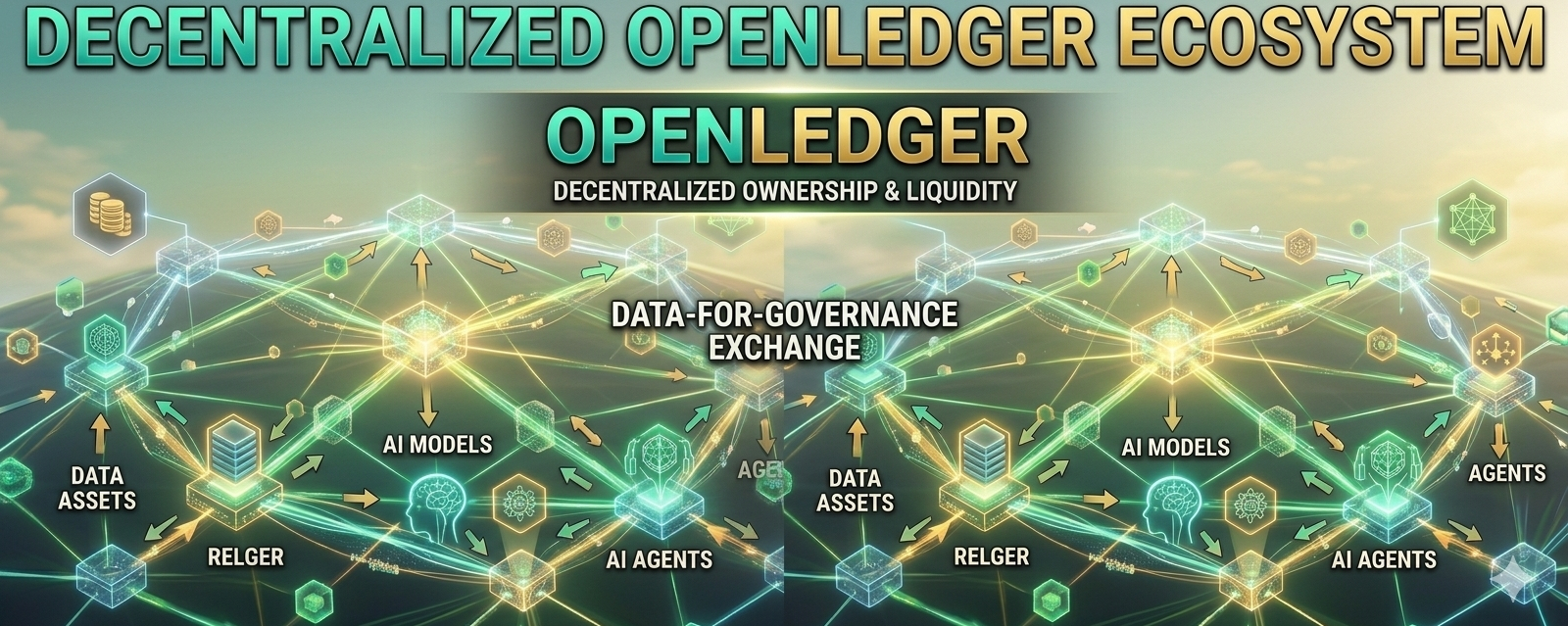
The idea behind OpenLedger is essentially to introduce real liquidity into parts of the AI ecosystem that are currently locked away. Not just financial liquidity, but functional value—where data, models, and even autonomous agents can be exchanged, improved, and rewarded in a more open environment. If someone’s data contributes to training a system, there’s at least a conversation about whether they should benefit from that contribution. It sounds simple, but it challenges the default structure that most people have already accepted.
At the same time, none of this is easy to build. Decentralized systems already come with their own set of problems, and combining them with AI only multiplies the complexity. Issues like data quality, spam, manipulation, governance, and scaling don’t magically disappear just because something is open. In fact, open systems often attract low-quality input unless incentives are designed carefully. That’s where a lot of projects fall apart—they underestimate how messy it gets when you try to coordinate value without a central authority.
Then there’s the cultural side of crypto, which can derail things just as quickly. The moment attention shifts toward price instead of purpose, the entire conversation changes. Instead of discussing how a system works or what problem it’s solving, everything turns into speculation. That shift has killed more than a few promising ideas, and it’s a real risk for anything operating in this space. If OpenLedger ends up being treated like just another asset to trade rather than infrastructure to build, it’ll likely face the same fate as many before it.
Still, the reason it stands out at all is because it’s addressing something that actually matters. AI isn’t just another trend—it’s becoming part of how the internet functions at a fundamental level. Search, communication, workflows, development, customer service—these are all being reshaped by systems that learn from data at scale. And as AI agents start becoming more autonomous, the scope expands even further. These agents won’t just assist; they’ll act. They’ll research, execute tasks, manage operations, and interact with other systems continuously. That shift creates an entirely new layer of economic activity, one where data and intelligence themselves become tradable resources.
If that future continues to develop inside closed ecosystems, the concentration of power will be significant. The companies controlling the models and infrastructure won’t just influence products—they’ll shape how information is processed and decisions are made. That’s a level of control that goes beyond what we’ve already seen with social media platforms. It moves from controlling attention to influencing intelligence itself, which is a much deeper layer of impact.
What OpenLedger is trying to do is intervene before that structure becomes too rigid to change. Once systems like this are fully established and widely adopted, decentralizing them becomes exponentially harder. People rarely move away from something that works well, even if it limits their control. That’s why timing matters. The window to experiment with alternative models exists now, but it won’t stay open forever.
Of course, none of this guarantees success. The gap between a strong idea and a working system is huge, especially in something as complex as decentralized AI. But at the very least, it’s pointing in a direction that acknowledges the real issue instead of avoiding it. The conversation isn’t just about better tools or faster models—it’s about who owns the underlying infrastructure and who benefits from it.
Most people are still focused on surface-level things—viral AI demos, new apps, short-term market movements. Those are easy to see and easy to react to. The deeper shift is quieter. AI is becoming infrastructure, and infrastructure defines power. That’s always been true, whether it’s roads, networks, or platforms. The difference now is that the infrastructure being built doesn’t just move information—it interprets it, learns from it, and acts on it.
And that’s where the real tension sits. Convenience continues to pull people toward centralized solutions, while control quietly concentrates in fewer hands. OpenLedger isn’t the only attempt to challenge that, and it might not even be the one that succeeds. But the fact that it’s trying to address ownership in the context of AI, rather than just riding the hype cycle, is what makes it worth paying attention to. Because once this layer of the internet is fully defined, the balance of power it creates won’t be easy to undo.
$OPEN @OpenLedger #OpenLedger $XAN