
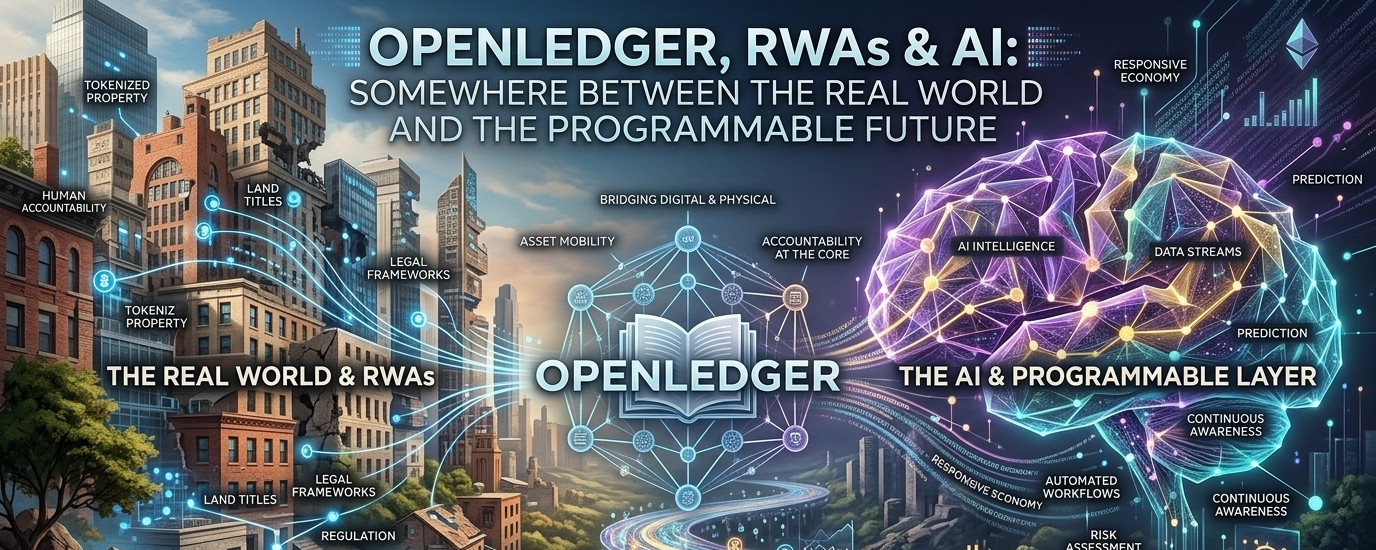
@OpenLedger There’s something strangely fascinating about the way people talk about the future of Web3 and AI now. Everything sounds so structured, so certain, almost as if the next economic system has already been designed behind closed doors and we are only waiting for it to fully arrive. But the more I think about it, the more I feel that maybe we are still only touching the outer surface of something much deeper and far more complicated than the simplified narratives we keep hearing online. A line like “RWAs bring the assets, AI brings the intelligence, together everything becomes programmable” sounds incredibly clean when you first read it. It feels efficient, modern, futuristic. But real systems are rarely that clean. The real world has never behaved in a perfectly logical way, and maybe that’s exactly where the tension begins.
When people talk about RWAs, they usually describe them in a very smooth way — houses, land, bonds, commodities, art, ownership, all being brought onto the blockchain as tokenized assets. On paper, it feels almost revolutionary because it promises liquidity, accessibility, transparency, and global participation. But once you think beyond the technical layer, things immediately become more complicated. A property is not just a digital entry with a price attached to it. Every real-world asset carries legal systems, local market behavior, regulations, taxes, disputes, emotional value, and unpredictable human situations around it. A building may exist on-chain as a token, but the physical structure still exists in an imperfect world where repairs are delayed, governments change policies, markets crash unexpectedly, and human conflict remains unavoidable. That’s why I sometimes wonder whether tokenization is actually simplifying the real economy or simply creating another abstraction layer above it. Because the complexity does not disappear — it only changes form.
Then comes AI, and honestly, this is where the conversation becomes even more interesting. People often use phrases like “AI brings intelligence” as if intelligence itself can be packaged into a flawless automated layer. But AI does not think in the way humans think. It reacts, predicts, calculates, and learns from patterns inside data. And data itself is never completely neutral or complete. Real life contains too much friction, too many invisible variables, too many emotional and irrational factors that no dataset can fully capture. Still, despite all these limitations, there is something undeniably powerful about the role AI could play inside tokenized economies. Maybe AI is not meant to replace human thinking at all. Maybe its real purpose is continuous awareness. Imagine a tokenized real estate asset where rental demand changes every week, maintenance costs fluctuate, market sentiment shifts, and investor behavior constantly evolves. Human management is often slow, reactive, and inconsistent. AI, on the other hand, can monitor these moving pieces continuously, identify patterns early, and respond faster than traditional systems ever could. In that sense, intelligence may not mean perfection. It may simply mean responsiveness.
But this is also the point where the idea starts feeling slightly uncomfortable to me. Because once assets become “programmable,” the relationship between humans and the economy also begins to change. If decision-making becomes increasingly automated through smart contracts and AI-driven systems, then where exactly does accountability remain? The more efficient systems become, the more invisible their internal decisions can become as well. And invisible systems are difficult to question. That is probably the part people discuss the least. Automation always sounds attractive until you realize that someone still writes the rules, trains the models, controls the data, and defines what the system considers “optimal.” So even in a decentralized environment, power does not disappear — it simply moves into different layers that are harder to notice.
At the same time, I can also understand why projects like OpenLedger feel important right now. They are not necessarily trying to create a perfect machine-like economy where every human problem disappears. What they seem to be pushing toward is an economy that reacts faster than the traditional one. And maybe that alone is enough to change everything. In older systems, assets mostly remain passive until humans decide to buy, sell, manage, or restructure them. But when AI and RWAs begin interacting together, assets slowly start behaving more like active entities within a network. A tokenized building could theoretically adjust pricing models based on demand, trigger maintenance workflows automatically, optimize operational decisions through AI analysis, and distribute financial outcomes transparently on-chain. A few years ago, this would have sounded unrealistic. Now it feels like the early foundations are already quietly being built around us.
Still, I don’t think the full picture is visible yet. And honestly, maybe that is the most honest way to look at all of this. We are probably living through a transition period where technology is moving faster than our ability to fully understand its long-term consequences. People want clean answers — either this becomes the programmable economy of the future or it fails completely. But reality rarely moves in extremes like that. Most likely, what we are building now is neither a final solution nor a perfect system. It may simply become a more advanced coordination layer placed on top of an already chaotic world. A world that remains human underneath no matter how intelligent the systems above it become. And perhaps that is why this whole space feels both exciting and uncertain at the same time. Because deep down, nobody truly knows whether we are witnessing the beginning of a completely new economic structure or just creating a more sophisticated digital reflection of the old one. The answer is still unfinished, and maybe that unfinished feeling is exactly what makes this moment so real.