That’s the part I can’t stop thinking about lately.
Every AI company loves talking about breakthroughs. Innovation. Intelligence. The future. They talk like these systems appeared out of thin air because a few genius engineers suddenly unlocked digital consciousness in a lab somewhere.
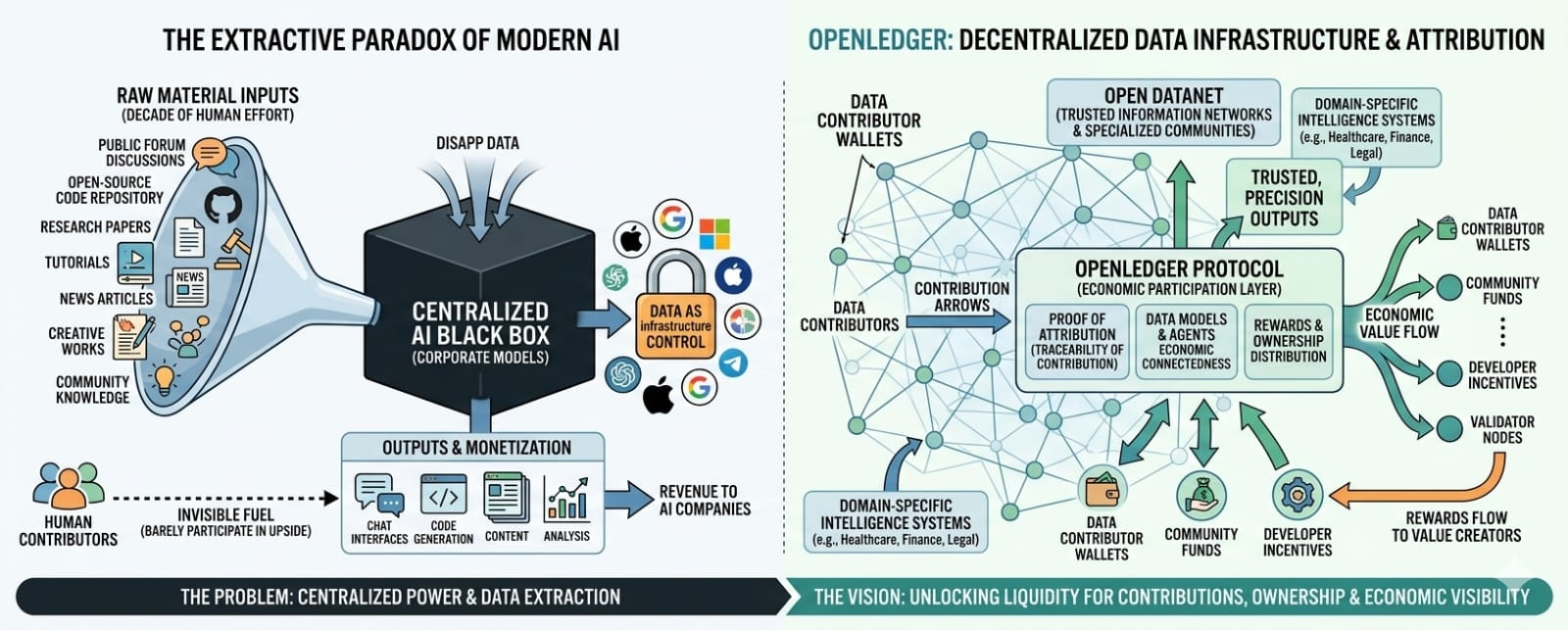
But when you strip away the branding and hype, most modern AI was trained on a ridiculous amount of human work collected from the internet over decades.
Public forums.
Open-source code.
Research papers.
Tutorials.
Articles.
Books.
Conversations.
Creative work.
Entire communities spending years building knowledge online without realizing giant machine-learning systems would eventually absorb all of it into commercial infrastructure.
And honestly the economic structure underneath that process still feels deeply weird.
Because the people who created most of the raw material barely participate in the upside now forming around AI. Companies control the models. Companies control the infrastructure. Companies monetize the outputs. Meanwhile contributors mostly become invisible fuel feeding systems they don’t own.
That imbalance is probably why OpenLedger even exists in the first place.
Not because blockchain magically solves intelligence. It doesn’t. Most crypto projects barely solve anything honestly. But OpenLedger is at least focused on a real structural issue instead of launching another fake AI narrative designed only to pump a token for six months.
The issue is attribution.
Ownership.
Economic participation.
Right now AI systems operate mostly like giant black boxes. Data goes in. Models train. Outputs come out. Nobody really knows how much value specific contributors created or how rewards should flow back toward the people and communities feeding these systems with information.
That setup already feels unstable.
Especially because AI isn’t slowing down anymore. It’s spreading into everything simultaneously. Search. Software. Education. Finance. Research. Customer support. Marketing. Healthcare. Content generation. Every industry AI touches increases the importance of the infrastructure underneath machine intelligence itself.
And right now that infrastructure is becoming heavily centralized.
That’s the part people probably underestimate most.
The AI boom isn’t just creating smarter tools. It’s concentrating power around whoever controls compute, datasets, and training pipelines at massive scale. OpenAI, Google, Meta, Anthropic… these companies are becoming gatekeepers for intelligence systems millions of people already depend on daily.
Which honestly should make more people uncomfortable than it does.
Because once intelligence becomes infrastructure, ownership matters a lot.
Who controls the models?
Who controls the data?
Who controls the economic systems around machine intelligence?
Right now the answers mostly point toward giant corporations with enough money to dominate the industry before competitors can realistically catch up.
OpenLedger seems built around the assumption that eventually people push back against that concentration.
Their whole “unlocking liquidity for data, models, and agents” idea basically comes down to making contribution economically visible instead of allowing value to disappear invisibly into centralized AI systems forever.
And honestly I think that conversation becomes unavoidable over time.
Because the internet itself is already changing in strange ways due to AI. Synthetic content floods platforms everywhere now. AI-generated articles. Machine-written comments. Fake expertise. Entire websites publishing automated garbage purely for clicks and search rankings.
The internet slowly becoming a machine-generated ecosystem feeding other machine-generated systems.
That sounds unhealthy because it probably is unhealthy.
Future AI systems still need reliable information to improve. But the public internet itself is becoming increasingly polluted with synthetic noise. Which means trustworthy human-curated datasets and specialized communities probably become much more valuable than people realize right now.
That’s another reason OpenLedger’s focus on attribution and specialized ecosystems keeps standing out to me. The future probably doesn’t belong entirely to giant universal models endlessly scraping the open web forever. It might belong to cleaner domain-specific systems built around trusted information networks and transparent contribution layers.
Smaller specialized intelligence systems could end up more useful than giant generalized models drowning in low-quality synthetic data.
Especially in serious industries where precision matters more than hype.
Healthcare doesn’t need AI-generated spam.
Finance doesn’t need hallucinated information.
Legal systems definitely don’t need unreliable outputs trained on polluted datasets.
At some point trust becomes infrastructure too.
That’s where OpenLedger’s Proof of Attribution model starts making sense. The idea is basically trying to create traceability around contribution before AI economies become too centralized and opaque to audit properly. Data contributors, communities, specialized datasets, models, and agents become economically connected instead of functioning like invisible labor feeding giant corporations forever.
At least that’s the vision.
And honestly I think the vision matters more than another AI startup bragging about benchmark scores nobody remembers a month later.
Because benchmarks are temporary.
Infrastructure lasts longer.
Still risky obviously.
Very risky.
Crypto people love confusing good narratives with guaranteed outcomes and reality is much harsher than that. Centralized AI companies have absurd advantages already. Better compute. Better engineers. Better funding. Better infrastructure. Better distribution.
Competing against that is brutal.
Most decentralized AI projects probably fail if we’re being realistic.
But centralized AI creates serious long-term problems too. Power concentration. Opaque systems. Dependency risks. Ownership imbalances. Growing public discomfort around a handful of corporations controlling increasingly important intelligence infrastructure.
And honestly I think society eventually notices those issues more aggressively once AI moves deeper into everyday economic life.
Because people tolerate extraction systems longer when technology still feels magical and new. Eventually the novelty fades. Then everyone starts paying attention to where the value actually flows.
That’s usually the moment infrastructure questions become impossible to ignore.
Who owns the system?
Who benefits?
Who controls the intelligence economy underneath it all?
Right now the answers still make the AI industry look a lot less decentralized and a lot more extractive than most companies would probably like to admit.
#OpenLedger $OPEN @OpenLedger