
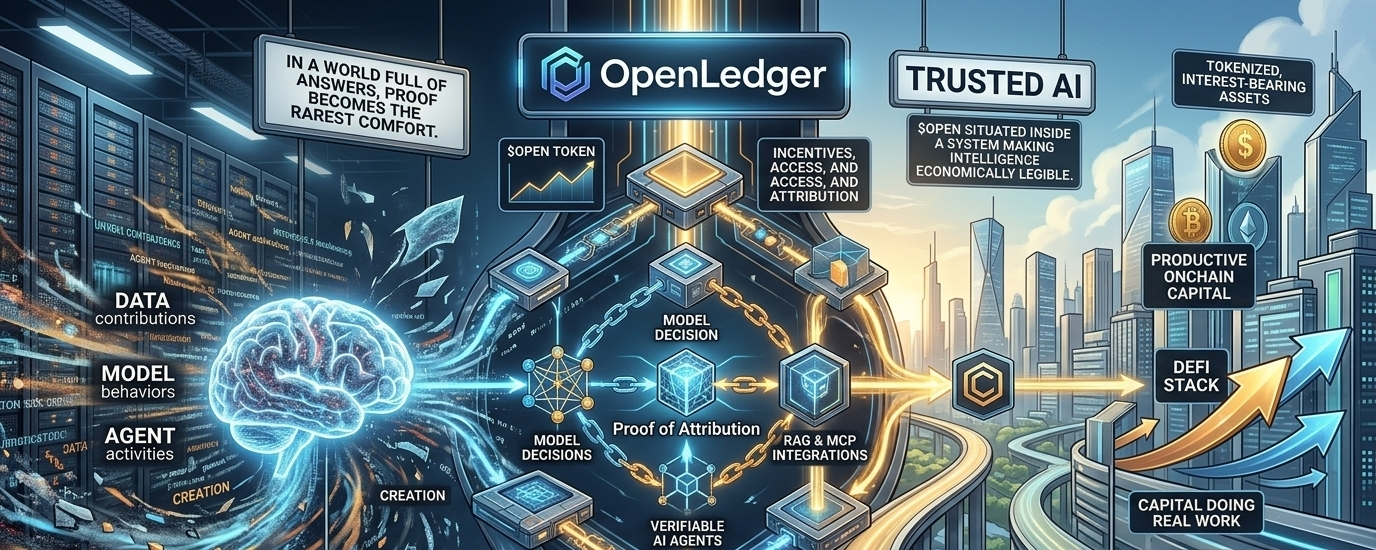
@OpenLedger OpenLedger is one of those projects that makes more sense the longer you sit with it. At first glance, it looks like another AI infrastructure story wrapped in blockchain language. Look closer, though, and the shape changes. What it is really trying to build is a trust layer for intelligence: a place where data contributions, model behavior, and agent activity can be traced instead of simply believed. OpenLedger describes itself as an AI blockchain built to monetize data, models, and agents, and its Proof of Attribution framework is designed to link model outputs back to the data that influenced them. That sounds technical, but emotionally it points to something simpler and more human: “In a world full of answers, proof becomes the rarest comfort.”
That is why $OPEN feels interesting in a way many tokens do not. Not because it needs to become a slogan, but because it sits inside a system that is trying to make intelligence economically legible. If OpenLedger succeeds in turning data, model provenance, and agent execution into something verifiable, then $OPEN is not just a tradable wrapper around the project. It becomes part of the coordination layer that keeps incentives, access, and attribution from drifting apart. The deeper bet here is not that AI will become scarcer. It is that trusted AI will. Creation may keep getting cheaper, faster, and more abundant, while legitimacy, permissioned access, and operational visibility become the real bottlenecks. “Abundance does not erase scarcity; it just moves it upstream.”
That shift matters because markets already run on hidden filters. Creator rankings decide who gets seen. Recommendation systems decide what gets amplified. Liquidity screens decide what becomes tradable attention. Credit scores, search algorithms, and even enterprise procurement checklists quietly determine what is allowed to matter. OpenLedger seems to be aiming at the same structural problem for AI: not merely making models smarter, but making their use more accountable, composable, and economically dependable. Its work around specialized models, real-time RAG and MCP integrations, and verifiable AI agents suggests a world where AI is not just a tool but a governed participant in digital commerce. Trust Wallet’s collaboration on an AI-native self-custodial wallet makes that direction feel especially concrete, because it places explainable agents directly into a high-stakes environment where users cannot afford black-box behavior.
The most ambitious part of the story may not even be AI. It may be the financial architecture forming around it. OpenLedger’s framing around unlocking liquidity across data, models, and agents points toward a broader convergence: tokenized, interest-bearing assets; productive onchain capital; and a DeFi stack where liquidity does more than sit still. In the best version of that future, capital efficiency improves because the same asset can help secure a system, generate yield, and remain composable as collateral or settlement fuel. TVL growth would matter less as a vanity metric and more as evidence that capital is finding useful pathways instead of just parking itself in dead liquidity. That is a more elegant economy: one where yield is not an afterthought, but a byproduct of capital doing real work. “Money becomes less like storage and more like motion.”
Still, the project’s promise should not be mistaken for certainty. Systems that reward attribution can also reward compliance theater. Systems that make trust measurable can also make fear measurable. The question is whether OpenLedger can create a network where honesty is not merely moralized, but economically easier than dishonesty. That is the part worth watching in $OPEN: not whether it becomes loud, but whether it becomes necessary. The future of AI may not be decided by who builds the smartest model. It may be decided by who builds the most believable path from intelligence to value. And once that path exists, the market will stop asking only what a system can say, and start asking what it is allowed to prove.