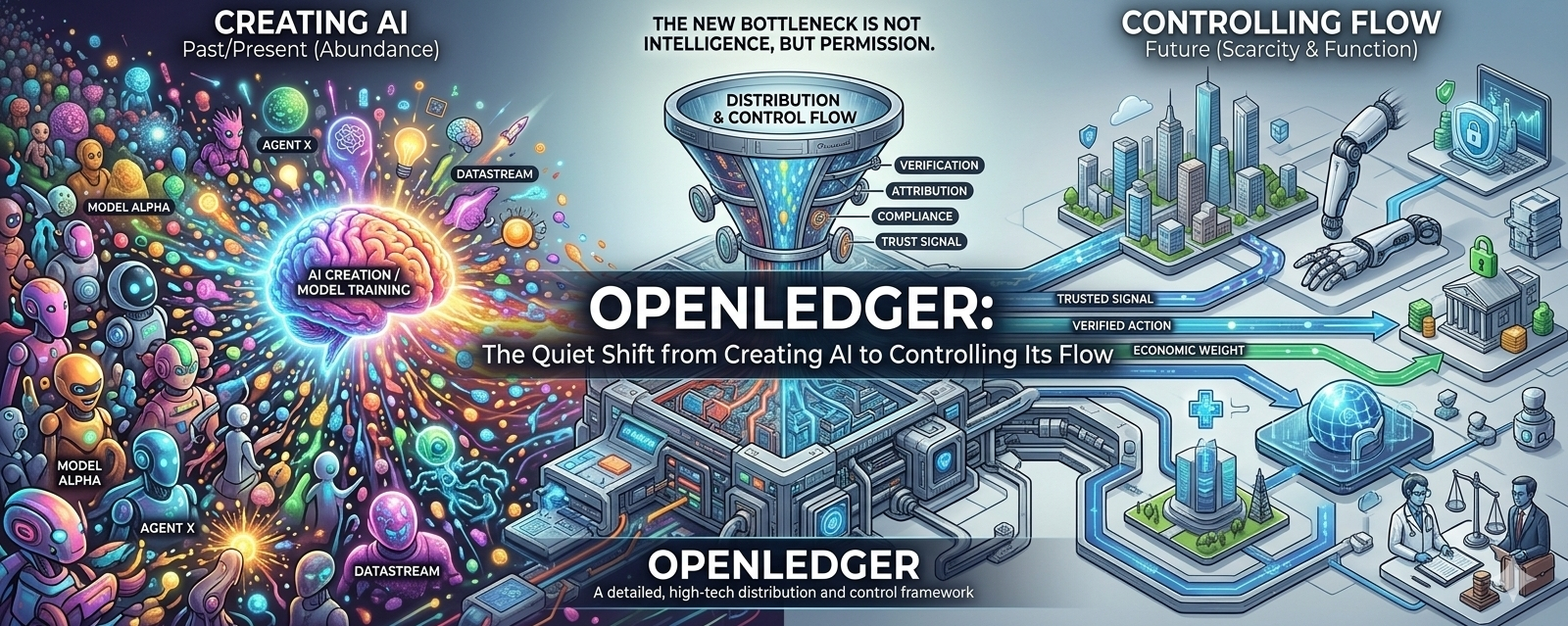
@OpenLedger For a long time, it felt natural to believe that the real value in AI would sit at the point of creation. The assumption was simple: whoever builds the smartest models, gathers the best data, or controls the strongest compute wins. That logic still holds in some corners, especially at the cutting edge where training costs remain enormous. But outside that narrow layer, something more subtle has been unfolding. Useful intelligence is no longer as rare as it once seemed. Models are getting more specialized, tools are becoming easier to use, and the barrier to generating something meaningful keeps dropping. It does not mean creation is free or trivial, but it is no longer the bottleneck people thought it would be. What feels increasingly constrained instead is everything that happens after something is created.
That shift is easy to overlook because it does not announce itself loudly. It shows up in small frictions. Who gets to use an output, who trusts it, where it can be deployed, and whether it can move through systems without raising risk or uncertainty. This is where the idea around OpenLedger starts to feel different. It does not fit neatly into the narrative of “better AI.” It feels closer to a layer that shapes how AI is allowed to exist in the real world. Not by making intelligence itself, but by turning it into something that can be recognized, verified, attributed, and ultimately accepted within economic and operational boundaries. In a strange way, the scarce thing stops being intelligence and becomes permission.
If that sounds abstract, it is probably because most markets already work like this, just in less visible ways. Content on the internet is abundant, yet only a small portion actually reaches people in a meaningful way. Not because everything else is bad, but because distribution systems filter aggressively. Financial trust is not about knowing everything about a person, but about compressing that complexity into scores and signals that systems can process. The same pattern could emerge with AI. It will not matter only which model can produce the best answer, but which output can pass through layers of verification, attribution, and compliance without friction. The systems downstream do not consume raw possibility, they consume structured, reliable signals.
This is where the idea of distribution as a scarcity layer starts to feel real. If many agents or models can solve the same problem, then the question quietly changes. It is no longer about capability alone, but about selection. Which output is trusted enough to act on, which agent is allowed to execute, which data trail is strong enough to hold economic weight. That selection process does not happen randomly. It is shaped by infrastructure that defines what counts as valid, traceable, and usable. And once that layer becomes important, it starts to carry its own kind of power. Not loud power, but quiet control over what flows and what gets ignored.
There is something slightly uncomfortable about that realization. Because even if the creation layer becomes open and abundant, the distribution layer can still narrow over time. Standards form, trust frameworks solidify, and certain pathways become more accepted than others. It does not have to be intentional or malicious. Often it is just the result of complexity. When there is too much output, systems need stronger filters. When risk increases, verification tightens. Abundance does not remove gatekeeping, it usually strengthens it. And in that environment, the ability to pass through those gates becomes incredibly valuable.
That is why OpenLedger feels like it might be tapping into something deeper than just another AI narrative. Not because it guarantees a specific outcome, but because it aligns with a shift that seems hard to avoid. If intelligence keeps spreading and becoming easier to produce, then the real question moves elsewhere. Who decides what is usable, what is trusted, and what is allowed to move forward? That decision may not sit with the models themselves, but with the systems that frame, validate, and distribute their outputs.
In the end, the most important part of intelligence might not be the moment it is created, but the moment it becomes acceptable to use. And that moment is shaped less by raw capability and more by the structures that surround it. If those structures become the new bottleneck, then scarcity does not disappear, it simply changes form. And the market, as it often does, will quietly reorganize itself around that new constraint.
$OPEN @OpenLedger #OpenLedger $XLM