
That’s what this whole industry feels like sometimes. Endless demos. Endless hype. “AI will change everything.” Cool. Maybe it will. But every system that changes everything also changes who controls money, information, and power underneath it.
And right now, that control looks extremely centralized.
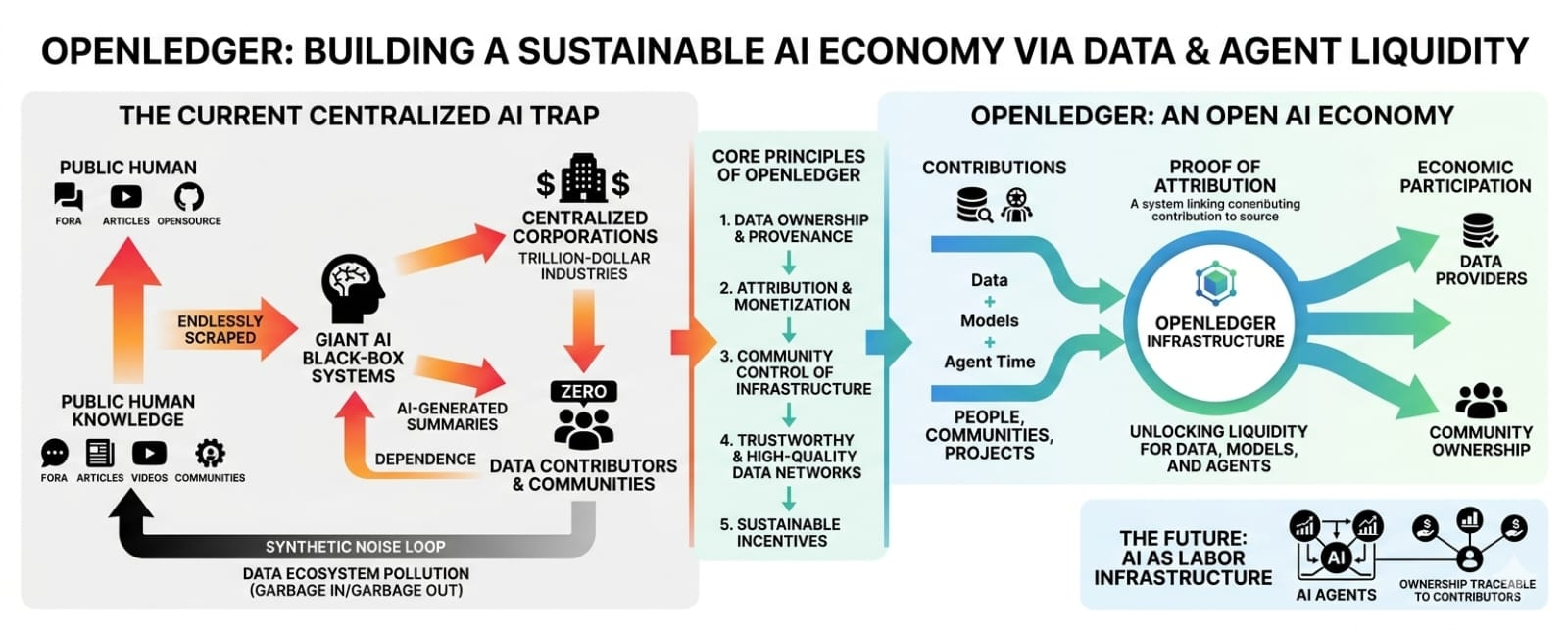
A few companies own the models. A few companies own the compute. A few companies own the distribution. Meanwhile millions of people unknowingly keep feeding the machine every single day through conversations, content, code, research, and behavior. The value extraction is massive, but most people barely notice because the products look convenient.
That balance probably does not hold forever.
This is why OpenLedger feels more interesting than most AI crypto projects I’ve seen lately. It is trying to build infrastructure around the part nobody wants to deal with yet: ownership. Not just ownership of tokens, but ownership around data, models, and agents themselves.
Because once AI agents start generating real economic output, the system underneath them matters a lot more. If an agent creates value, who owns it? If data trains a profitable model, who benefits from that? If AI becomes a core economic layer, can everything really stay locked inside centralized platforms forever?
That is the bigger question hiding underneath all the AI hype right now.
I’m not saying OpenLedger automatically solves it. Crypto loves turning real problems into speculative chaos. That risk is always there.
But at least this project is focused on something deeper than shiny demos and fake futurism.
The AI economy needs structure. Right now it mostly feels like a land grab.#OpenLedger $OPEN @OpenLedger