
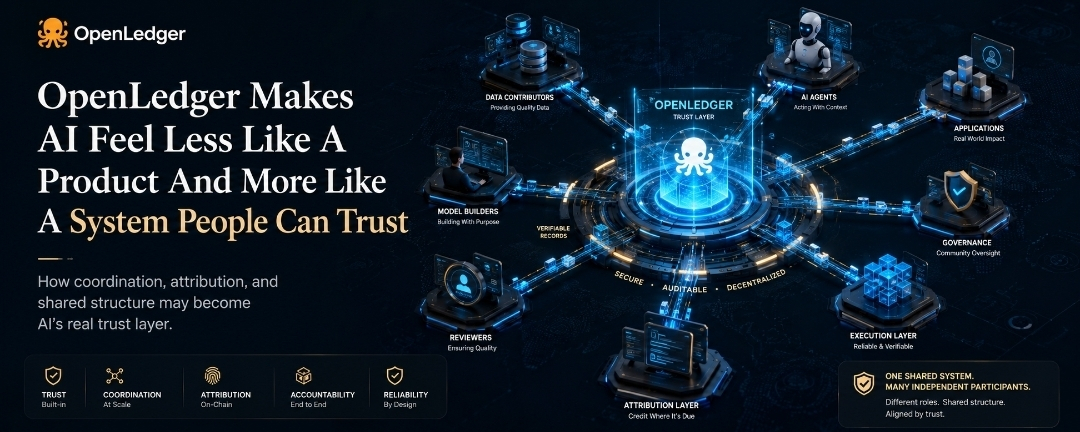
OpenLedger keeps making me think about franchise systems, and not because of marketing, branding, or expansion. It is more about how trust works when many separate participants are expected to follow the same structure without everything being controlled from one central place all the time. A good franchise does not survive only because the main company has a strong name. It survives because every location can deliver something familiar, stable, and reliable even when different people are running different parts of the operation. The moment that consistency starts breaking, people slowly stop trusting the whole system, even if some individual branches are still doing things correctly.
That same idea feels very close to where AI is heading now. AI is no longer just one model sitting alone and giving answers. It is becoming a much bigger environment where datasets, contributors, agents, applications, feedback loops, and execution layers are all connected and moving at the same time. Most users will never see what is happening behind the output, but they will still depend on the result. That means the real challenge is not only making AI smarter or faster. The harder challenge is keeping all these moving parts aligned for a long time without the system slowly becoming messy, unreliable, or difficult to trust.
This is where @OpenLedger starts looking different to me compared to many other AI projects around $OPEN . A lot of projects focus on what people can immediately see, like better outputs, stronger models, faster responses, or impressive demos. OpenLedger feels more focused on the structure underneath. Attribution, contribution flow, coordination between systems, and the way value moves through the network become much more important once AI stops feeling experimental and starts becoming infrastructure. In that kind of environment, knowing where intelligence comes from, who contributed to it, how it is being used, and how the system keeps itself organized is not a small detail. It becomes part of the trust layer.
The interesting thing about complex systems is that they usually do not break in one big dramatic moment. They start drifting slowly. One weak data source affects one output. One unclear contribution path creates confusion. One feedback loop becomes less useful. One agent acts with incomplete context. At first, none of these things look serious by themselves, but over time they can weaken the whole network. Once many systems are connected to each other, small problems do not always stay small. They move quietly through the environment until users begin feeling that something is less dependable, even if they cannot clearly point to where the issue started.
That is why the franchise comparison keeps making sense to me. The value is not just in having many different participants. The real value is in having enough shared structure that all those participants can still produce something reliable together. For AI, this may become one of the biggest questions of the next few years. As autonomous systems grow, people will not want to manually check every dataset, every model behavior, every hidden dependency, or every contribution path before trusting what comes out. They will need systems where trust is built into the coordination layer itself.
That is why #OpenLedger keeps staying on my radar from a structural point of view. The long-term winner in AI may not be the loudest project or the one with the flashiest demo. It may be the one that can keep large autonomous networks working with consistency, accountability, and clear coordination when the number of moving parts becomes too much for humans to manage manually. If AI is becoming more distributed, then the real race is not only about building smarter intelligence. It is about building the kind of network where that intelligence can remain organized, reliable, and trusted at scale.