
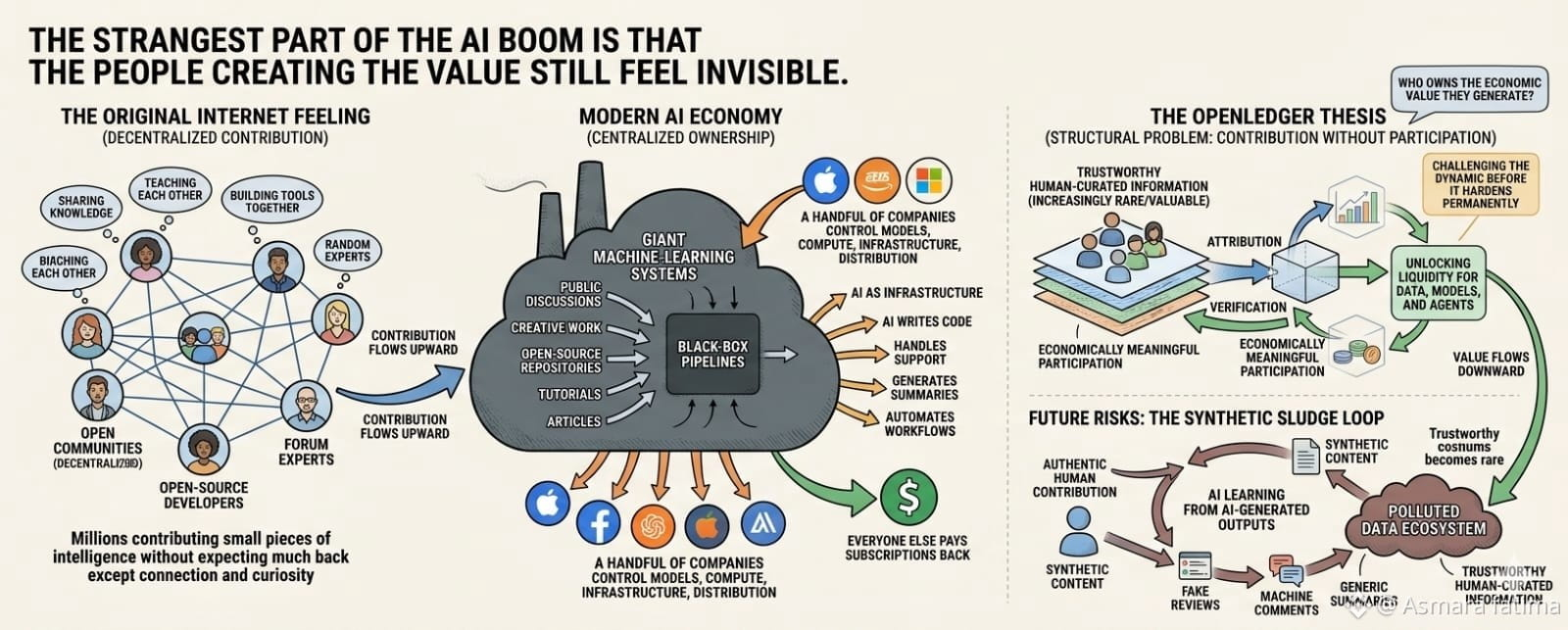
THE STRANGEST PART OF THE AI BOOM IS THAT THE PEOPLE CREATING THE VALUE STILL FEEL INVISIBLE
The internet was supposed to make knowledge more open.
That was the original feeling anyway. People sharing information freely. Communities teaching each other things. Open-source developers building tools together. Forums full of random experts explaining stuff better than universities sometimes. The internet felt alive because millions of people were constantly contributing small pieces of intelligence without expecting much back except connection, reputation, maybe curiosity.
Now AI companies are turning that entire history into infrastructure.
And honestly I don’t think most people fully processed what that means yet.
Because modern AI systems didn’t appear magically. They were trained on human output collected across years of internet activity. Conversations. Research. Articles. Tutorials. Creative work. Public discussions. Open-source repositories. Entire communities unknowingly feeding giant machine-learning systems one piece at a time.
Then the systems got centralized almost immediately.
That’s the part that feels off to me.
The internet created the raw intelligence layer collectively, but the ownership layer around AI is becoming concentrated incredibly fast. A handful of companies now control the models, the compute, the infrastructure, the distribution, and eventually maybe huge sections of the global information economy itself.
And somehow contributors mostly disappeared from the conversation.
People who helped create the data rarely participate economically in any serious way. The internet trained the machine. The companies own the machine. Everyone else pays subscriptions back into the system.
That model already feels unstable honestly.
Especially because AI is moving beyond being “just software” now. The technology is becoming infrastructure underneath daily life much faster than most people expected. AI writes code. Handles support systems. Generates research summaries. Assists legal work. Creates marketing. Automates workflows. Helps manage businesses. The deeper it spreads into industries, the more important the economic structure underneath it becomes.
Because once intelligence itself becomes infrastructure, ownership matters a lot.
That’s why OpenLedger keeps standing out to me more than most AI projects in crypto right now.
Not because it promises some magical decentralized utopia. Honestly crypto people exaggerate constantly. But OpenLedger at least seems focused on a real structural problem instead of recycling empty AI buzzwords for engagement.
The structural problem is contribution without participation.
Right now the AI economy mostly treats human knowledge like free raw material. Information flows upward into giant centralized systems, then value flows upward toward whoever owns the infrastructure controlling the outputs.
OpenLedger’s entire thesis seems built around challenging that dynamic before it hardens permanently into the internet’s next economic model.
Their whole “unlocking liquidity for data, models, and agents” idea sounds abstract until you break it down simply. They’re basically trying to create systems where contributions inside AI ecosystems become traceable and economically meaningful instead of disappearing invisibly into giant black-box pipelines forever.
And honestly that conversation matters way more than another AI demo video showing a chatbot answering questions slightly faster.
Because the internet itself is already changing in strange ways due to AI scaling too fast. Synthetic content floods everything now. AI-generated articles. Machine-written comments. Fake product reviews. AI-generated videos. Entire websites built automatically for algorithms instead of humans.
The web increasingly feels like machines talking to machines.
And the scary part is future AI systems train on this environment too.
That creates this weird loop where machine-generated content slowly pollutes the same information ecosystems future models depend on. AI learning from AI-generated outputs over and over until the distinction between authentic human contribution and synthetic noise becomes harder to separate.
Honestly I think people are underestimating how dangerous that gets long term.
Because information quality eventually becomes infrastructure too.
If the underlying knowledge environment degrades badly enough, even the smartest models start drifting toward unreliable outputs. Bigger models don’t magically solve polluted data ecosystems forever. At some point trustworthy human-curated information becomes incredibly valuable simply because it becomes rare.
That’s another reason OpenLedger’s focus on attribution keeps making sense to me. The future AI economy probably depends heavily on systems capable of verifying where information came from, who contributed it, and how value should flow through increasingly automated machine ecosystems.
Otherwise the entire internet slowly turns into synthetic sludge optimized only for algorithms and engagement metrics.
And honestly we’re already halfway there.
You can feel it online now. Everything sounds polished but empty. Endless AI-generated “thought leadership.” Generic summaries repeating generic summaries. Content designed entirely around visibility instead of insight. Human creativity slowly flattened into machine-optimized formats because platforms reward quantity more than depth.
The internet used to feel chaotic in a human way.
Now it increasingly feels optimized in a machine way.
That shift probably gets more intense once AI agents become normal too. Autonomous systems interacting economically nonstop across online platforms. AI managing businesses. Negotiating deals. Running workflows. Creating products. Generating content automatically at scale.
Who owns those systems?
Who owns the economic value they generate?
Who controls the data pipelines feeding them?
Right now the answer mostly points toward giant centralized companies with enough money to dominate AI infrastructure before alternatives can realistically scale.
That concentration should probably worry more people than it does.
OpenLedger seems built around the assumption that eventually society pushes back against that structure and demands more transparent participation systems around machine intelligence. Systems where communities, data contributors, specialized datasets, and AI models remain economically connected rather than functioning like invisible labor powering centralized corporations forever.
At least that’s the idea.
Still risky obviously.
Very risky.
Centralized companies have absurd advantages already. Better compute. Better funding. Better engineering talent. Faster coordination. Crypto communities love romanticizing decentralization while ignoring how brutally efficient centralized systems can be in practice.
That’s reality.
But centralized AI creates huge long-term weaknesses too. Dependency risks. Power concentration. Opaque infrastructure. Ownership imbalances. Growing distrust around systems nobody can fully inspect while they quietly shape larger sections of society every year.
And honestly I think those tensions eventually become impossible to ignore.
Because once AI stops feeling new, people stop focusing only on what the systems can do.
They start asking who owns the systems themselves.
Right now that answerTHE STRANGEST PART OF THE AI BOOM IS THAT THE PEOPLE CREATING THE VALUE STILL FEEL INVISIBLE
The internet was supposed to make knowledge more open.
That was the original feeling anyway. People sharing information freely. Communities teaching each other things. Open-source developers building tools together. Forums full of random experts explaining stuff better than universities sometimes. The internet felt alive because millions of people were constantly contributing small pieces of intelligence without expecting much back except connection, reputation, maybe curiosity.
Now AI companies are turning that entire history into infrastructure.
And honestly I don’t think most people fully processed what that means yet.
Because modern AI systems didn’t appear magically. They were trained on human output collected across years of internet activity. Conversations. Research. Articles. Tutorials. Creative work. Public discussions. Open-source repositories. Entire communities unknowingly feeding giant machine-learning systems one piece at a time.
Then the systems got centralized almost immediately.
That’s the part that feels off to me.
The internet created the raw intelligence layer collectively, but the ownership layer around AI is becoming concentrated incredibly fast. A handful of companies now control the models, the compute, the infrastructure, the distribution, and eventually maybe huge sections of the global information economy itself.
And somehow contributors mostly disappeared from the conversation.
People who helped create the data rarely participate economically in any serious way. The internet trained the machine. The companies own the machine. Everyone else pays subscriptions back into the system.
That model already feels unstable honestly.
Especially because AI is moving beyond being “just software” now. The technology is becoming infrastructure underneath daily life much faster than most people expected. AI writes code. Handles support systems. Generates research summaries. Assists legal work. Creates marketing. Automates workflows. Helps manage businesses. The deeper it spreads into industries, the more important the economic structure underneath it becomes.
Because once intelligence itself becomes infrastructure, ownership matters a lot.
That’s why OpenLedger keeps standing out to me more than most AI projects in crypto right now.
Not because it promises some magical decentralized utopia. Honestly crypto people exaggerate constantly. But OpenLedger at least seems focused on a real structural problem instead of recycling empty AI buzzwords for engagement.
The structural problem is contribution without participation.
Right now the AI economy mostly treats human knowledge like free raw material. Information flows upward into giant centralized systems, then value flows upward toward whoever owns the infrastructure controlling the outputs.
OpenLedger’s entire thesis seems built around challenging that dynamic before it hardens permanently into the internet’s next economic model.
Their whole “unlocking liquidity for data, models, and agents” idea sounds abstract until you break it down simply. They’re basically trying to create systems where contributions inside AI ecosystems become traceable and economically meaningful instead of disappearing invisibly into giant black-box pipelines forever.
And honestly that conversation matters way more than another AI demo video showing a chatbot answering questions slightly faster.
Because the internet itself is already changing in strange ways due to AI scaling too fast. Synthetic content floods everything now. AI-generated articles. Machine-written comments. Fake product reviews. AI-generated videos. Entire websites built automatically for algorithms instead of humans.
The web increasingly feels like machines talking to machines.
And the scary part is future AI systems train on this environment too.
That creates this weird loop where machine-generated content slowly pollutes the same information ecosystems future models depend on. AI learning from AI-generated outputs over and over until the distinction between authentic human contribution and synthetic noise becomes harder to separate.
Honestly I think people are underestimating how dangerous that gets long term.
Because information quality eventually becomes infrastructure too.
If the underlying knowledge environment degrades badly enough, even the smartest models start drifting toward unreliable outputs. Bigger models don’t magically solve polluted data ecosystems forever. At some point trustworthy human-curated information becomes incredibly valuable simply because it becomes rare.
That’s another reason OpenLedger’s focus on attribution keeps making sense to me. The future AI economy probably depends heavily on systems capable of verifying where information came from, who contributed it, and how value should flow through increasingly automated machine ecosystems.
Otherwise the entire internet slowly turns into synthetic sludge optimized only for algorithms and engagement metrics.
And honestly we’re already halfway there.
You can feel it online now. Everything sounds polished but empty. Endless AI-generated “thought leadership.” Generic summaries repeating generic summaries. Content designed entirely around visibility instead of insight. Human creativity slowly flattened into machine-optimized formats because platforms reward quantity more than depth.
The internet used to feel chaotic in a human way.
Now it increasingly feels optimized in a machine way.
That shift probably gets more intense once AI agents become normal too. Autonomous systems interacting economically nonstop across online platforms. AI managing businesses. Negotiating deals. Running workflows. Creating products. Generating content automatically at scale.
Who owns those systems?
Who owns the economic value they generate?
Who controls the data pipelines feeding them?
Right now the answer mostly points toward giant centralized companies with enough money to dominate AI infrastructure before alternatives can realistically scale.
That concentration should probably worry more people than it does.
OpenLedger seems built around the assumption that eventually society pushes back against that structure and demands more transparent participation systems around machine intelligence. Systems where communities, data contributors, specialized datasets, and AI models remain economically connected rather than functioning like invisible labor powering centralized corporations forever.
At least that’s the idea.
Still risky obviously.
Very risky.
Centralized companies have absurd advantages already. Better compute. Better funding. Better engineering talent. Faster coordination. Crypto communities love romanticizing decentralization while ignoring how brutally efficient centralized systems can be in practice.
That’s reality.
But centralized AI creates huge long-term weaknesses too. Dependency risks. Power concentration. Opaque infrastructure. Ownership imbalances. Growing distrust around systems nobody can fully inspect while they quietly shape larger sections of society every year.
And honestly I think those tensions eventually become impossible to ignore.
Because once AI stops feeling new, people stop focusing only on what the systems can do.
They start asking who owns the systems themselves.
Right now that answer still feels very far away from the open internet people originally thought they were helping build. still feels very far away from the open internet people originally thought they $OPEN @OpenLedger