
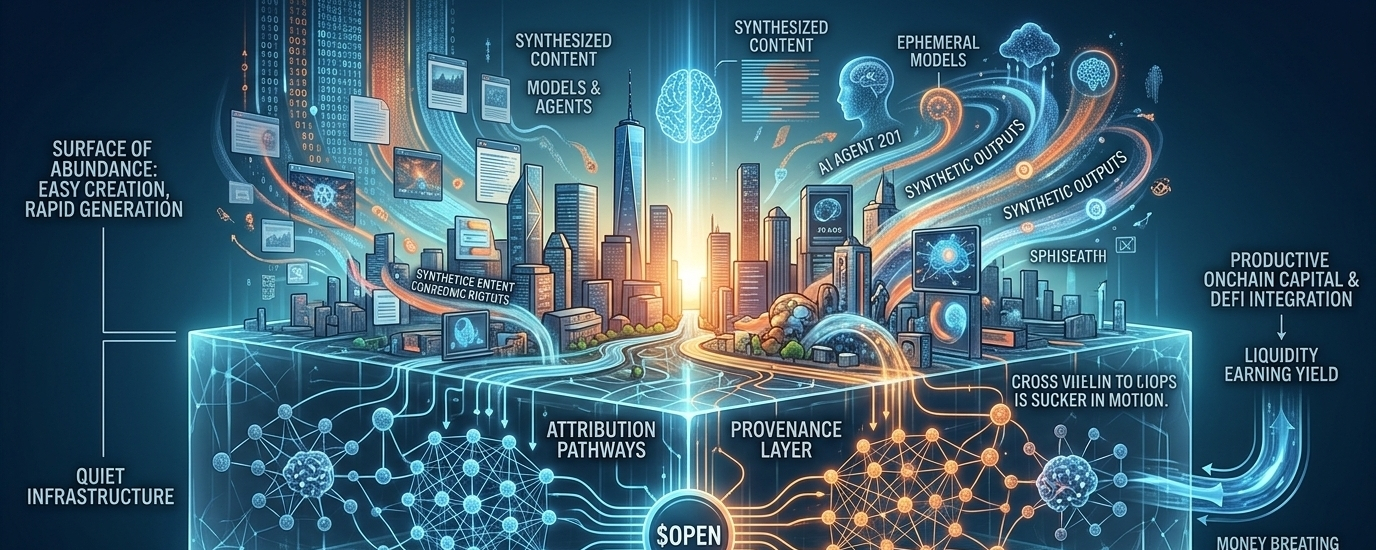
@OpenLedger The strange thing about the future is that it rarely arrives wearing the costume people expect. It usually shows up as an adjustment in what we trust, what we notice, and what we are willing to pay for. AI is already proving that intelligence can be manufactured at scale, but OpenLedger seems to be asking a more uncomfortable question: once intelligence becomes abundant, what becomes scarce? Not the model itself. Not the raw output. It may be the right to be recognized inside the system.
That is where OpenLedger becomes more interesting than another story about AI performance. Its real proposition appears to sit in the quieter layers of the stack: attribution, provenance, operational visibility, and the ability to connect contribution to outcome. In a world where machines can remix knowledge endlessly, the decisive edge may no longer be who can generate the most, but who can preserve the path behind what was generated. “Creation is easy to copy. Context is harder to fake.” That line feels like the kind of truth the market only learns after it has already paid for the lesson.
OpenLedger and the token $OPEN live inside that tension. The token is not just a symbol of participation; it suggests a way to organize incentives around an economy where data, feedback, models, and specialized contributions all carry economic weight. That matters because AI systems do not emerge from nowhere. They are shaped by people, by inputs, by curation, by feedback loops, and by invisible coordination costs. When those costs become too high, systems drift toward centralization. When attribution becomes unclear, trust gets abstracted away. OpenLedger feels like an attempt to make that hidden machinery legible again.
There is a broader market lesson here that goes beyond AI. Digital economies already run on filters that decide what deserves visibility. Creator rankings shape who gets seen. Recommendation systems shape what gets distributed. Credit scoring shapes who gets access. Liquidity signals shape what capital believes in. In each case, the surface appears open, but the real economy is governed by eligibility, trust boundaries, and algorithmic permission. OpenLedger seems to understand that the same logic may define AI ecosystems too. The most valuable systems may not simply be the smartest ones. They may be the ones that know how to decide what is legitimate, usable, and worth routing forward.
That is also where the conversation begins to overlap with DeFi. Tokenized interest-bearing assets, productive onchain capital, and composable financial infrastructure all point toward a future where liquidity no longer sits idle in a static container. It starts working. It earns yield, backs collateral, moves across protocols, and becomes more than a balance sheet entry. In that world, capital efficiency is not a technical preference; it is a survival trait. TVL growth matters less as a vanity metric than as evidence that capital is willing to remain in motion without losing trust. “Money wants to breathe. Systems that let it breathe will matter.” That feels true whether the asset is a stablecoin, a tokenized bond, or a piece of AI infrastructure with economic rights attached to it.
$OPEN, in that sense, belongs to a much larger structural shift. It is easy to talk about tokens as if they are only price proxies, but the deeper question is whether they become coordination instruments for economies where intelligence itself is being fragmented into services, agents, datasets, and proofs. If AI agents are going to transact, negotiate, borrow, verify, and cooperate, they will need more than raw inference. They will need trust rails. They will need rules about access. They will need economic memory. They will need a way to know what came from where, and what should be rewarded when value is created downstream.
Maybe that is why OpenLedger feels timely even in a crowded narrative market. It is not trying to convince anyone that AI will matter. Everyone already knows that. The more difficult idea is that the bottleneck may move. Creation becomes cheap. Abundance becomes default. Then the precious thing is not output, but discernment; not volume, but traceability; not speed, but the quiet infrastructure that tells the system what deserves to exist with legitimacy.
And perhaps that is the real emotional center of the thesis. In the end, people do not only want more intelligence. They want confidence that what they are seeing still has a path back to something real. When the world fills with synthetic abundance, the most valuable layer may be the one that remembers how things were made.