THE FUTURE OF AI PROBABLY BELONGS TO WHOEVER CONTROLS TRUST NOT JUST WHOEVER BUILDS THE BIGGEST MODEL
For a while everybody thought the AI race was simple.
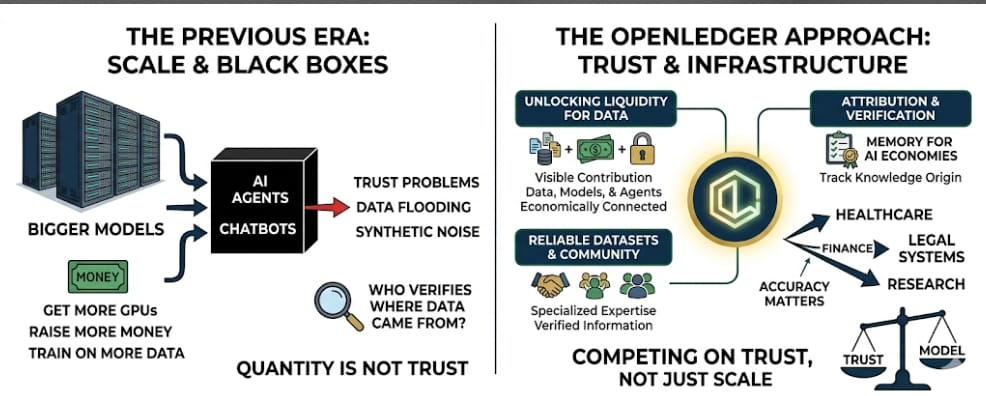
Build bigger models.
Get more GPUs.
Raise more money.
Train on more data.
Repeat forever until your chatbot becomes smarter than everyone else’s chatbot.
That was basically the whole narrative. Bigger equals better. Scale equals dominance. And honestly maybe that worked in the early phase because the jump in capabilities was so dramatic people stopped asking deeper questions. The outputs were impressive enough to distract everyone from the structure underneath the industry.
Now I think the cracks are starting to show.
Because bigger models do not automatically solve trust problems. They do not solve ownership problems either. They definitely do not solve the fact that the internet itself is slowly getting flooded with synthetic content generated by the same systems everybody is trying to scale infinitely.
That part feels important.
The AI industry talks constantly about intelligence, but I think the next major battle is actually about trust. Who can provide reliable information? Who can verify where data came from? Which systems can people depend on once machine-generated content completely floods the internet?
Because honestly the web already feels different now.
You search for something and half the results sound machine-written. Social media replies feel empty. Entire websites look like they were assembled automatically by an algorithm trying to hit SEO keywords instead of communicate with actual humans. Everything feels optimized for engagement and visibility instead of meaning.
And the scary thing is future AI systems train on this environment too.
That creates a feedback loop where models slowly start learning from synthetic outputs generated by previous models. AI consuming AI consuming AI until the original human signal underneath everything becomes weaker over time. Nobody fully understands where that leads long term because the industry is moving too fast to stop and think properly.
That is why OpenLedger keeps standing out to me compared to most AI crypto projects.
Most projects just chase the obvious narrative. “AI agents.” “Autonomous future.” “Revolutionary intelligence.” Same recycled hype. Same fake futurism. Most of it feels shallow honestly.
OpenLedger at least seems focused on the infrastructure problem underneath AI itself.
Trust.
Attribution.
Verification.
The things that actually matter once the hype cools down.
Because right now the AI economy mostly functions like a black box. Data gets scraped from the internet. Models train behind closed doors. Outputs come out. Companies monetize access. Nobody really knows which datasets shaped what outputs or how contributors should participate economically in the systems built partly from their knowledge.
That setup already feels unstable.
Especially because the internet itself was built collectively. Millions of people contributed information, code, discussions, tutorials, research, and creativity into public online ecosystems for years without expecting giant machine-learning companies would eventually absorb all of it into commercial infrastructure.
Now those same companies are becoming some of the most powerful entities in tech.
And the contributors mostly disappeared from the equation.
That imbalance probably becomes impossible to ignore eventually.
OpenLedger’s whole “unlocking liquidity for data, models, and agents” idea seems built around exactly that tension. They are basically trying to create systems where contribution becomes visible instead of invisible. Where datasets, communities, models, and AI agents remain economically connected instead of functioning like unpaid fuel feeding centralized corporations forever.
And honestly I think that direction makes more sense than endlessly chasing bigger models forever.
Because bigger models eventually hit diminishing returns. But trustworthy infrastructure becomes more valuable over time.
Reliable datasets become valuable.
Verified information becomes valuable.
Specialized communities become valuable.
Transparent contribution systems become valuable.
Especially once AI spreads deeper into industries where accuracy matters more than hype. Healthcare. Finance. Research. Legal systems. Education. You cannot build serious long-term infrastructure entirely on top of polluted information ecosystems where nobody can verify provenance properly.
That is where OpenLedger’s Proof of Attribution model starts feeling important. The project is basically trying to create memory for AI economies. A way to track where knowledge came from, who contributed value, and how rewards should flow through increasingly automated systems instead of disappearing upward into centralized black boxes.
At least that is the idea.
And honestly even if the execution ends up messy, I still think the problem itself is real. Because the internet is already becoming saturated with machine-generated content at absurd speed. AI-generated articles. AI-generated comments. AI-generated marketing. Entire businesses pumping out automated content nonstop because machines made quantity infinitely cheaper.
But quantity is not the same thing as trust.
That distinction matters more every year.
People eventually get exhausted by synthetic noise. They start looking for reliable communities again. Reliable data again. Reliable expertise again. The more polluted the information environment becomes, the more valuable verified systems become too.
That feels like the direction OpenLedger is betting on.
Not just AI growth.
AI accountability.
And honestly that seems smarter than most of the market right now.
Still risky obviously.
Very risky.
Crypto people always jump from “interesting idea” straight to “this changes the world” while ignoring how brutally hard infrastructure battles actually are. Centralized AI companies still dominate because centralized systems coordinate faster, move faster, and spend faster. OpenAI, Google, Meta, Anthropic… these companies have absurd advantages already.
Competing against that is brutal.
Most decentralized AI projects probably fail.
But centralized AI creates huge long-term weaknesses too. Dependency. Power concentration. Opaque training systems. Ownership imbalances. Public distrust around models nobody can inspect properly while they increasingly shape communication, labor, education, and information flow itself.
That tension is not going away.
And honestly I think the next stage of AI is less about building machines that sound smarter and more about building systems people can actually trust once machine-generated content becomes impossible to escape.
Because eventually intelligence alone is not enough.
People need to know where the intelligence came from too.
#OpenLedger $OPEN @OpenLedger