
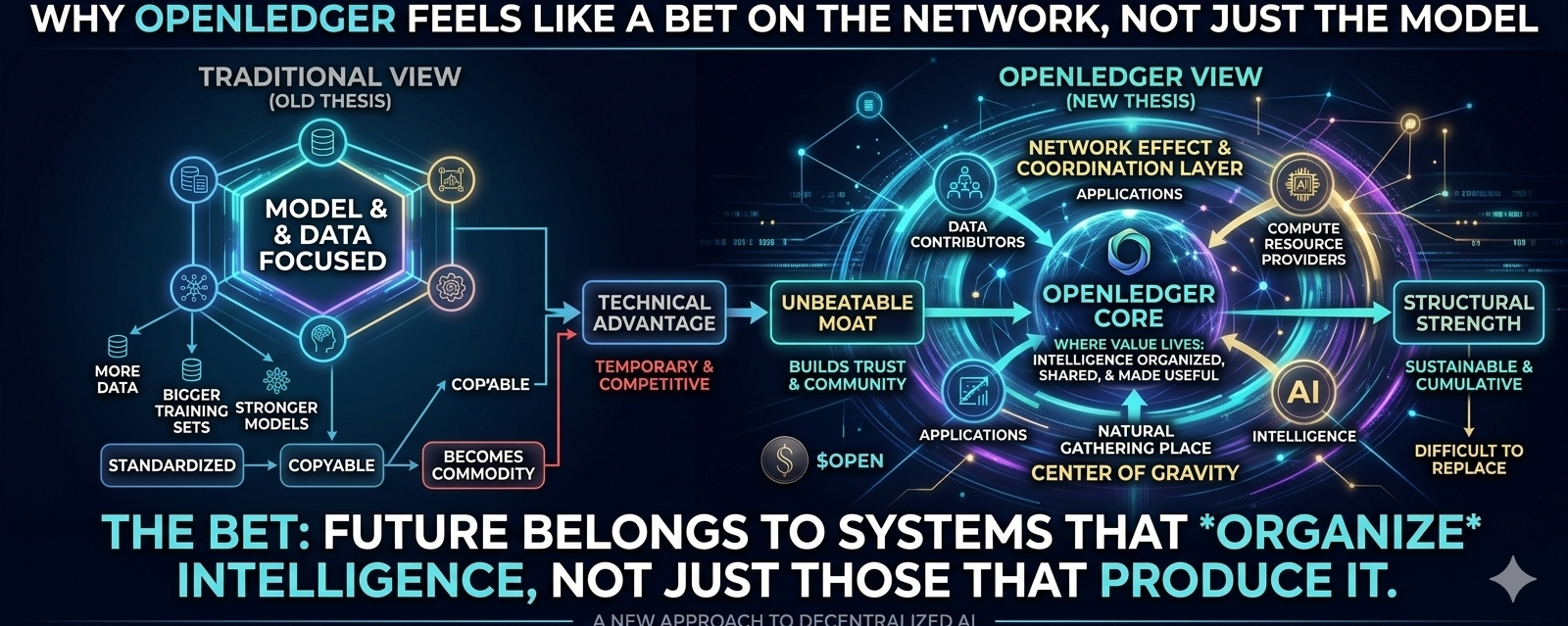
For a long time, I assumed the AI story would mostly come down to data. More data, cleaner data, stronger models, bigger training sets. That was the simple version, and for a while it made perfect sense. But the more I watch this space, the more I feel that data is only part of the picture. Important, yes. But maybe not the thing that decides everything. What keeps standing out to me is that the real advantage may not be the data itself, but the ability to coordinate the people, systems, and incentives around it. That is the part that feels much harder to copy, much harder to fake, and much harder to build from scratch.
That is why OpenLedger keeps interesting me. Not because it is just another name in AI, but because it seems to point toward a deeper idea: that the future value of AI may sit in the network layer, where intelligence is organized, shared, and made useful. Compute gets cheaper. Models improve. Infrastructure catches up. Over time, a lot of the things people once thought were unbeatable tend to become standard. But coordination is different. You cannot simply buy trust. You cannot instantly create a community that wants to contribute. You cannot force people to align just because the product exists. That kind of thing takes time, momentum, and a reason for people to stay.
And that is what makes the OpenLedger thesis feel both exciting and difficult at the same time. If it works, the value may not show up in the usual places people look first. It may not be about which model is best on paper, or which platform has the fastest inference, or which team collected the largest dataset. It may come from something softer but more powerful: whether OpenLedger can become a place where data, contributors, applications, and intelligence naturally gather. That is a very different kind of strength. It is less about raw technical edge and more about becoming a center of gravity.
What also makes this interesting is how fragmented decentralized AI still feels. Everything is spread out. Data is here, models are there, contributors are somewhere else, and applications often feel disconnected from the rest. A lot of people like the idea of decentralization, but liking the idea is not the same as building something that actually coordinates people well. That is the hard part. And usually, that is where the real moat appears. Systems that solve coordination tend to matter more than systems that just look smart. They become the place where activity builds on itself. They become difficult to replace, not because they are perfect, but because they become useful in a way others cannot easily replicate.
That is why I think many people may be looking at $OPEN through the wrong lens. The real question may not be whether decentralized AI can beat centralized AI in some direct contest. The real question might be whether OpenLedger can become a meaningful coordination layer for an AI economy that is still being built. If it does, then its value may be bigger than any single feature or metric can capture. And if it does not, that may be because coordination turns out to be even harder to decentralize than infrastructure itself. Either way, the bigger story is not just about data anymore. It is about whether a network can become the thing that makes intelligence useful at scale.
Right now, I do not think the answer is obvious. That is probably why the idea keeps pulling me back. OpenLedger feels like a bet on something more structural than a model trend or a temporary AI narrative. It feels like a bet on whether the future belongs to the systems that produce intelligence, or the systems that organize it. And that is a much more interesting question.
$OPEN @OpenLedger #OpenLedger $HOME
