The more I think about AI, the stranger the whole thing feels.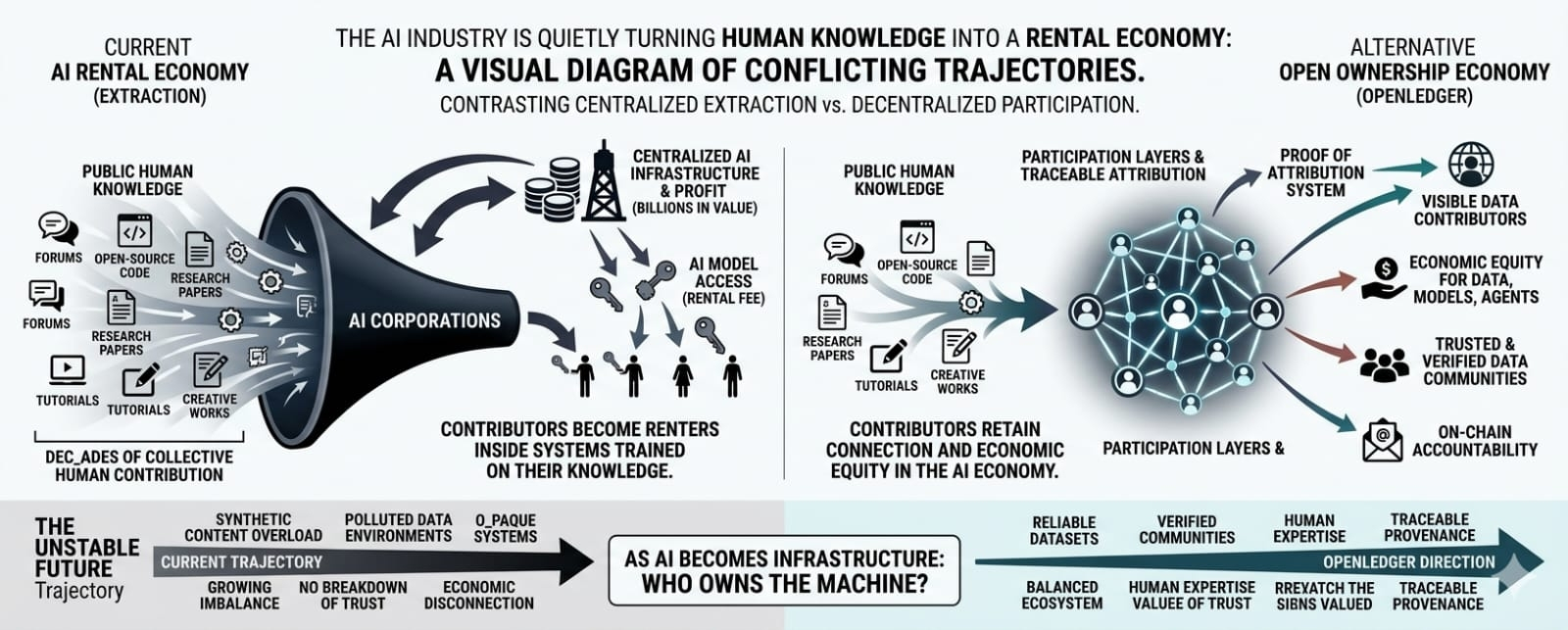
Not the technology itself. The economics underneath it.
Because what is actually happening right now is kind of absurd when you strip away the hype. Millions of people spent decades building the internet into this giant living archive of human knowledge. Forums, open-source projects, tutorials, articles, research papers, communities, conversations, creativity, all layered on top of each other slowly over time.
Then AI companies showed up and realized all of it could become training fuel.
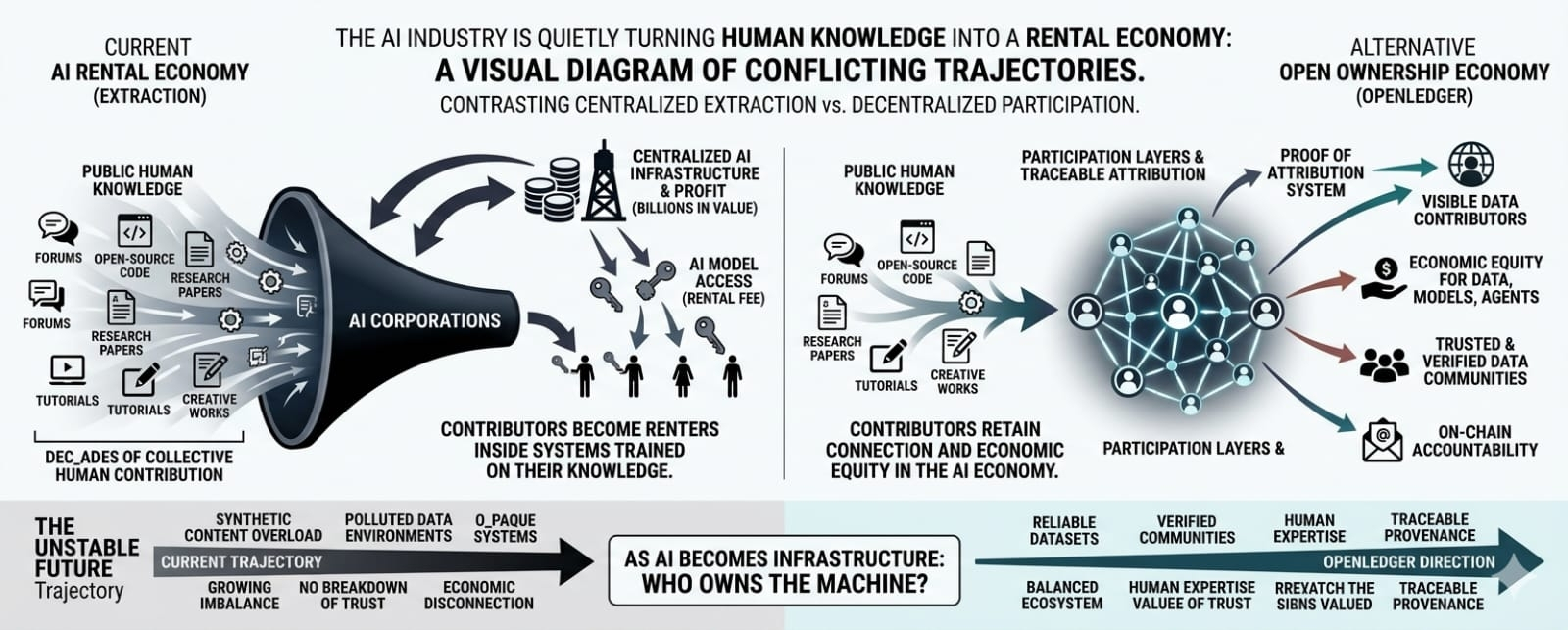
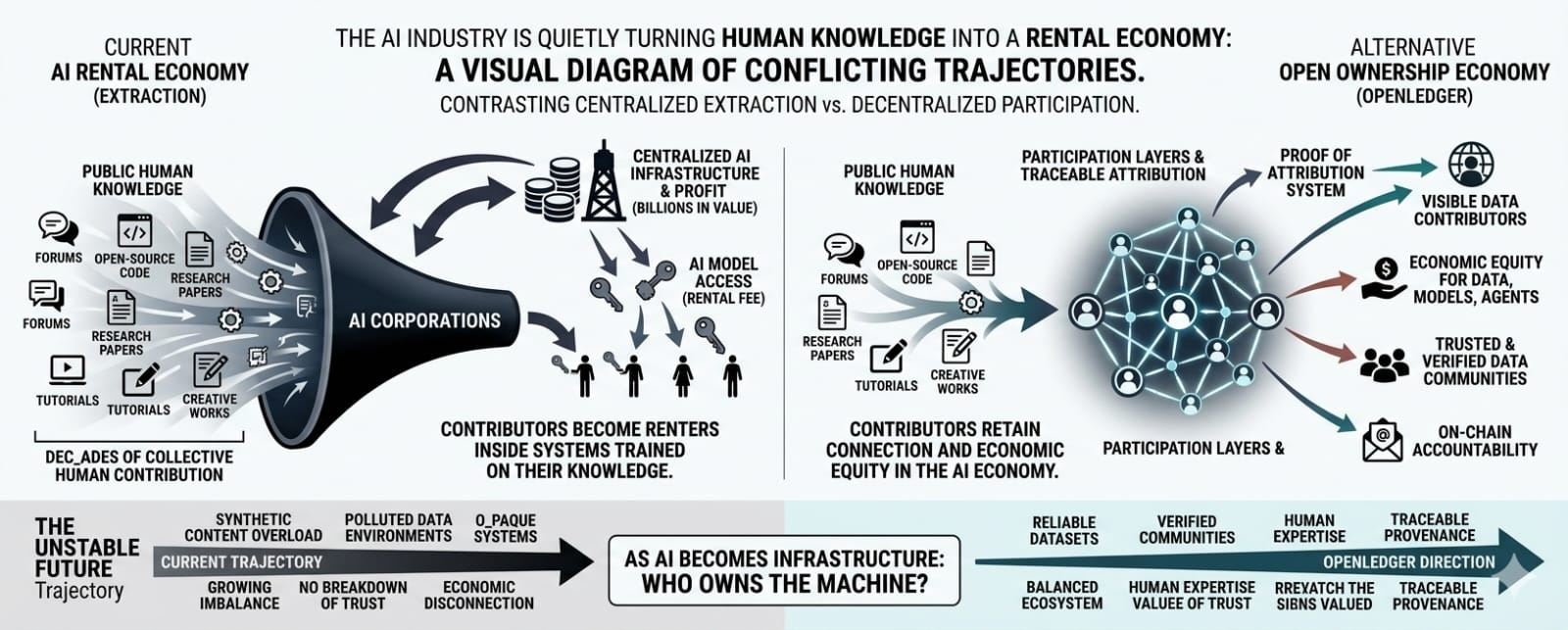
Now those same companies are building systems worth billions from information they largely did not create themselves. And instead of contributors owning part of the intelligence economy forming around their knowledge, most people are basically being turned into renters inside systems trained partly from public human contribution.
That is the weirdest part to me.
The internet was built collectively. The ownership layer around AI is becoming centralized incredibly fast.
And honestly I do not think society fully understands how big that shift is yet.
Because AI is not just another app category anymore. It is becoming infrastructure underneath daily life. Search, software, research, communication, marketing, customer support, education, coding, finance, healthcare. Every year machine intelligence moves deeper into systems people depend on economically.
That means whoever controls the infrastructure underneath AI eventually controls huge sections of digital life itself.
Right now that power mostly belongs to giant centralized companies with enough money to dominate compute and training systems at scale.
That is exactly why OpenLedger stands out to me more than most AI projects in crypto right now.
Not because it promises magic decentralization fixes. Most crypto projects promise impossible things honestly. But OpenLedger at least seems focused on a real structural problem instead of another shallow AI narrative built entirely around hype and engagement farming.
The structural problem is ownership.
Right now the AI economy mostly functions like extraction. Human knowledge flows upward into proprietary machine-learning systems. Economic value flows upward into corporations controlling infrastructure. Contributors remain mostly invisible once the data gets absorbed into the models.
And the crazy thing is people accepted this incredibly fast because the outputs are impressive enough to distract everyone from the imbalance underneath.
But eventually people start noticing where the value actually goes.
They always do.
Social media followed the same pattern. Early internet culture felt open and decentralized. Then slowly a handful of platforms absorbed huge amounts of influence and monetized user-generated activity at global scale while users themselves mostly got algorithms and ads in return.
AI feels like a much more extreme version of that process.
Because now companies are not just monetizing attention anymore.
They are monetizing intelligence itself.
That is why OpenLedger’s whole “unlocking liquidity for data, models, and agents” idea actually matters more than it sounds at first. They seem to understand that future AI systems need participation layers underneath them instead of functioning like giant closed economies owned entirely by whoever controls the biggest GPU clusters.
Their Proof of Attribution system is basically trying to make contribution visible again. Instead of data disappearing invisibly into giant black-box models forever, contributors, datasets, and communities remain connected to the economic activity generated through AI systems.
At least that is the goal.
And honestly I think the direction makes sense because the internet itself is already starting to break under the pressure of AI scaling too fast. Synthetic content floods platforms everywhere now. AI-generated articles. Machine-written comments. Automated marketing. Entire websites built entirely for algorithms instead of humans.
The web increasingly feels artificial.
And the scary part is future AI systems train on this environment too. Which means the internet slowly becomes this giant feedback loop where machine-generated content feeds future machine-generated systems over and over.
That creates a serious problem.
Because AI systems are only as reliable as the information ecosystems underneath them. Bigger models do not magically fix polluted data environments forever. At some point trust becomes infrastructure too.
Reliable datasets become valuable.
Verified communities become valuable.
Human expertise becomes valuable.
The more synthetic the internet becomes, the more important provenance and attribution probably become too.
That is another reason OpenLedger keeps sticking in my head. They are not just focused on making AI bigger. They seem focused on making AI economies more traceable before the entire system hardens into centralized infrastructure nobody outside a few corporations can realistically challenge.
Because honestly the current trajectory already feels unstable.
A handful of companies controlling increasingly important intelligence systems while contributors remain economically disconnected from the value they helped create. Public human knowledge turning into private machine infrastructure. AI systems replacing larger sections of labor while ownership concentrates upward into smaller groups.
That tension probably gets worse over time, not better.
Especially once AI agents become more autonomous. Imagine systems running businesses, negotiating deals, handling research, generating products, managing workflows nonstop online.
Who owns those agents?
Who gets paid from the outputs?
Who controls the information pipelines feeding them?
Right now the answer mostly points toward centralized corporations.
OpenLedger is basically betting that eventually people reject that structure before it becomes permanent.
Still risky obviously.
Very risky.
Crypto communities love romanticizing decentralization while ignoring how brutally efficient centralized systems can be in practice. OpenAI, Google, Meta, Anthropic… these companies have absurd advantages already. Better compute. Better infrastructure. Better engineers. More money than most decentralized ecosystems can realistically compete with.
That is reality.
But centralized AI creates dangerous dependencies too. Power concentration. Opaque systems. Ownership imbalances. Information bottlenecks. The deeper AI spreads into society, the more uncomfortable those weaknesses become.
And honestly I think the next stage of AI is less about who builds the smartest chatbot and more about who builds economic systems people actually trust underneath machine intelligence itself.
Because eventually people stop being impressed by the magic trick.
Then they start asking who owns the machine.
#OpenLedger $OPEN @OpenLedger