
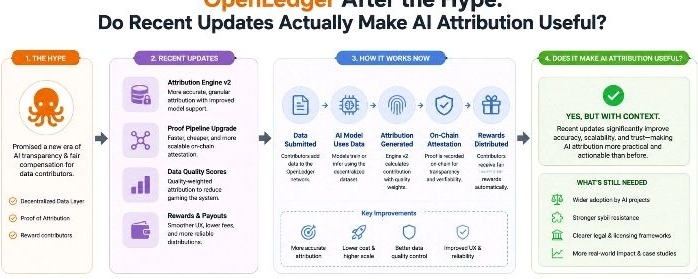
When I first learned about OpenLedger (OPEN), what caught my attention was not the blockchain itself. It was the idea behind it. Many people create valuable things online every day. Some share information, some build tools, and others create systems that help people solve problems. Yet many contributors never receive fair value for what they provide.
OpenLedger is trying to address this issue in a different way. Its goal is to create a system where data, models, and agents can become assets that people can own, use, and earn from. I find this idea interesting because it focuses on the people who contribute rather than only the platforms that collect the benefits.
One challenge in today's digital world is that valuable contributions are often difficult to measure. A person may spend years collecting useful information or building something valuable, but the connection between effort and reward is not always clear. OpenLedger is trying to create a structure where those contributions can be recognized and linked to economic value.
What I like about this approach is that it starts with a simple question. If something creates value, who should benefit from it? In many cases, the answer is not easy. Large systems usually involve many participants. Some provide information, some build tools, and some help improve the overall network. OpenLedger appears to be exploring ways to make these contributions more visible.
Another reason I find OpenLedger worth watching is its focus on liquidity. In simple terms, liquidity makes it easier for assets to move and be used. Without liquidity, ownership can exist only on paper. An asset may have value, but it can be difficult to access or use that value. OpenLedger aims to make digital assets more flexible so participants can interact with them more easily.
I think this matters because ownership alone is not enough. People also need practical ways to benefit from what they own. If contributors cannot access the value they create, the system may struggle to keep participants engaged over the long term.
At the same time, I believe every project faces challenges. Good ideas are only the beginning. The real test comes when people start using a system in everyday situations. A project can have a strong vision, but success depends on execution, reliability, and adoption. OpenLedger will need to prove that its approach works in practice and can support real users over time.
I also think trust plays an important role. People want clear rules and fair treatment. They want to understand how value is created and distributed. Any platform that deals with ownership and rewards must be transparent enough for participants to feel confident about taking part.
One thing I appreciate is that OpenLedger is focused on a problem that is becoming more important. As digital ecosystems grow, questions about ownership, contribution, and rewards become harder to ignore. More people are asking who benefits when value is created and whether contributors receive a fair share.
From my perspective, OpenLedger is not simply about technology. It is about building a system that connects contribution with opportunity. Whether it fully succeeds or not remains to be seen, but I believe the problem it is trying to solve deserves attention.
In the end, I see OpenLedger as a project worth following because it focuses on something fundamental: recognizing and rewarding value creation. The digital world continues to expand, and systems that help contributors participate more fairly may become increasingly important. I will be watching closely to see how OpenLedger develops, how users respond, and whether it can turn its vision into something practical and useful for the people who help create value every day.
