
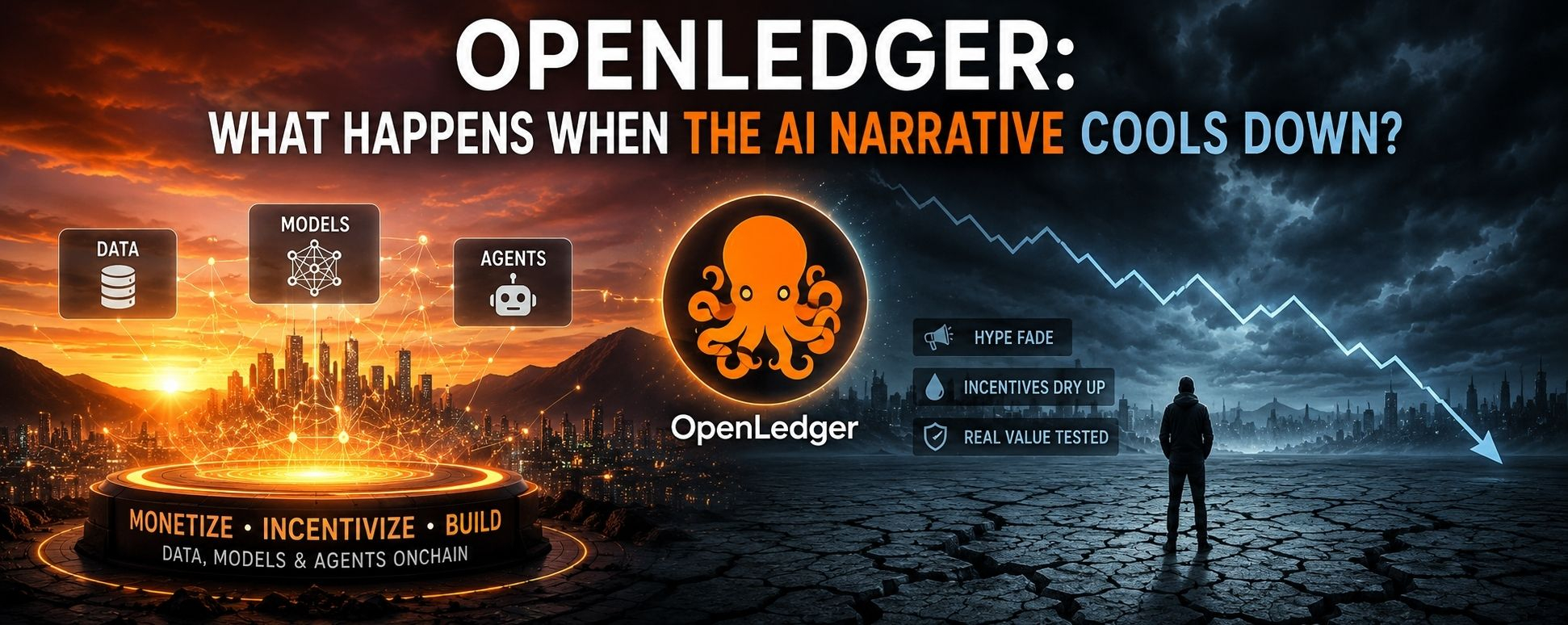
I keep looking at AI-related crypto projects and asking myself the same question.
What survives when the excitement disappears?
Not when funding is easy. Not when AI dominates headlines. Not when every new announcement gets rewarded by the market.
What survives when people stop caring about the narrative?
That's where I find myself with OpenLedger.
The idea is easy enough to understand. AI needs data. Data has value. The people providing that data usually capture only a small portion of the upside. OpenLedger is trying to build a system where data, models, and AI agents can be monetized through blockchain-based incentives.
On paper, that sounds reasonable.
The market is full of reasonable ideas.
I've been around long enough to know that reason alone doesn't get a project very far.
Good ideas fail all the time.
The harder part is creating a system that people continue using after the initial incentives fade.
That's the part that matters.
When I look at OpenLedger, I don't spend much time thinking about the vision. Every project has a vision. Every project talks about transforming an industry. Every project can explain why its market opportunity is enormous.
Eventually the conversation comes back to incentives.
Who benefits?
Why do they stay?
What happens when the easy money leaves?
Those questions usually tell you more than any whitepaper ever will.
Crypto has a habit of mistaking activity for demand.
I've watched it happen repeatedly.
A network launches rewards. Users arrive. Transactions increase. Social engagement grows. Everyone points to the numbers as proof that something important is happening.
Then the incentives shrink.
The activity disappears.
Suddenly what looked like adoption was really just participation chasing rewards.
The industry has been running that experiment for years.
OpenLedger will face the same reality at some point.
If contributors are supplying data today, would they still participate under less generous conditions?
If developers are building applications, are they doing it because the network solves a genuine problem or because there is funding available?
Those are very different motivations.
The distinction often doesn't become obvious until much later.
That's usually where the cracks begin.
The AI angle makes things even more interesting.
Right now, almost anything connected to AI receives attention. Investors want exposure. Builders want exposure. Funds want exposure.
That's understandable.
But attention is not demand.
The market confuses those things all the time.
A lot of projects benefit simply because they are standing near a powerful narrative.
The challenge is proving value once the narrative becomes ordinary.
And eventually every narrative becomes ordinary.
The question for OpenLedger isn't whether AI will continue growing.
It probably will.
The question is whether AI participants actually need a blockchain-based marketplace to solve their problems.
That's a much tougher question.
Because businesses tend to choose convenience over ideology.
If centralized platforms remain faster, simpler, and cheaper, many users will take that route regardless of how elegant a decentralized alternative may be.
Markets don't always reward the most interesting solution.
They usually reward the easiest one.
That's a reality every crypto project has to deal with.
The token is another piece of the puzzle.
Not from a trading perspective.
From a behavioral perspective.
Does the token create meaningful coordination between participants?
Does it encourage useful activity that strengthens the network over time?
Or is it primarily a vehicle for speculation attached to future expectations?
Those answers matter more than short-term price movements.
Prices tell you what people hope will happen.
Usage tells you what is actually happening.
The two don't always move together.
I've watched markets reward noise before utility.
I've watched projects reach extraordinary valuations before proving that anyone truly needed them.
I've also watched quiet projects slowly build relevance while nobody was paying attention.
The market rarely makes that distinction early.
OpenLedger sits somewhere in the middle right now.
The idea makes sense.
The timing makes sense.
The opportunity is obvious.
But opportunities alone don't create durable networks.
Execution does.
Real users do.
Real demand does.
What interests me most isn't whether OpenLedger can attract attention.
Most AI-related projects can do that right now.
What interests me is whether people continue showing up when attention moves somewhere else.
Because that is where the real evaluation begins.
The harder question starts after the hype.
And for OpenLedger, that question is still unanswered.