
In 2017 it was blockchain fixing banking. Then it was NFTs fixing ownership. Then DAOs were supposed to fix organizations. Now the pitch has mutated again. This time it's AI and blockchain getting married in what sounds like a venture capitalist fever dream.
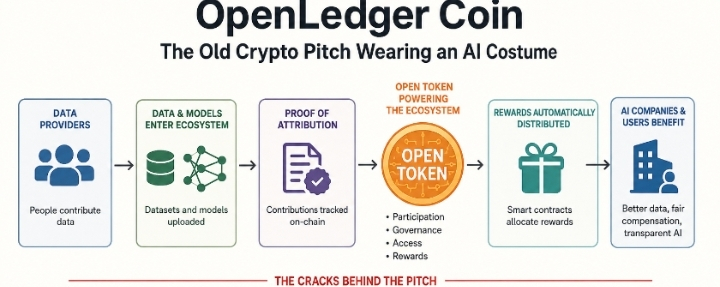
The project is called OpenLedger. The promise is simple enough: AI companies use huge amounts of data, the people providing that data rarely get paid fairly, and giant tech firms keep everything locked inside black boxes. OpenLedger says it can track who contributed what, record it on-chain, and automatically distribute rewards. They call it "Proof of Attribution."
It sounds tidy.
On paper, at least.
But the moment you stop reading the marketing slides and start asking uncomfortable questions, the cracks start showing.
The Problem They Claim to Fix
The sales pitch goes something like this:
AI models are trained on mountains of data.
Nobody knows exactly where all that data came from.
The people who contributed useful information don't get compensated.
OpenLedger wants to create a blockchain where datasets, models, and AI agents can be tracked and monetized. Every contribution gets recorded. Every contributor gets rewarded. Everything becomes transparent.
Fair enough.
That's a real problem.
The issue is that crypto projects have a habit of identifying genuine problems and then attaching a token to them whether it's necessary or not.
That's where things get interesting.
Why the "Solution" Feels Like More Machinery
Let's be honest.
Most businesses don't wake up in the morning thinking, "You know what we're missing? Another blockchain."
They want something that works.
Now imagine you're building an AI model.
You already have datasets, cloud infrastructure, APIs, compliance requirements, security audits, version control systems, and lawyers breathing down your neck.
OpenLedger's answer is to add another layer.
Now you have on-chain attribution systems.
Token incentives.
Wallet infrastructure.
Governance mechanisms.
Smart contracts.
Reward distribution logic.
A native token called OPEN sitting in the middle of everything.
That's not removing complexity.
That's wrapping complexity inside even more complexity and calling it innovation.
It's like claiming you've solved traffic by adding another highway directly on top of the existing highway.
The Part Nobody Wants to Talk About
Here's the question that rarely appears in crypto whitepapers:
Who decides whether a piece of data was actually valuable?
Because that's the entire game.
OpenLedger talks about attributing model outputs back to specific data contributors. Sounds great. But AI models aren't simple machines. They're messy statistical systems. Determining exactly which dataset created which outcome is not nearly as straightforward as the marketing implies.
And once money enters the equation?
People start gaming the system.
They always do.
You'll get spam data.
Synthetic data.
Low-quality contributions designed purely to farm rewards.
Entire businesses built around exploiting attribution formulas.
Decentralized? Sure. Until It Isn't.
This is where crypto projects love playing word games.
The website talks about community ownership, decentralized infrastructure, and open participation.
But then you keep reading.
The project has venture funding.
Token allocations.
Core teams.
Foundations.
Roadmaps controlled by a relatively small group of people.
Which raises the uncomfortable question:
If a handful of insiders guide development, influence token economics, negotiate partnerships, and shape governance, how decentralized is this thing really?
Because decentralization is often strongest in press releases and weakest when something goes wrong.
When systems break, users don't call "the community."
They call the company.
Follow the Money
This is my favorite part.
Every crypto project eventually reaches the same moment.
Someone asks where the value comes from.
Not the token price.
Not the market cap.
Actual value.
OpenLedger's token is supposed to power participation, governance, rewards, and access across the ecosystem.
Fine.
But does the system genuinely need a tradable token?
Or is the token the product?
Those are very different things.
Because one creates utility.
The other creates speculation.
And crypto history is littered with projects where the exciting technology somehow became secondary to watching the chart move up and down every fifteen seconds.
Funny how that keeps happening.
The Human Reality
Here's the part the glossy presentations skip.
Imagine an AI company actually depends on this infrastructure.
Now imagine the token crashes 60%.
Or regulators start asking questions.
Or the attribution mechanism gets manipulated.
Or a governance fight breaks out.
Or a critical smart contract has a bug.
What happens then?
Does the AI company stop operating?
Does compensation stop flowing?
Does everybody agree on who owns what contribution?
Technology people love discussing ideal conditions.
Real businesses live in worst-case scenarios.
Those are not the same thing.
The language changes every cycle.
In one era it was "decentralized finance."
Then "Web3."
Then "metaverse."
Now it's "AI attribution."
The underlying formula rarely changes.
Find a real problem.
Add a token.
Promise transparency.
Promise fairness.
Promise a new economic model.
Raise money.
Hope adoption arrives before skepticism does.
Maybe OpenLedger succeeds. Stranger things have happened.
But after two decades of watching technology companies promise to replace trust with code, middlemen with protocols, and institutions with tokens, I've learned one thing.
The harder a project works to explain why it needs a blockchain, the more likely that's the first question people should be asking.
