
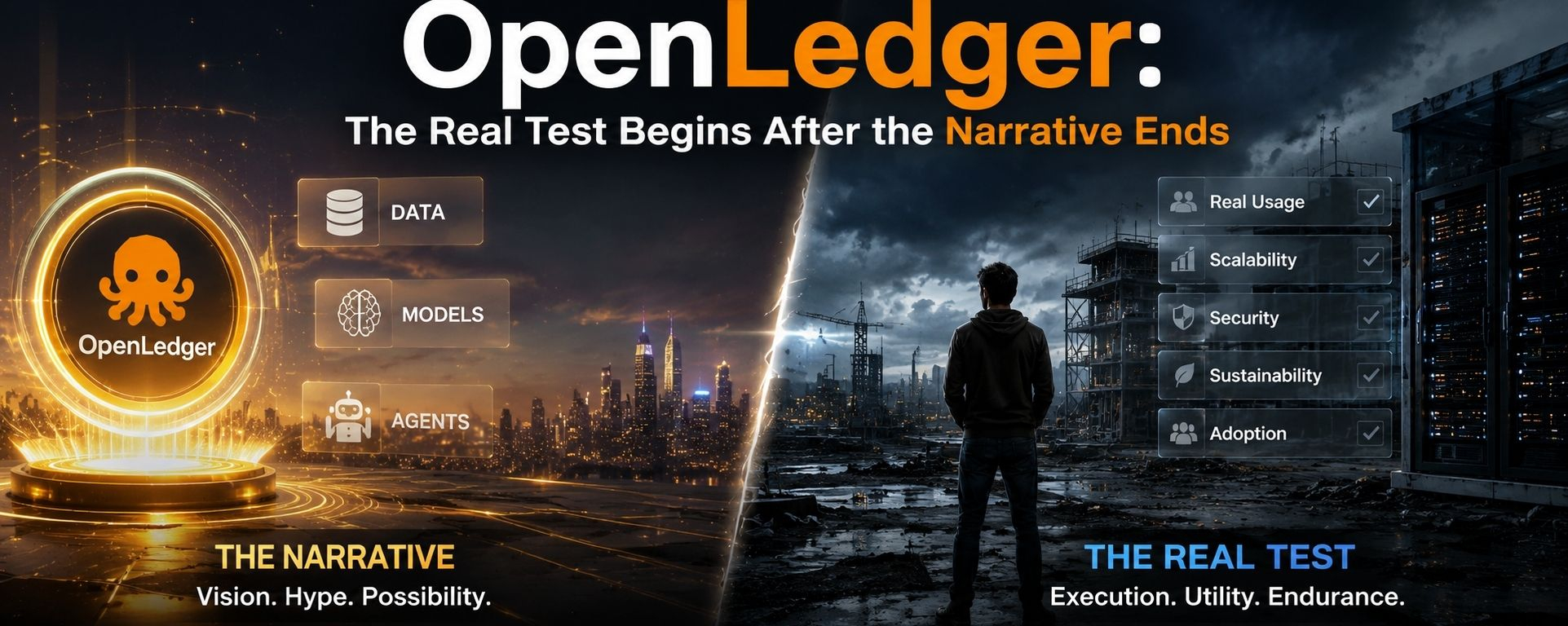
I keep returning to the same thought whenever I look at projects like OpenLedger. After watching technology markets for long enough, it becomes difficult to get overly excited by a narrative alone. The story always arrives first. The expectations arrive shortly after. What takes much longer is discovering whether a product can survive the ordinary pressures of real usage. That is usually the part that interests me most. Not the launch, not the attention, not the early optimism, but the period that comes afterward when a system has to justify its existence every single day.
OpenLedger enters the conversation at a moment when artificial intelligence is expanding into almost every corner of the technology industry. Data has become valuable. Models have become valuable. Even the idea of autonomous agents is beginning to develop its own economy. On paper, creating infrastructure that allows these assets to be monetized and exchanged feels like a natural progression. Yet experience has a way of making simple ideas look much more complicated once they encounter reality.
The technology industry often speaks about data as if value is automatically embedded within it. In practice, most data is messy, fragmented, inconsistent, and difficult to evaluate. The challenge is rarely collecting information. The challenge is determining what information remains useful after the excitement fades. The same applies to AI models. Building a model can be impressive. Keeping it relevant is usually far more difficult. Markets celebrate creation because it is visible. Maintenance receives less attention because it happens quietly in the background.
That distinction matters because technology tends to look strongest during demonstrations. Controlled environments remove uncertainty. Real-world deployment introduces it. Suddenly there are costs to manage, workflows to integrate with, users to support, and expectations to meet. Systems that appear efficient in presentations often encounter friction once they become part of someone's daily routine.
This is where many promising narratives begin to slow down. Not because the technology stops working, but because operating technology is different from showcasing it. Organizations do not adopt products simply because they are technically capable. They adopt products because the benefits outweigh the inconvenience of change. Every new layer added to a workflow creates questions. Does it save time? Does it reduce costs? Does it improve outcomes consistently enough to justify its presence?
The same questions apply to AI agents and the broader ecosystem OpenLedger hopes to support. Agents can be intelligent. Models can be sophisticated. Data can be abundant. Yet none of those qualities automatically create usefulness. Utility emerges when systems become dependable enough that people stop thinking about them. Reliability is often less exciting than innovation, but it tends to matter much more over time.
One pattern that repeats across nearly every technology cycle is the tendency to confuse attention with adoption. Attention can arrive quickly. Adoption moves at a much slower pace. A project can attract interest from thousands of observers while only becoming genuinely useful to a much smaller group of participants. The difference between those two things is often where the real story exists.
Infrastructure projects face an even tougher challenge because their success is usually measured years rather than months after launch. The strongest infrastructure rarely feels dramatic. It becomes valuable because it continues functioning while trends change around it. It survives shifts in market sentiment, shifts in technology, and shifts in user behavior. That kind of resilience cannot be demonstrated overnight.
For OpenLedger, the more interesting question is not whether there is demand for better coordination between data, models, and AI-driven systems. That demand clearly exists. The question is whether the framework can remain useful once it faces the ordinary realities of scale, competition, economic pressure, and evolving user expectations. Those are the conditions that reveal strengths and weaknesses far more effectively than market enthusiasm ever can.
The technology sector has always been full of impressive ideas. What remains relatively rare are systems capable of turning those ideas into long-term habits. Habits are what create durability. People return because something consistently solves a problem. They integrate it into their workflows because removing it would create inconvenience. That kind of adoption develops slowly and often without much attention.
Perhaps that is why projects like OpenLedger are most interesting when viewed through a longer lens. The vision itself is easy to understand. The harder part is understanding how that vision behaves when exposed to years of practical use rather than months of anticipation. There is a meaningful difference between attracting interest and becoming infrastructure. One is driven by possibility. The other is earned through repetition.
For now, the story remains unfinished. The ideas are ambitious, but technology history has shown repeatedly that ambition alone rarely determines outcomes. What matters is whether the system continues proving its usefulness when the excitement becomes quieter, when expectations become higher, and when users begin evaluating it not as a concept but as a tool. That is usually the point where appearance gives way to reality, and where the future of a project becomes much easier to see.