

One thing I've learned after years of watching crypto markets is that the biggest opportunities rarely arrive looking important.
Most people pay attention to the loudest narratives. The tokens making headlines. The charts moving vertically. The promises of a new revolution every few months. But when I look back at the projects that actually changed the industry, many of them started as boring infrastructure. They solved a problem before most people even realized the problem existed.
That's partly why OpenLedger caught my attention.
Not because it combines AI and blockchain. That alone doesn't mean much anymore. Every cycle eventually reaches a point where attaching a popular narrative to a token becomes easy. What interests me is a deeper question that the project is trying to explore.
Who owns intelligence?
It's a strange question, but I think it becomes more important every day.
Right now, AI is creating enormous amounts of value. People contribute data. Developers build models. Autonomous agents perform tasks. Businesses integrate AI into products and workflows. Yet most of the economic value still flows toward a small number of centralized platforms.
The contributors often remain invisible.
The data becomes someone else's asset. The model becomes someone else's business. The value gets captured somewhere far away from where it was actually created.
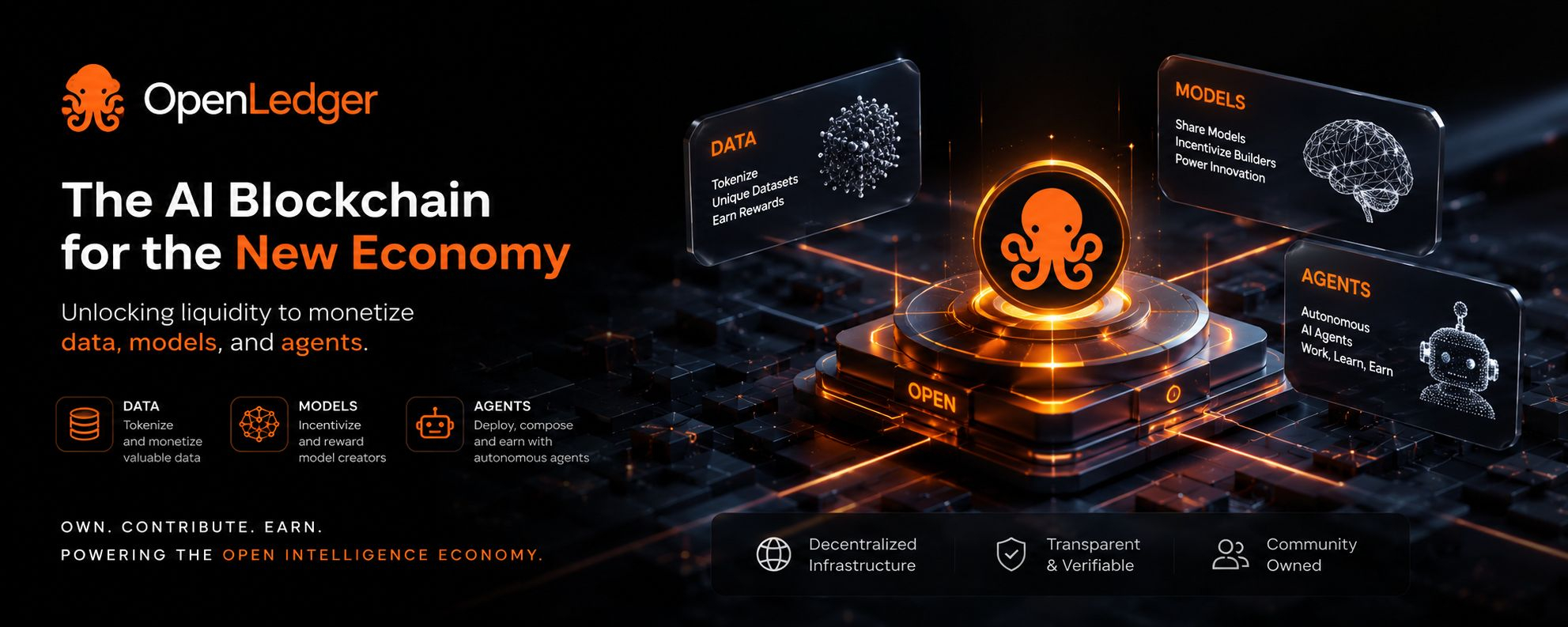
What OpenLedger seems to be pursuing is an alternative structure. A system where data, models, and AI agents can become economic assets that are easier to track, attribute, and monetize.
Maybe that sounds technical.
But I don't think it's really a technology story.
I think it's a market story.
Crypto has always been at its best when it creates new forms of coordination. Bitcoin created digital scarcity. Stablecoins created internet-native dollars. Decentralized exchanges created global liquidity networks.
The interesting question now is whether AI needs its own economic infrastructure.
If intelligence becomes a resource, then perhaps it also needs markets. Markets where contributors can participate instead of simply being extracted from.
That's the theory.
The reality is much harder.
Building the technology is only the first step. Creating a functioning economy around that technology is a completely different challenge. History is full of networks that worked perfectly from an engineering perspective and failed completely from an economic perspective.
People need reasons to contribute.
Developers need reasons to build.
Businesses need reasons to trust the system.
Without those things, even the most elegant infrastructure remains an interesting experiment.
This is where my optimism and skepticism meet each other.
I can see why the idea matters. AI is moving faster than almost any technology I have seen during my time in markets. New models appear every month. Agent frameworks evolve every week. Entire workflows are being redesigned around machine intelligence.
But speed alone doesn't create value.
Ownership does.
Incentives do.
Coordination does.
The projects that matter over the next decade may not be the ones building the smartest AI. They may be the ones building the economic rails that allow intelligence to move, trade, and generate value across open networks.
Whether OpenLedger becomes one of those projects remains to be seen.
There are still difficult questions. Will builders choose decentralized infrastructure when centralized alternatives are simpler? Can attribution be measured accurately enough to reward contributors fairly? Will value accrue to the network itself or simply to the applications built on top of it?
Nobody knows yet.
And honestly, that's what makes it interesting.
The market often treats uncertainty as a weakness. I tend to view it differently. Uncertainty is where genuine discovery happens.
When I look at OpenLedger, I don't see a guaranteed winner. I see an attempt to solve a problem that will become increasingly important as AI becomes embedded into everyday economic actvity.
Maybe it works.
Maybe it doesn't.
But if the future economy is increasingly powered by intelligence, then figuring out who owns that intelligence and who gets paid for creating it feels like one of the most important questions the industry can ask.
The answer may end up being worth far more than the latest narrative driving today's price action.