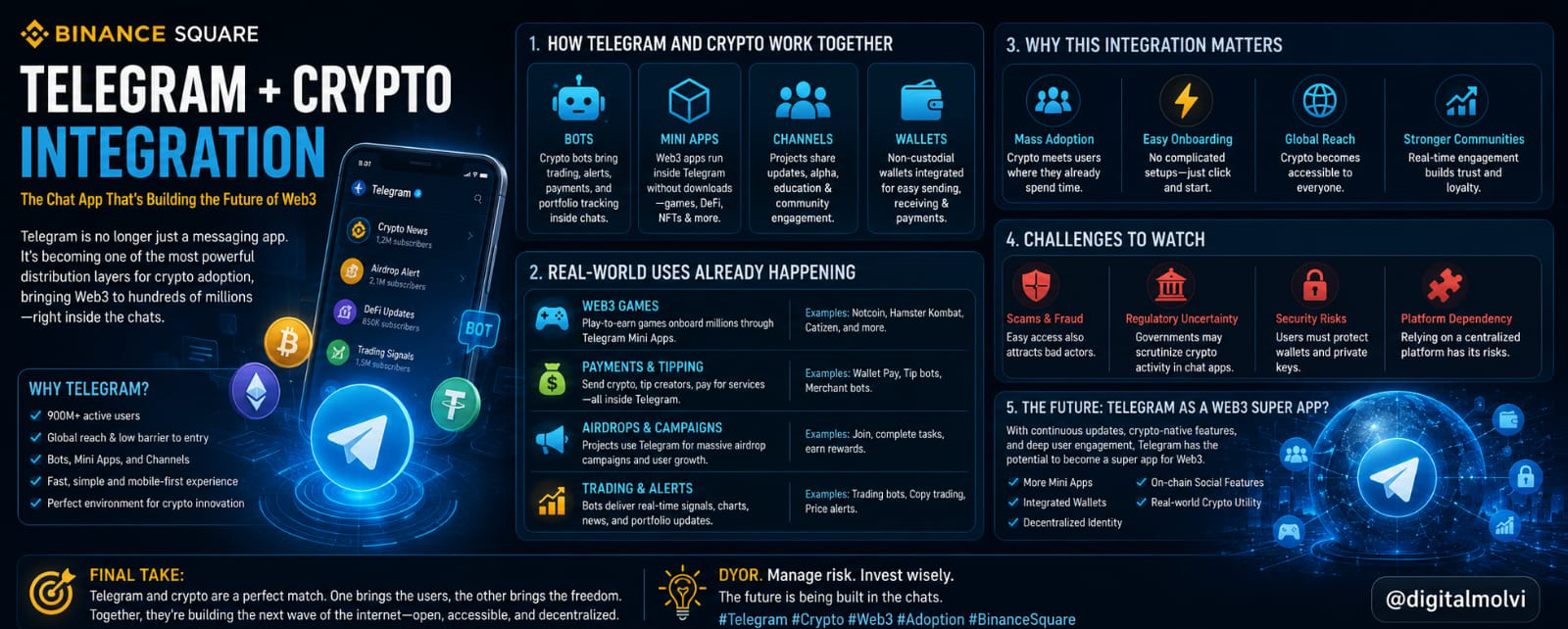
Telegram has become one of the most important “distribution layers” in crypto. While most blockchains fight to acquire users, Telegram already has massive global reach—so integrating wallets, payments, and mini apps can turn crypto from a niche product into something people use daily.
Here’s how Telegram + crypto integration works, why it’s powerful, and the key risks to track.
1) Why Telegram is a big deal for crypto
Crypto adoption usually fails at the same points:
complicated wallets and seed phrases
confusing onboarding
high friction to pay or receive money
users don’t know what to do after buying a coin
Telegram solves part of this by offering:
built-in social graphs (groups, channels, communities)
instant distribution (bots, mini apps, viral loops)
global messaging + payments use cases (tipping, P2P, subscriptions)
If crypto becomes “one tap” inside a chat app, adoption can accelerate fast.
2) What “integration” actually means (not just hype)
A) Wallets inside Telegram
Telegram-style wallets aim to make crypto feel like:
sending a message
sending a file
sending money
Impact: easier onboarding, faster transactions, more casual users.
B) Payments and stablecoins
The most realistic mass adoption path is stablecoins:
cross-border transfers
remittances
creator payments
small business payments
Impact: real demand for blockspace and transaction fees (if usage is organic).
C) Bots and mini apps (the “super app” model)
Telegram bots can power:
trading tools
games
ticketing
loyalty points
on-chain identity
community commerce
Impact: crypto becomes a feature inside apps, not a separate world.
D) Community-driven token distribution
Telegram communities are built for:
launches
airdrops
referral programs
meme coin virality
Impact: fast growth—but also higher risk of low-quality hype cycles.
3) The TON angle (why people connect Telegram with TON)
TON is often discussed alongside Telegram because the ecosystem focuses on:
consumer UX
low-fee transfers
mini app experiences
payments and social distribution
Important: long-term value depends on whether activity is real usage (payments, commerce, retained users) vs incentive farming.
4) What Telegram integration could unlock (real use cases)
Tipping + micro-payments in communities
Creator monetization (subscriptions, paid groups, digital goods)
P2P commerce (simple escrow-like flows)
Gaming economies (items, rewards, marketplaces)
Onboarding for emerging markets (stablecoin rails + low friction)
If these scale, it’s not just “crypto trading”—it’s crypto as internet money.
5) The risks people ignore
A) Scams scale faster inside messaging apps
Where there’s distribution, there’s also:
fake bots
phishing links
impersonation admins
“guaranteed profit” schemes
B) Platform and policy risk
If a platform changes rules, limits certain features, or faces regulatory pressure, crypto integrations can be impacted quickly.
C) Incentive-driven activity
Airdrops and referral loops can inflate user metrics. The real test is retention after rewards.
D) Centralization perception
If too much depends on one platform or a small set of entities, markets may price in extra risk.
6) A simple checklist: How to judge if integration is “real”
Track these signals over time:
stablecoin transfer volume (not just token transfers)
repeat users / retention in top mini apps
merchant/creator adoption (payments for real goods/services)
organic liquidity (DEX volume + TVL without heavy incentives)
security incidents (bot scams, wallet exploits)
Telegram + crypto integration is powerful because it combines distribution + community + payments in one place. If the ecosystem proves real retention and stablecoin utility, it can be one of the strongest adoption engines in crypto. But the same distribution also amplifies scams and hype—so tracking real usage metrics matters more than headlines.#digitalmolvi #Telegram #TON #Web3 #BinanceSquare
@CZ @Binance Academy @Yi He @Binance Square Official @Binance Announcement