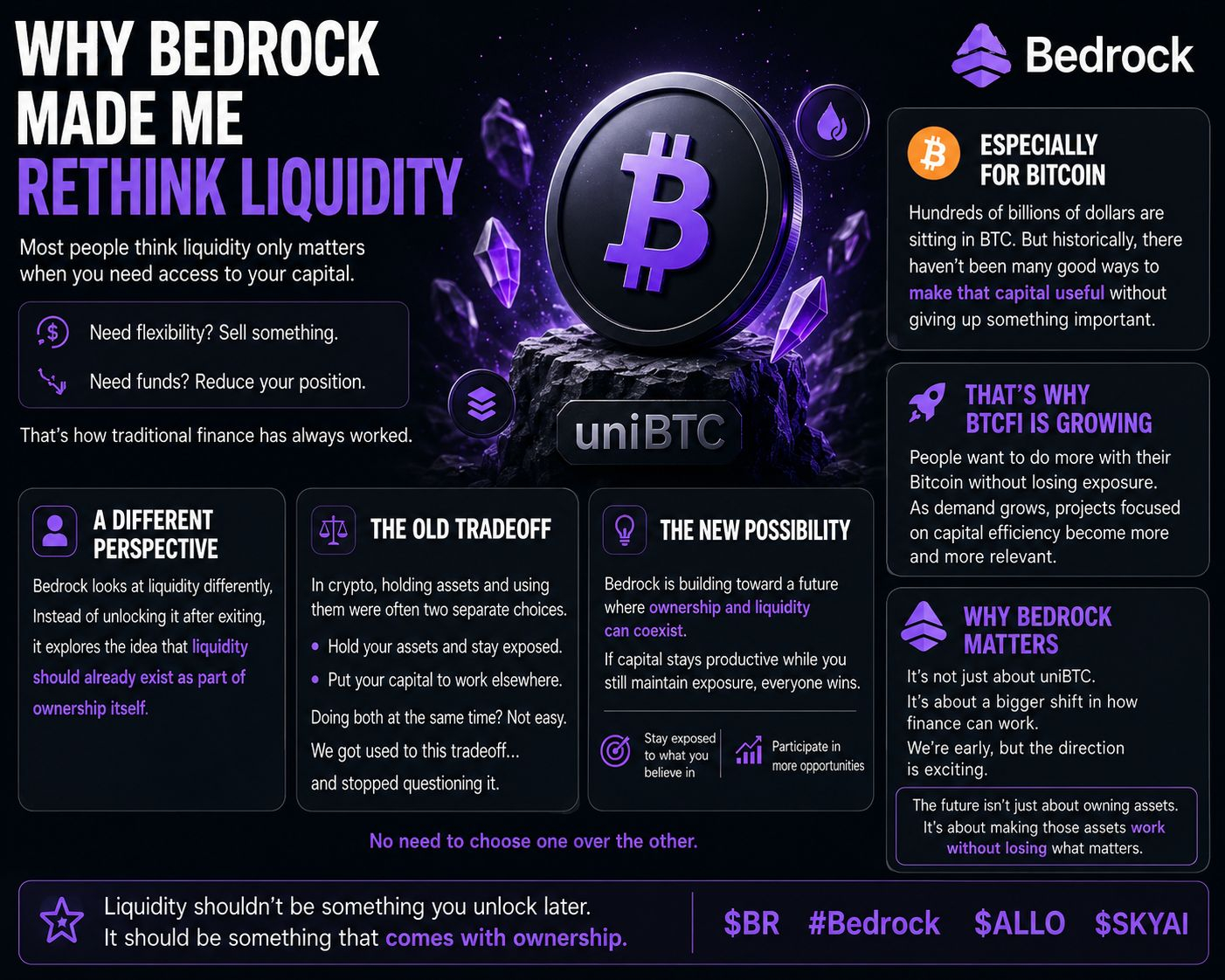
One thing I've noticed is that most people think about liquidity in a very traditional way.
The common belief is simple: if you need access to your capital, you sell something. If you want flexibility, you reduce your position. That's how investing has worked for decades, and naturally many of us carried the same mindset into crypto.
But recently I've been looking at Bedrock, and it made me think about liquidity from a different perspective.
Instead of treating liquidity as something you unlock after giving up ownership, Bedrock seems to explore the idea that liquidity should be part of ownership from the beginning. That concept is what really caught my attention.
For a long time, crypto users have had to make a choice. You either hold your assets and stay exposed to their potential growth, or you put those assets to work somewhere else to earn additional rewards. In many cases, doing both efficiently at the same time wasn't easy.
The interesting part is that most of us became so used to this tradeoff that we stopped questioning it.
Bedrock appears to be approaching the problem differently.
What stands out to me isn't just uniBTC itself. It's the bigger vision behind it. The idea that ownership and utility don't have to be separated could have a much larger impact than many people realize.
If capital can remain productive while you still maintain exposure to the underlying asset, the entire experience becomes more efficient. Instead of choosing between holding and participating, investors may be able to benefit from both.
And when we talk about Bitcoin, that becomes even more important.
There is an enormous amount of value sitting in BTC. Yet for most of Bitcoin's history, holders had limited options when it came to making that capital useful. You could hold it and wait, but generating additional utility from your Bitcoin often required compromises that many investors weren't comfortable with.
That's one of the main reasons BTCFi has started gaining so much attention recently.
People are looking for ways to do more with their Bitcoin without necessarily giving up their long-term conviction. As demand for that grows, projects focused on improving capital efficiency naturally become more relevant.
That's where Bedrock enters the conversation.
I'm not saying it has all the answers, and it's still early to know exactly how this space will evolve. But I do think the direction is interesting. The idea that liquidity and ownership can exist together challenges a lot of assumptions that investors have followed for years.
Maybe that's why I've been paying closer attention to projects like Bedrock.
Because the future of crypto probably isn't just about owning assets. It's about finding smarter ways to make those assets work while still keeping exposure to what you believe in.
And if that trend continues, Bedrock could end up being part of a much bigger shift happening across the industry.
#NasdaqWorstDayInOverAYear #JPMorganBofACitiPlanTokenizedDepositNetwork #ZcashUnlimitedMintingFlawFound #BitcoinBounceBackAbove$61K