
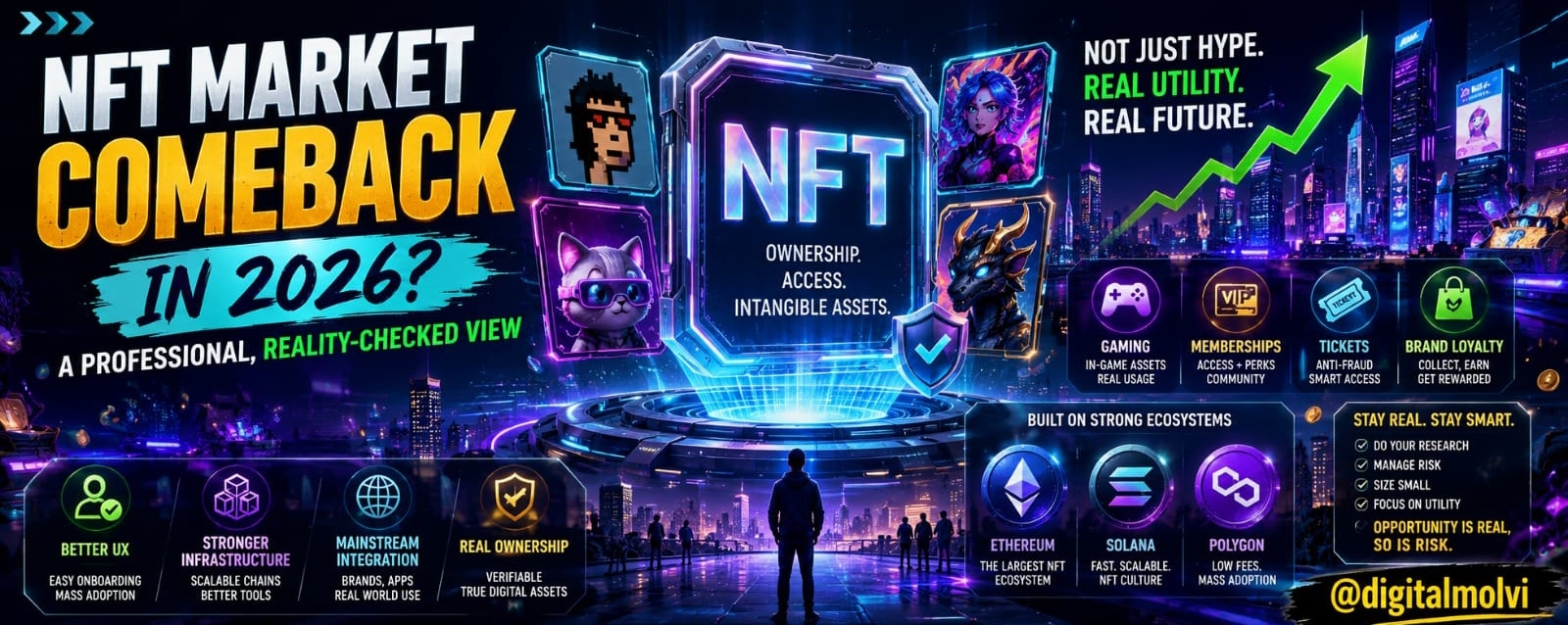
NFTs have already lived through a full hype cycle: explosive growth, oversupply, collapsing floor prices, and a long period of low confidence. Now the question many investors are asking in 2026 is simple: is the NFT market setting up for a comeback—or is it permanently broken?
A professional answer is: NFTs can come back, but the next cycle will likely look different. The market is shifting away from “profile picture speculation” toward NFTs as infrastructure for ownership, access, gaming assets, and brand distribution. That doesn’t mean every collection will recover—most won’t. But it does mean the category can regain relevance if real utility and better user experience drive demand.
1) What Would Actually Drive an NFT Comeback?
A sustainable NFT rebound usually needs at least a few of these forces working together:
A) Better user experience (UX) and onboarding
The last cycle was too complicated for mainstream users (wallet setup, gas fees, signing risks). A comeback becomes more likely when:
wallets are simpler
marketplaces feel like normal apps
payments (including stablecoins/fiat rails) are smoother
B) Gaming and digital items with real usage
NFTs make the most sense when they are used, not just held:
in-game skins/items
tradable assets inside ecosystems
creator economies where ownership unlocks perks
If a game or platform has real daily active users, NFTs can become a natural layer for ownership and trading.
C) Brands, tickets, memberships, and loyalty
NFTs can work as:
event tickets (anti-fraud + resale rules)
memberships (access + perks)
loyalty programs (collectibles tied to real benefits)
This is less “get rich quick” and more “digital product + community.”
D) A broader crypto bull market
NFTs are still a risk-on asset. Historically, they perform best when:
liquidity is expanding
traders are confident
majors (BTC/ETH) are strong and volatility is constructive
2) What’s Different This Time (If a Comeback Happens)
The next NFT wave is likely to be more selective:
Quality over quantity: fewer collections matter, more of the rest go to zero.
Utility + distribution wins: projects with real users, strong IP, or platform integration outperform.
Royalties and marketplace dynamics: creators and marketplaces are still figuring out sustainable economics.
Regulatory and compliance awareness: teams will be more careful about how NFTs are marketed and sold.
In short: the “everything pumps” era is less likely. The “winners take most” era is more likely.
3) Key Risks (Don’t Ignore These)
Even if NFTs rebound, the risks remain serious:
Liquidity risk: floors can drop fast when buyers disappear.
Oversupply: too many collections, not enough lasting demand.
Wash trading / fake volume: some NFT volume can be inflated.
Security risk: phishing, fake mints, malicious signatures.
Narrative risk: attention can rotate away quickly to memes, AI, or other sectors.
Professional approach: treat NFTs as high-risk satellite exposure, not a core portfolio.
4) How to Position Smartly (Without Overexposure)
If you want NFT exposure with a more conservative mindset:
Prefer infrastructure over random collections
Instead of betting on one collection, consider the ecosystems that benefit from NFT activity.
Focus on chains where NFTs actually trade
Follow real marketplace activity, not just Twitter hype.
Size small, scale in
NFTs can be extremely volatile—small sizing protects you from permanent damage.
Have an exit plan
Decide in advance: are you holding for utility, or trading for profit?
5) 3 Big Coins Related to an NFT Comeback (Last Mein)
Here are three major coins that are commonly linked to NFT market activity and infrastructure:
ETH (Ethereum) – The largest NFT ecosystem historically, with major marketplaces, collections, and deep liquidity.
SOL (Solana) – Strong NFT trading culture and fast/low-cost transactions, often favored for high-frequency NFT activity.
MATIC (Polygon) – Widely used for consumer/brand NFT drops due to lower fees and broad integrations.
(Not financial advice—just the most directly connected large ecosystems.)
Final Take
An NFT comeback is possible in 2026, but it likely won’t be a repeat of the old PFP mania. The stronger thesis is NFTs as digital ownership rails for gaming, communities, tickets, and brands—supported by better UX and a healthier crypto liquidity environment. If you want exposure, think like a professional: prioritize ecosystems, manage risk, and avoid illiquid hype.
#NFTMarket #Ethereum #solana #BinanceSquare #digitalmolvi

