
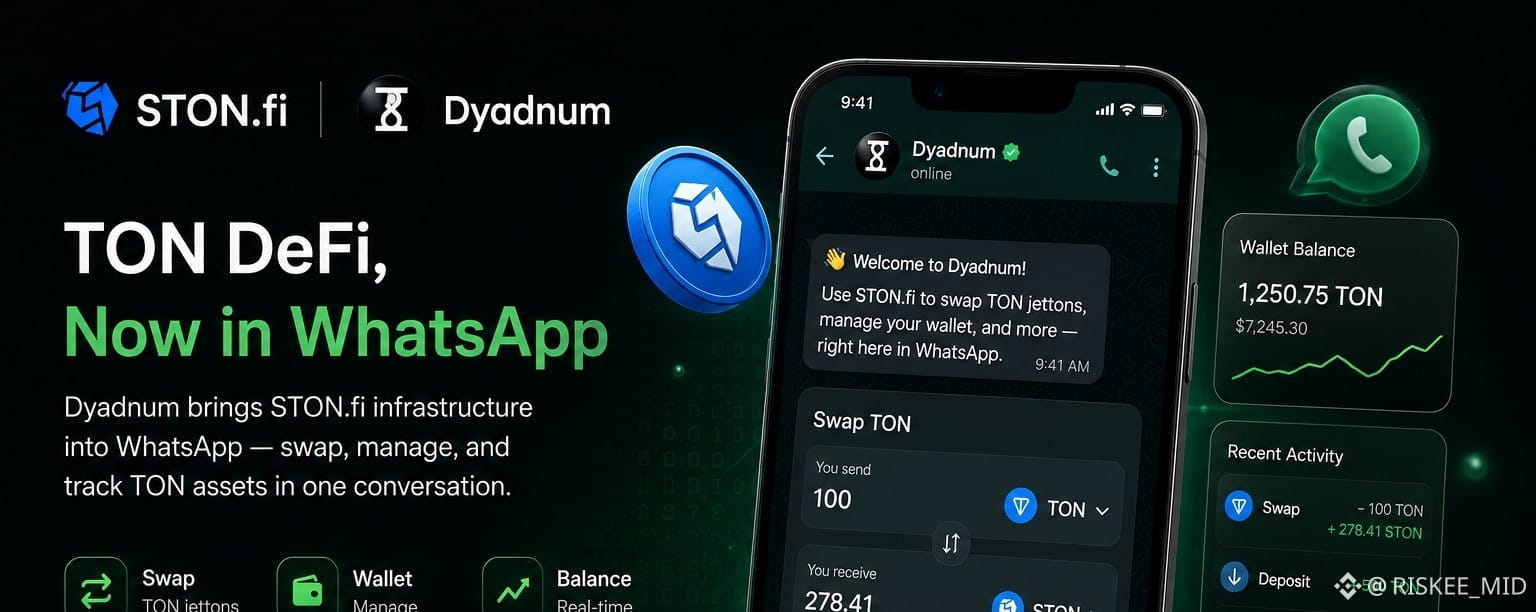
STON.fi Extends TON DeFi Beyond Telegram: What the WhatsApp Integration Signals
Introduction
TON-based DeFi is entering a new phase of adoption, one where blockchain functionality is no longer confined to dedicated crypto applications. Instead, decentralized finance services are gradually becoming embedded into platforms that people already use every day.
A recent example of this trend is the integration between Dyadnum and STON.fi infrastructure, which brings TON swaps directly into WhatsApp conversations. While the feature itself is noteworthy, the broader significance lies in what it reveals about the future direction of TON infrastructure and user onboarding.
Bringing TON Swaps Directly Into WhatsApp
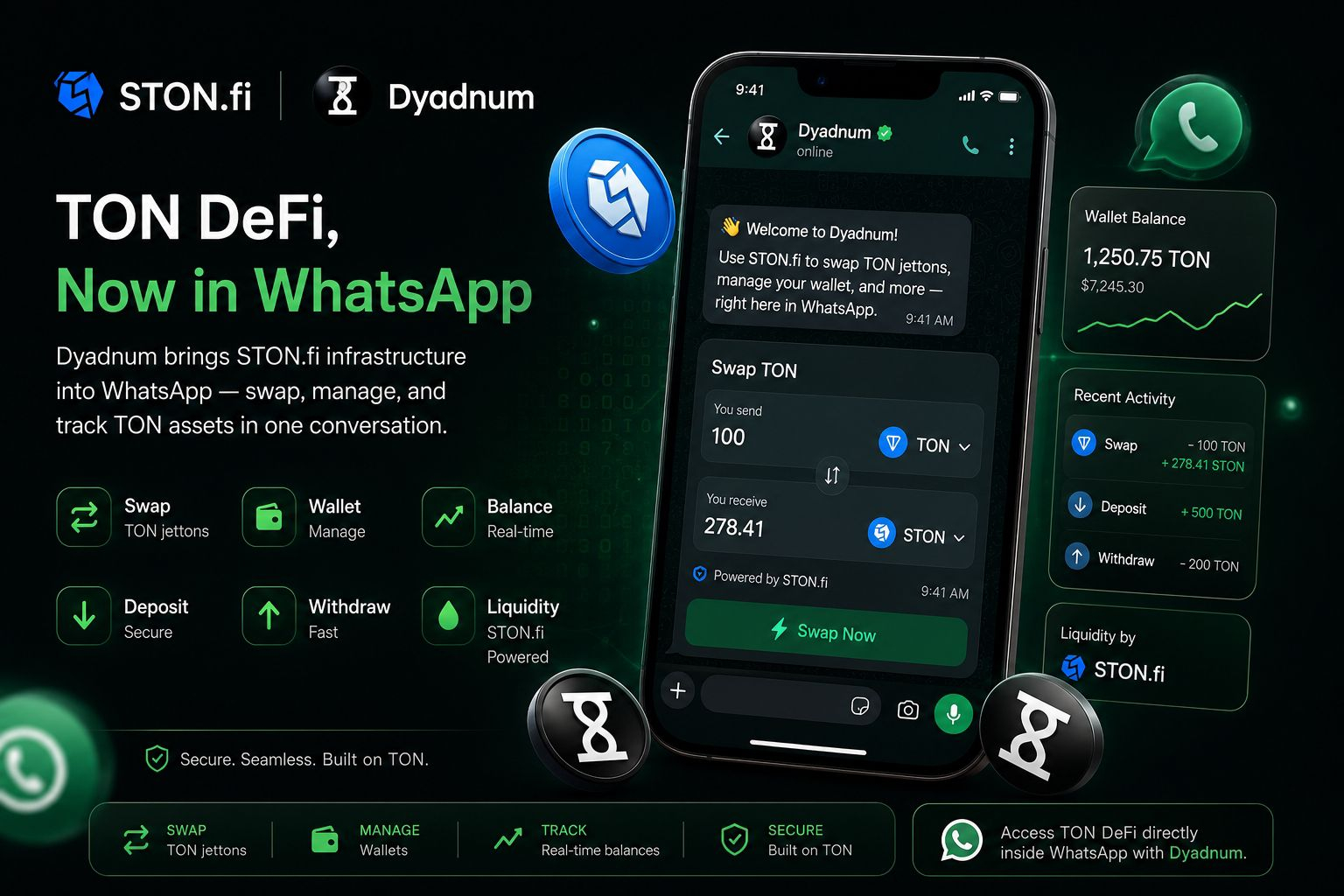
The Dyadnum integration allows users to interact with TON-based assets without relying on traditional DeFi interfaces.
Through WhatsApp, users can:
Swap TON jettons directly inside conversations
Manage wallets through a simplified workflow
Monitor balances in real time
Deposit and withdraw assets
Access optimized swap execution powered by STON.fi liquidity routing
Rather than navigating multiple applications, connecting wallets across different interfaces, and switching between platforms, users can complete key DeFi actions within a familiar messaging environment.
This significantly reduces friction and creates a more intuitive experience for both existing crypto users and newcomers.
Why User Experience Matters
One of the biggest barriers to DeFi adoption has always been complexity.
Many first-time users are required to:
Install specialized wallets
Learn new interfaces
Understand gas fees
Navigate decentralized exchanges
Manage multiple application layers
For experienced users, these steps may feel routine. For newcomers, they often become major obstacles.
Embedding DeFi directly into messaging platforms changes this dynamic. Users no longer need to actively seek out crypto applications. Instead, blockchain functionality becomes available inside environments they already understand.
This creates a smoother onboarding process and reduces the learning curve associated with decentralized finance.
STON.fi's Evolution Beyond a Traditional DEX
STON.fi has established itself as one of the leading liquidity protocols within the TON ecosystem.
However, its recent infrastructure developments suggest that the project is expanding beyond the role of a conventional decentralized exchange.
The introduction of Omniston and related routing infrastructure demonstrates a larger vision:
Building a liquidity layer that can power external applications, wallets, bots, and communication platforms.
Instead of requiring users to visit STON.fi directly, developers can integrate liquidity access into their own products while leveraging STON.fi's execution and routing capabilities behind the scenes.
This transforms STON.fi from a standalone application into foundational infrastructure for the broader TON ecosystem.
The Rise of Embedded DeFi
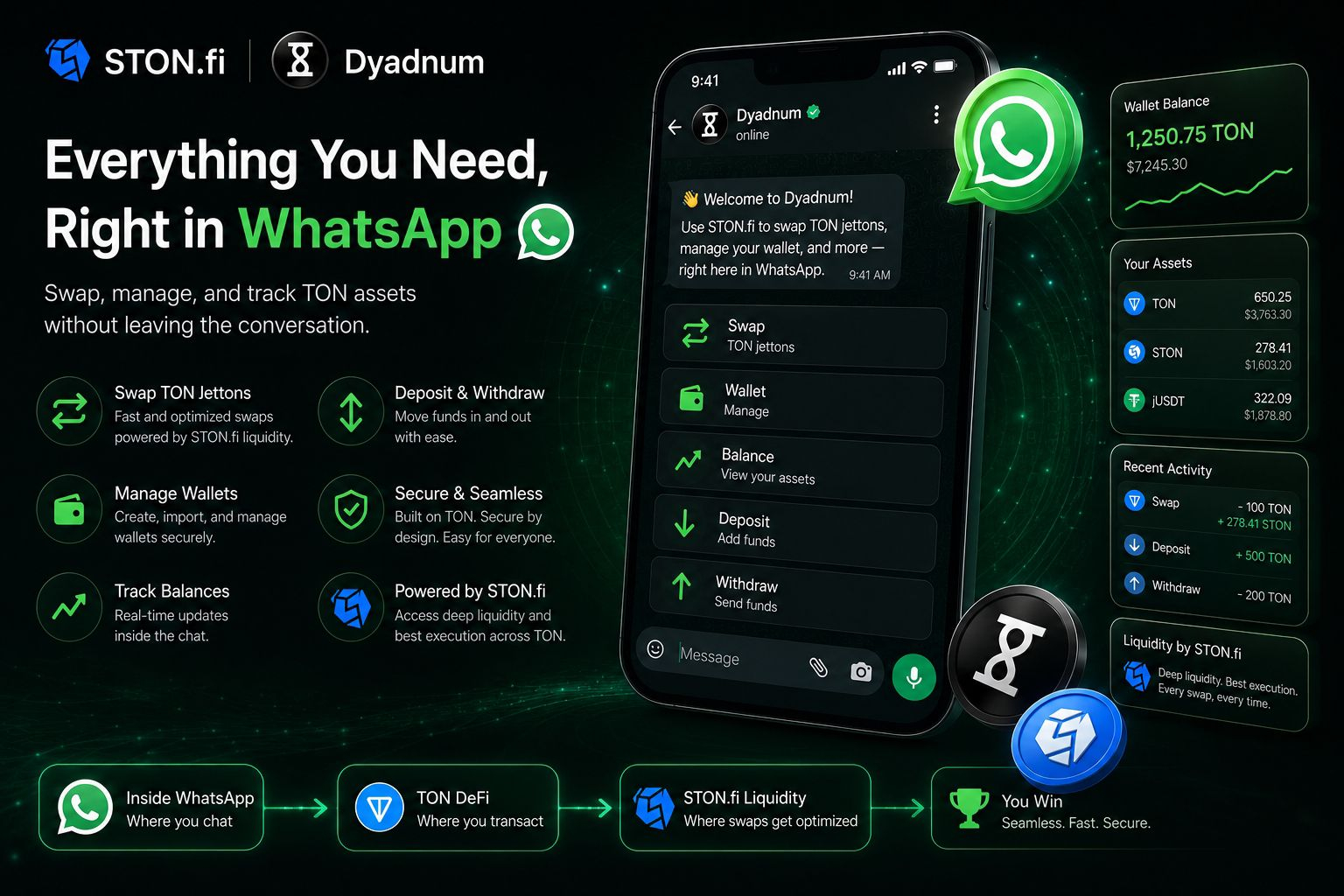
The Dyadnum integration highlights a growing trend across the blockchain industry: embedded finance.
Historically, DeFi applications functioned as isolated destinations where users traveled to perform transactions.
The next generation of infrastructure is reversing that model.
Rather than bringing users to DeFi, DeFi is being brought to users.
Messaging applications, social platforms, wallets, and consumer products are increasingly becoming direct access points for on-chain activity.
In this model:
Conversations become transaction channels
Wallets become invisible infrastructure
Liquidity becomes accessible anywhere
Blockchain interactions become more natural
The WhatsApp integration serves as an early example of this transformation.
What This Means for the TON Ecosystem
TON has consistently focused on accessibility and mainstream adoption.
Much of its growth has been driven by products that simplify blockchain interactions through familiar digital experiences.
The expansion of liquidity infrastructure into external communication platforms aligns closely with that vision.
As integrations like Dyadnum emerge, the ecosystem gains:
Easier onboarding pathways
Greater accessibility for non-technical users
Wider distribution channels
Increased transaction activity
Stronger utility for TON-based assets
Most importantly, these integrations extend TON's reach beyond its native applications and into environments already used by millions of people daily.
Infrastructure Becomes the Product
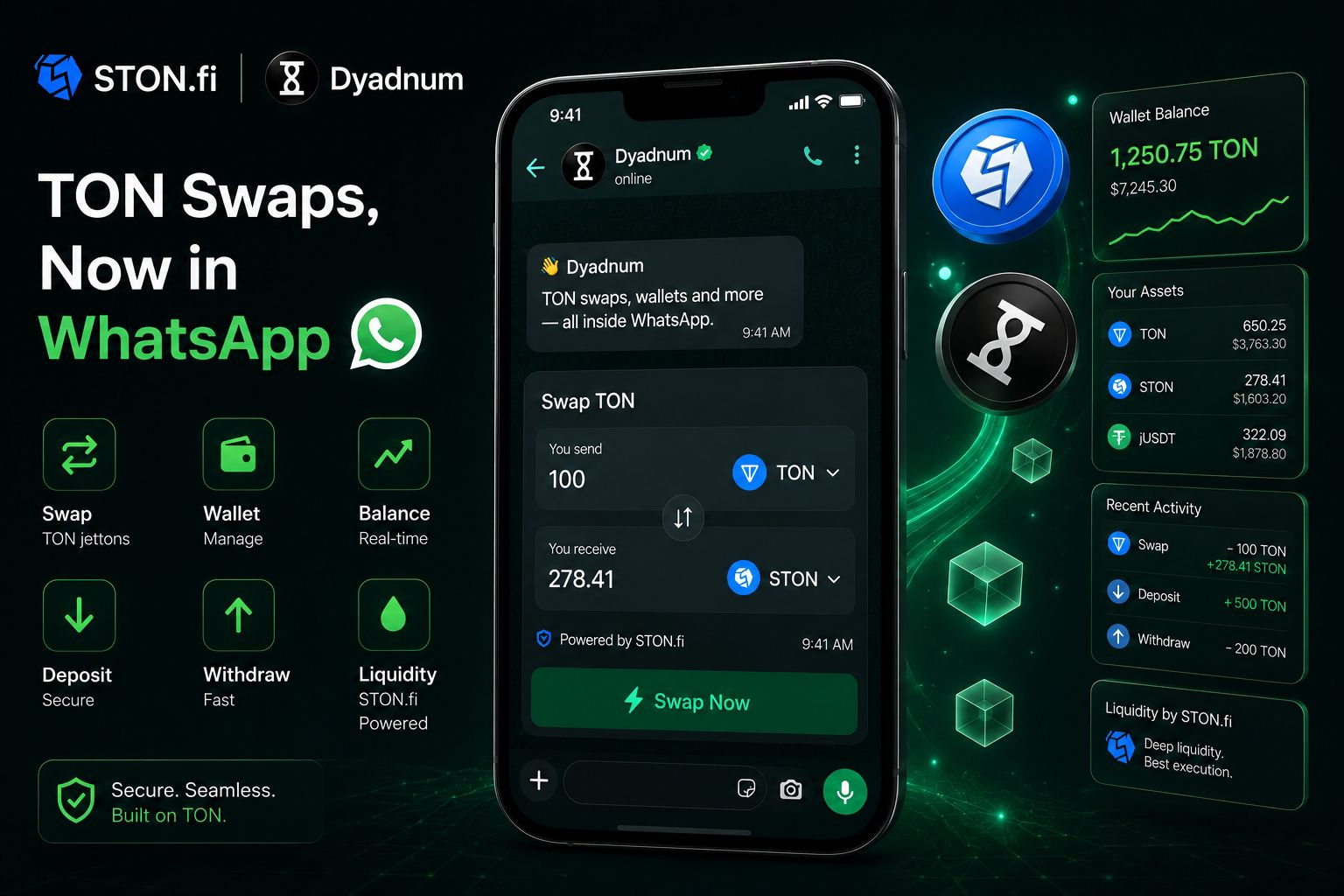
Perhaps the most important takeaway is that infrastructure itself is becoming the core product.
Users are increasingly less concerned with which protocol executes a trade and more concerned with whether the experience is fast, seamless, and reliable.
In this environment, liquidity networks and execution engines become the critical foundation powering user-facing applications.
STON.fi's expanding infrastructure strategy reflects this shift.
By positioning itself as a liquidity layer that can serve wallets, bots, applications, and messaging platforms, STON.fi is building for a future where DeFi functionality exists everywhere, even when users never directly interact with the underlying protocol.
Conclusion
The Dyadnum and STON.fi WhatsApp integration is more than a new swap interface.
It represents a broader evolution in how decentralized finance is delivered to users.
Instead of requiring people to enter dedicated crypto environments, TON infrastructure is increasingly embedding liquidity, execution, and wallet functionality into applications that users already engage with every day.
As this trend accelerates, messaging platforms may become some of the most important gateways to on-chain activity.
For STON.fi, the integration reinforces its growing role not just as a decentralized exchange, but as a foundational liquidity layer powering the next generation of TON-based applications and user experiences.
Trade now: open.dyadnum.com
| Explore more on STON.FI: app.ston.fi