
Imagine this.
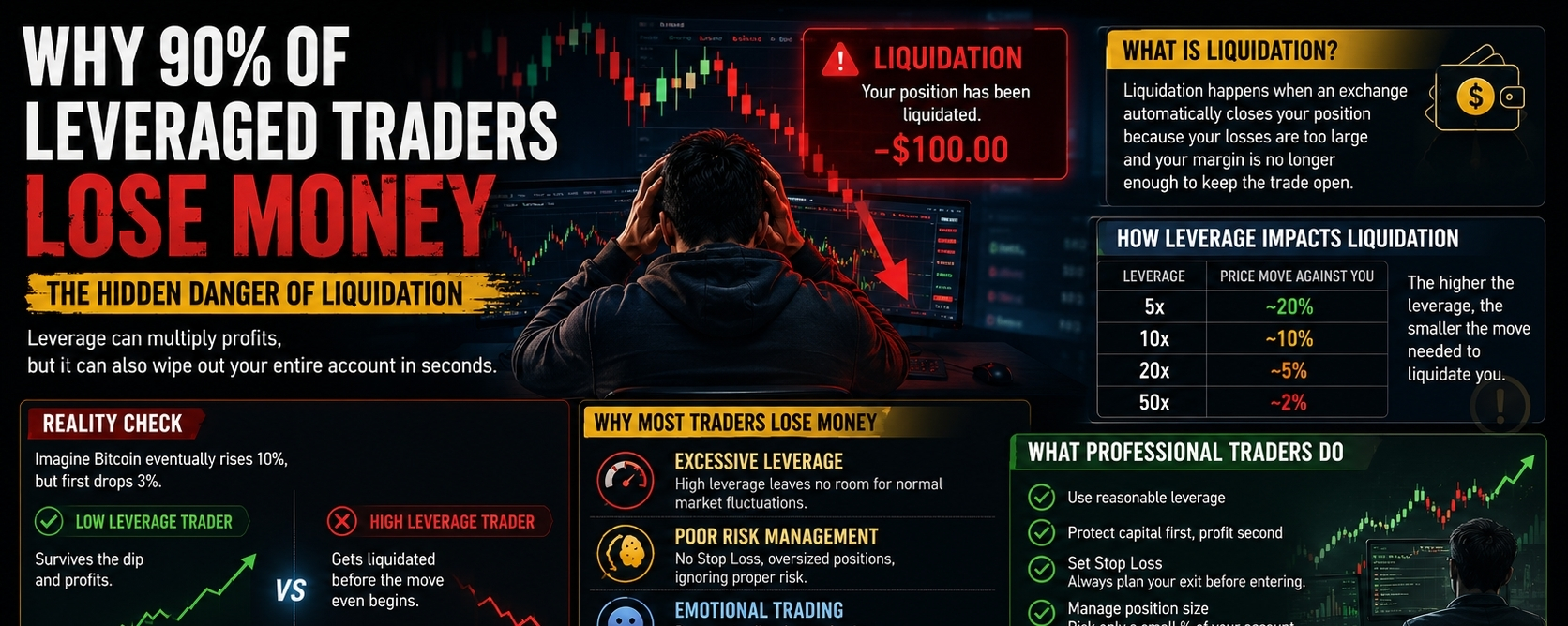
You have $100 in your futures wallet and you see Bitcoin moving up. Confident that the rally will continue, you open a 50x leveraged trade.
Suddenly, a small market dip appears.
Bitcoin falls just 2%.
You check your position and panic.
Your entire $100 is gone.
Welcome to the reality of liquidation.
Many beginners enter futures trading believing leverage is the fastest path to wealth. Social media is filled with screenshots of traders turning a few hundred dollars into thousands overnight. What most people don't see are the countless accounts that get wiped out every single day.
So what exactly is liquidation?
Liquidation happens when an exchange automatically closes your position because your losses have become too large. In simple terms, the market moves against you so much that there isn't enough margin left to keep your trade open.
The higher the leverage, the smaller the move needed to destroy your position.
For example:
A trader using 5x leverage has more room for price fluctuations.
A trader using 50x leverage can be liquidated by a relatively small market move.
This is why liquidation alerts appear constantly in crypto markets.
But here's the truth:
Most traders don't lose because of bad analysis.
They lose because of poor risk management.
Many traders correctly predict the market direction but still get liquidated because they use excessive leverage.
Imagine Bitcoin eventually rises 10%, but first drops 3%.
A trader using low leverage survives the dip and profits.
A trader using high leverage gets liquidated before the move even begins.
The market was right.
Their risk management was wrong.
Another major mistake is trading with emotions.
After a losing trade, many traders increase leverage hoping to recover quickly. Instead of reducing risk, they take even bigger positions.
This often creates a cycle of losses that ends with a blown account.
Professional traders think differently.
They focus on protecting capital first and making profits second.
Most successful traders use reasonable leverage, set stop losses, and never risk a large percentage of their account on a single trade.
They understand that surviving the market is more important than winning every trade.
The goal of trading is not to get rich overnight.
The goal is to stay in the game long enough to let good decisions compound over time.
Before opening your next leveraged trade, ask yourself one question:
Are you trading to make money, or are you gambling with leverage?
That single question could save your account from becoming the next liquidation statistic.