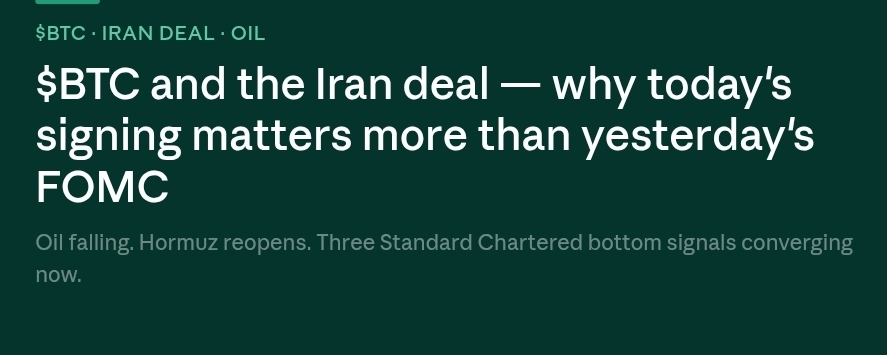
I said this in yesterday's package and I'll say it again today because the sequence of events has validated it exactly: everyone was watching the Fed, but the Iran deal was always the more important catalyst for btc near-term trajectory.
The formal peace agreement was signed in Geneva today. The formal US-Iran peace signing on June 19 remains the one near-term macro tailwind. The recovery from the $59,130 May low is not over — but it just hit a significant speed bump with yesterday's FOMC. The Block
Here's why the signing matters more than Warsh's press conference for $BTC #Bitcoin specifically. The Fed delivered a hawkish surprise, which is bad. But it's a known bad now, fully priced, and the rate trajectory is based on inflation data. The Iran deal directly attacks that inflation data. Oil falling after the Strait of Hormuz reopens pulls energy prices down, which pulls headline CPI down, which gives the Fed less justification for the hike that 66% of prediction markets are currently pricing for later this year.
The one consolation for crypto is that none of this is a surprise anymore. The real test comes at the July meeting, where those hike odds will either keep climbing or fade depending on whether the post-deal slide in oil starts pulling headline inflation down with it. Substack
Standard Chartered said they're watching three signals for the cycle bottom. $MSTR #Strategy resuming purchases — check. ETF inflows turning positive — tentative check. Oil continuing to fall — this one is now very much in play as the Hormuz reopens fully for commercial shipping.
All three of those signals converging simultaneously, today, on the same day as the signing, is not noise. It's the setup that people who've been waiting for a clear re-entry signal into $BTC #Bitcoin have been looking for since May.
$BTC #Bitcoin #Iran #Geopolitics #MacroTrading
DYOR. Not financial advice