

#USJobsData
⸻
MODEL OBJECTIVE
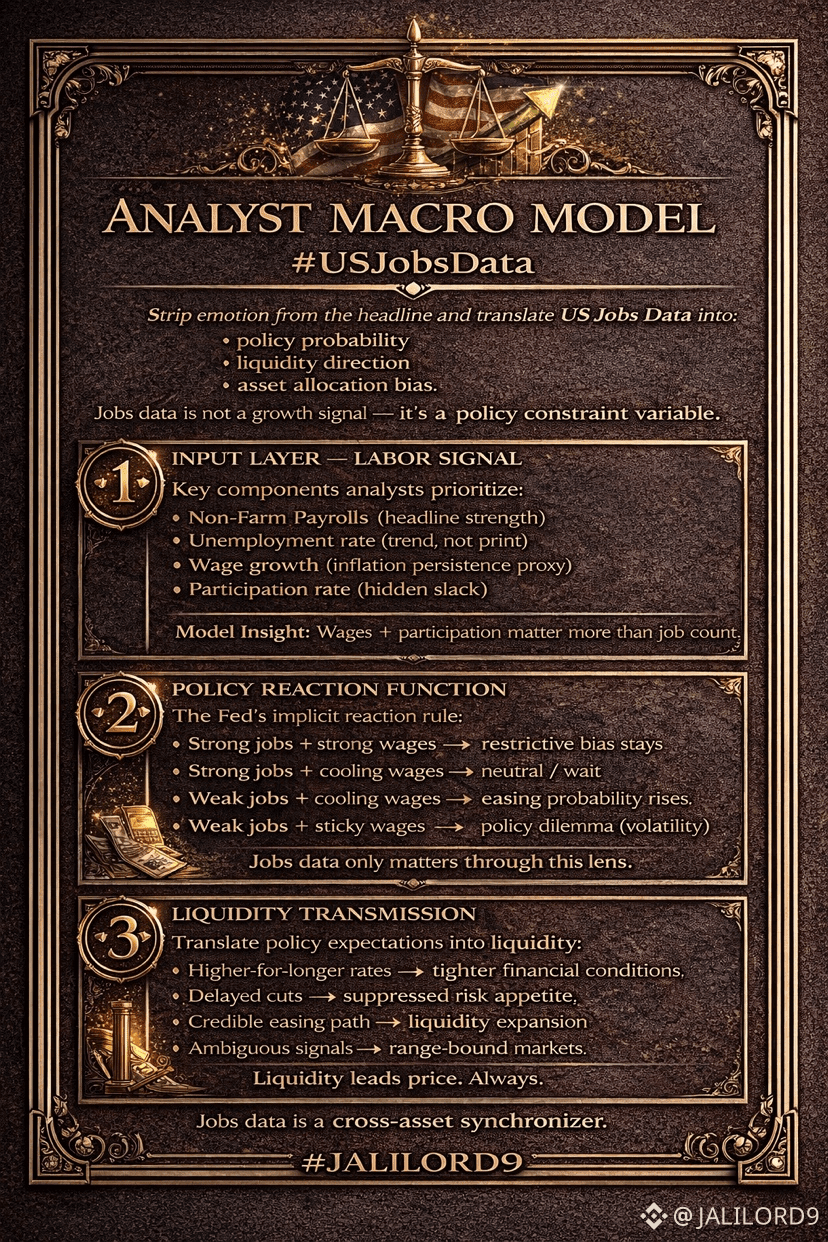
Strip emotion from the headline and translate US Jobs Data into:
• policy probability
• liquidity direction
• asset allocation bias
Jobs data is not a growth signal — it’s a policy constraint variable.
⸻
🧠 1️⃣ INPUT LAYER — LABOR SIGNAL
Key components analysts prioritize:
• Non-Farm Payrolls (headline strength)
• Unemployment rate (trend, not print)
• Wage growth (inflation persistence proxy)
• Participation rate (hidden slack)
Model Insight:
Wages + participation matter more than job count.
⸻
⚖️ 2️⃣ POLICY REACTION FUNCTION
The Fed’s implicit reaction rule:
• Strong jobs + strong wages → restrictive bias stays
• Strong jobs + cooling wages → neutral / wait
• Weak jobs + cooling wages → easing probability rises
• Weak jobs + sticky wages → policy dilemma (volatility)
Jobs data only matters through this lens.
⸻
💵 3️⃣ LIQUIDITY TRANSMISSION
Translate policy expectations into liquidity:
• Higher-for-longer rates → tighter financial conditions
• Delayed cuts → suppressed risk appetite
• Credible easing path → liquidity expansion
• Ambiguous signals → range-bound markets
Liquidity leads price. Always.
⸻
📉 4️⃣ ASSET CLASS RESPONSE MATRIX
• Equities: Sensitive to wage-driven rate expectations
• Bonds: React first, confirm later
• USD: Strengthens with restrictive bias
• Crypto: Trades liquidity expectations, not jobs
• Gold: Benefits from policy credibility loss
Jobs data is a cross-asset synchronizer.
⸻
🧩 5️⃣ VOLATILITY FILTER
High volatility conditions emerge when:
• headline beats but revisions disappoint
• wages surprise while payrolls miss
• participation shifts suddenly
These are false-confidence zones where positioning gets punished.
⸻
📊 MODEL OUTPUT
Bullish risk regime:
✔ Cooling wages
✔ Stable employment
✔ Rising easing probability
Bearish risk regime:
✖ Hot wages
✖ Policy delay
✖ Tight liquidity
Neutral/chop regime:
➖ Mixed labor signals
➖ Fed ambiguity
➖ Range-bound positioning
⸻
🧠 ANALYST CONCLUSION
#USJobsData is not a directional trade by itself.
It is a macro input that:
• shapes policy probabilities
• dictates liquidity expectations
• filters risk-on vs risk-off regimes
Analysts don’t trade the number.
They trade the second-order effects.
⸻

🌎🌎🌎🌎🌎🌎🌎🌎🌎🌎🌎🌎🌎🌎🌎🌎🌎