
Core Qualities: Infrastructure, Erasure Coding, Scalability
The digital age has long been reliant on centralized cloud storage providers, creating single points of failure and censorship risks. The @Walrus 🦭/acc represents a paradigm shift in this landscape. Built on the high-performance Sui blockchain, Walrus is not merely a storage solution; it is a sophisticated decentralized infrastructure layer designed to handle "blobs"—large unstructured data files—with unprecedented efficiency. By leveraging advanced cryptographic techniques and the unique properties of the Sui network, Walrus offers a robust alternative to traditional cloud services, specifically engineered for the needs of decentralized finance (DeFi), Web3 applications, and enterprise-grade data management.
Architecture of Resilience: The Sui Advantage
At the heart of the Walrus protocol is its strategic integration with the Sui blockchain. Unlike standalone storage networks that must bootstrap their own consensus security from scratch, #walrus leverages the established security and speed of Sui. This integration allows Walrus to decouple the storage of raw data from the coordination of that data.
Sui serves as the control plane for Walrus. It manages the metadata—the "receipts" of storage—and handles the financial settlement via the WAL token, while the actual heavy lifting of storing binary large objects (blobs) is distributed across a vast network of independent storage nodes. This separation of concerns allows the protocol to achieve lightning-fast transaction finality for storage requests. When a user uploads a file, the proof of its existence and availability is anchored on Sui, inheriting the blockchain's immutability and censorship resistance. This architecture ensures that while the data itself is distributed off-chain for efficiency, the "truth" of that data’s ownership and integrity is secured on-chain.
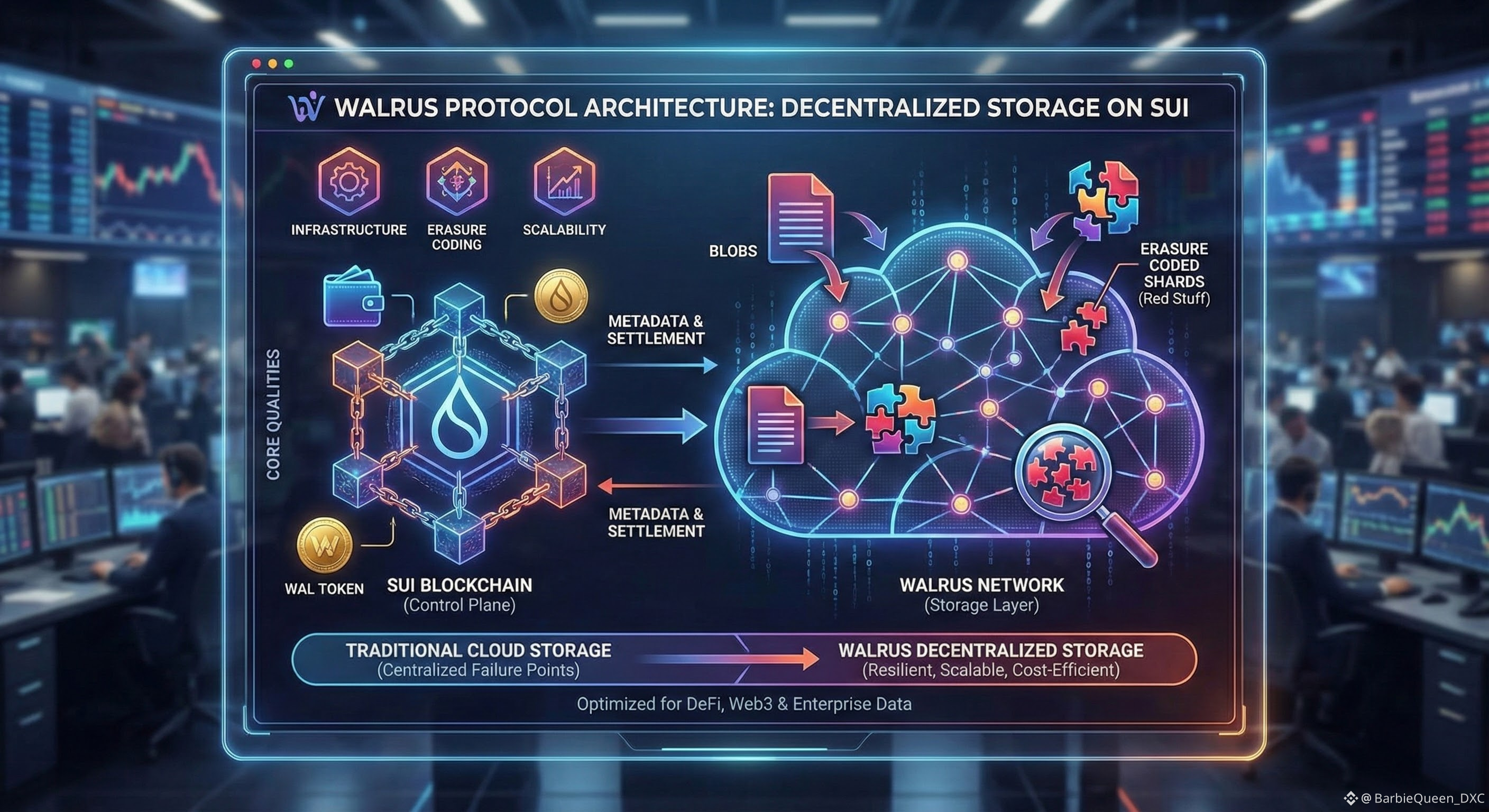
Erasure Coding and "Red Stuff": A Leap in Efficiency
The technical crown jewel of the Walrus protocol is its implementation of advanced erasure coding, often referred to within the ecosystem as "Red Stuff" (a reference to the specialized 2D encoding algorithms used). Traditional decentralized storage often relies on full replication—storing complete copies of a file on multiple nodes. While secure, this method is highly inefficient and expensive, requiring 3x to 5x the storage capacity for every file.
Walrus utilizes Fountain codes and a two-dimensional erasure coding scheme to fragment data into smaller pieces. These fragments are mathematically encoded such that the original file can be reconstructed from only a fraction of the total shards. For instance, if a file is split into 100 shards and distributed across the network, a user might only need to retrieve any 30 of them to perfectly reconstruct the original file.
This approach drastically reduces the storage overhead (and consequently the cost) while increasing resilience. If a significant percentage of storage nodes go offline or are seized, the data remains retrievable as long as the minimum threshold of shards is available. This "Red Stuff" architecture makes Walrus exceptionally resistant to node churn, a common issue in decentralized networks where amateur node operators may frequently join and leave the network.
Scalability and Blob Storage Optimization
Walrus is explicitly optimized for "blob" storage. In the context of blockchain and computing, a blob (Binary Large Object) refers to large, unstructured data such as images, videos, audio files, and complex application code. Most blockchains are terrible at storing blobs; storing a 1MB image on Ethereum, for example, would cost thousands of dollars.
Walrus solves this by acting as a specialized side-layer for this data. It allows dApps (Decentralized Applications) to store their heavy assets on Walrus while keeping their lightweight logic on Sui. This creates a symbiotic relationship where high-throughput DeFi platforms can maintain rich user interfaces and complex datasets without clogging the main execution layer. The protocol’s scalability is theoretically infinite; as more nodes join the network to earn WAL tokens, the total storage capacity and retrieval bandwidth of the system increase. This horizontal scalability ensures that Walrus can support not just static files, but the dynamic, high-bandwidth needs of the next generation of the internet, including decentralized social media platforms and AI model training data.
#walrus @Walrus 🦭/acc #WAL $WAL

