
The Dusk whitepaper, authored by a team of experts including Marta Bellés-Muñoz, Hein Dauven, Emanuele Francioni, and Federico Franzoni from Dusk in the Netherlands, outlines a groundbreaking blockchain designed to connect decentralized systems with traditional finance. Last updated on November 29, 2024, this document highlights how DusK tackles key challenges like privacy protection, regulatory alignment, and high-performance needs in finance. As a privacy-oriented, compliance-ready platform, $DUSK incorporates advanced features such as hidden transactions that remain auditable,quick finality through its unique consensus, and an efficient communication setup. This makes it a strong fit for financial sectors demanding both speed and security.
Introduction: Bridging Decentralization and Traditional Finance
Blockchain has opened doors to secure, decentralized operations across industries, particularly finance, but striking a balance between openness and confidentiality remains tough, especially for sensitive data. DUSK steps in as a specialized protocol for regulated markets, offering scalability, privacy, and adherence to rules that traditional setups require. Unlike general platforms like Ethereum($ETH) or Bitcoin($BTC), which often struggle with private details, quick settlements, or efficiency in finance, Dusk builds in solutions from the ground up.
Platforms like Zcash and Monero have pioneered privacy with tools like zk-SNARKs and ring signatures to hide sender, receiver, and amounts, but they fall short on regulatory tools, audit features, or confidential smart contracts needed for finance. DUSK fills this void by blending these privacy advances with compliance essentials.
A standout feature is the succinct attestation consensus, delivering finality in seconds to match finance's fast pace, while keeping the network scalable and decentralized. The Kadcast protocol underpins communication for reliable, swift data spread. DUSK uses two transaction types: Moonlight for clear, account-style dealings and Phoenix for UTXO-based, optionally hidden transfers. This duo supports private finance without losing oversight, allowing regulators access while protecting public views.
Additionally, Dusk includes Zedger for confidential contracts focused on securities and financial tools, ensuring they meet legal standards while keeping executions private. Overall, Dusk creates infrastructure that fits finance's rules.
Compared to Ethereum(ETH) or Cardano(ADA), Dusk prioritizes regulatory fit with built-in privacy, unlike Ethereum's transparency issues or add-on fixes like zk-rollups. Against Zcash or Monero, it adds compliance for sectors like trading or audits.
The whitepaper structures as: Kadcast P2P (Section 2), SA consensus (Section 3), transaction models (Section 4), energy efficiency (Section 5), implementation (Section 6), and wrap-up (Section 7).
Here's a visual of a privacy-focused blockchain network:
And another diagram showing blockchain bridging TradFi and DeFi:
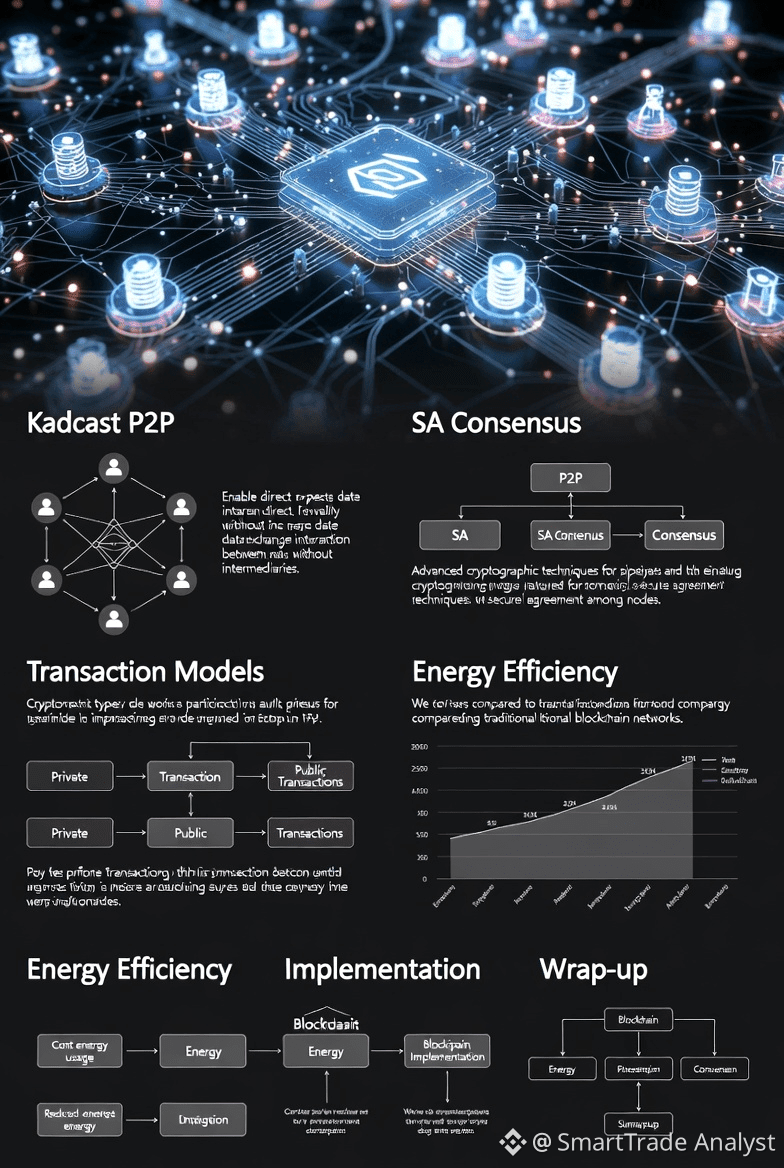

Peer-to-Peer Communication: The Power of Kadcast
DUSK relies on Kadcast for P2P messaging to spread blocks, transactions, and votes efficiently. Built on Kademlia's DHT, Kadcast cuts redundancy and delays common in older P2P systems, ideal for resource-limited, low-latency needs. Its design also aids privacy by masking message sources through indirect routing.
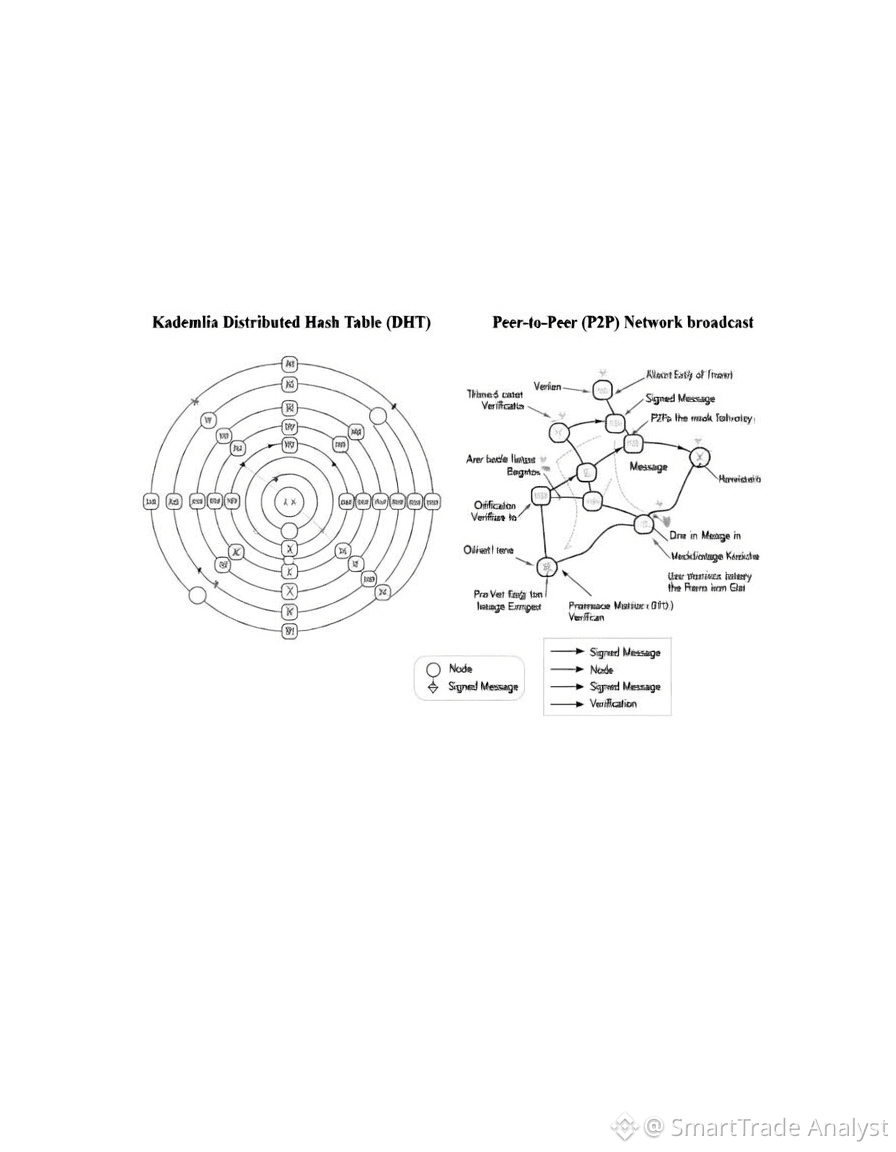
Kadcast organizes nodes hierarchically using XOR distance in routing tables divided into buckets for peer info at varying distances. This setup means distant nodes need fewer hops, speeding up propagation.
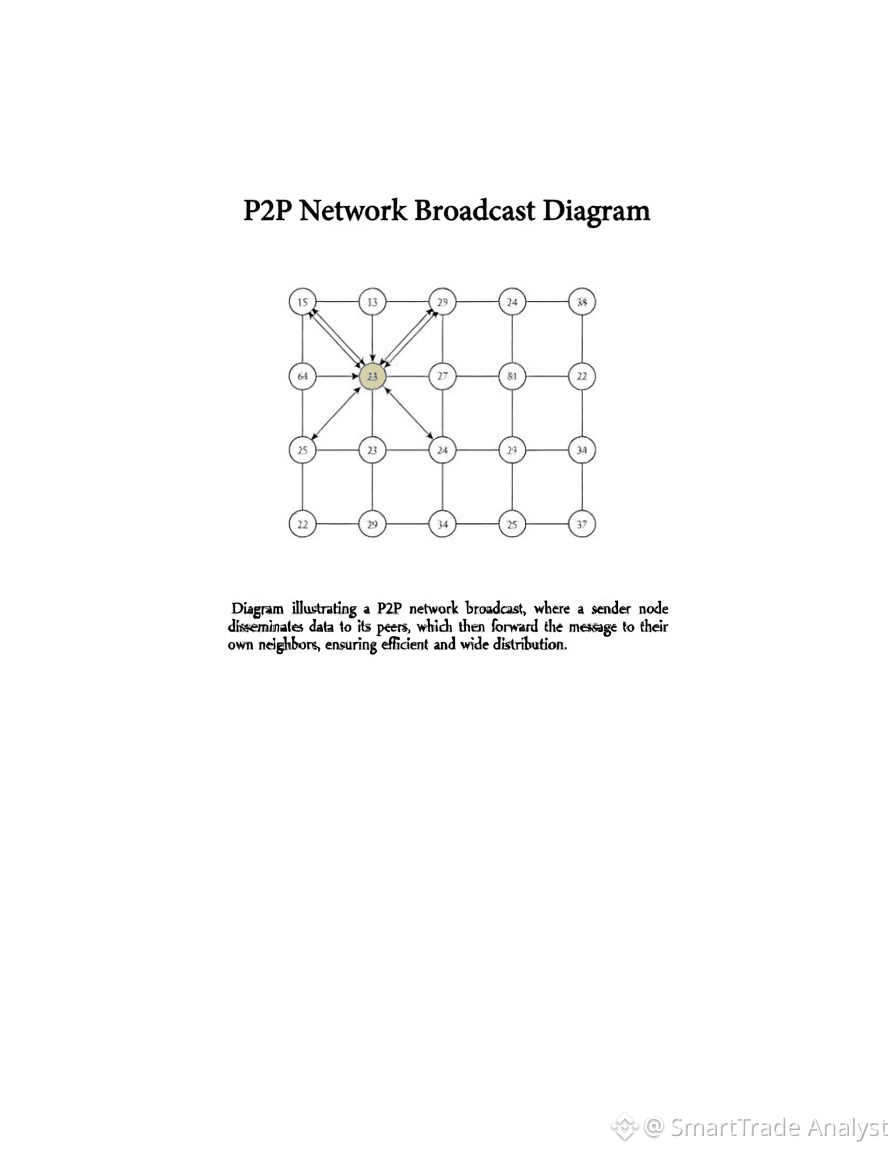
The broadcast innovation forwards messages only to chosen peers at growing XOR distances, creating a cascade that slashes bandwidth versus flooding or gossip methods where everything goes to all neighbors.
Multicast trees group nodes by DHT proximity; messages start close and fan out, covering the network with minimal relays and transmissions.
For resilience, Kadcast handles dynamic networks where nodes join/leave often by updating tables, removing failed peers, and using bucket multiples for backup paths, ensuring reliability in unpredictable decentralized settings.
Security-wise, it fights Sybil attacks with signed messages verified before forwarding, allowing only valid data through. Privacy benefits from propagation obscuring origins, crucial for $DUSK's confidential focus.
Visualize a Kademlia DHT structure:
And a P2P network broadcast diagram:
Consensus Mechanism: Succinct Attestation in Action
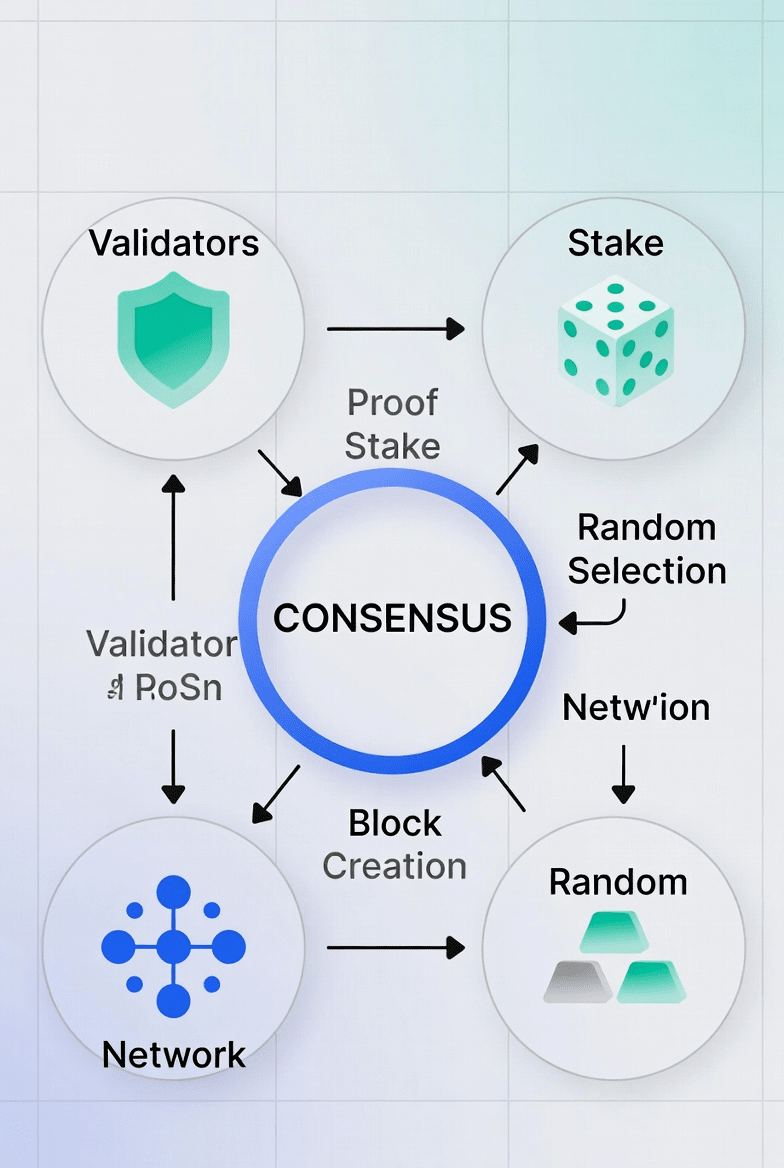
Succinct Attestation (SA) is $DUSK's permissionless, PoS consensus run by stakers called provisioners who generate/validate blocks. Using deterministic sortition (DS), it picks a single generator and unique committees per block in a fair, decentralized manner.
Provisioners stake at least 1000 DUSK via transactions, defined as (amount, height). They unstake similarly. Eligibility requires min stake and maturity: M = 2*epoch - (height mod epoch), with epoch=2160 blocks. Stakes eligible if amount >= min and round > height + M, syncing at epoch starts.
SA runs in rounds adding blocks, each with iterations generating candidates and agreeing. Max 50 iterations. Steps:
Proposal: DS picks generator to create/broadcast candidate. Outputs block or NIL on timeout.
Validation: DS committee votes Valid/Invalid/NoCandidate on candidate. Quorum: 2/3 Valid or 1/2+1 Invalid/NoCandidate. Outputs result with sigs or NoQuorum.
Ratification: Another committee confirms validation. Quorum: 2/3 Valid or 1/2+1 others. Success/Fail/unknown. Broadcasts quorum msg on Success/Fail.
Success ends round with new tip; Fail/unknown starts new iteration.
Committees: Provisioner arrays with 64 credits total, weighted votes. Ordered from 0. Votes BLS-signed, aggregated for efficiency. Bitsets verify subsets.
Attestations prove quorums: success (2/3 Valid) or fail (majority others), with sigs. Multiple possible, but blocks include unique certificate for rewards/penalties.
DS uses DE to pick proportionally to stake. DE iterates eligible list, compares weight to pseudo-random score. Selected if >=, else subtract and continue. Weight drops 1 DUSK per credit for balance. Score from SHA3 of prior seed, round/step, credit num. Seed: generator sig on prior seed, unpredictable.
Emergency mode after 16 fails: no timeouts, iterations indefinite till quorum. Open iterations concurrent, lowest wins on multiple. Last iteration: emergency block if majority stake requests, empty with new seed.
Fallback resolves forks: lowest iteration replaces higher. Iteration 0 safe from lower.
Rolling finality assesses stability via attestations:
Accepted: success but possible lower without fail.
Attested: success, all prior fail or iteration 0.
Confirmed: attested with attested/confirmed successor; accepted after 2*n attested/confirmed (n=non-attested priors).
Final: confirmed, parent final.
Incentives encourage participation: rewards from minted DUSK/fees (80% generator, 10% committee, 10% Dusk). Generator's 10% variable on votes included. Voters proportional to credits.
Mitigate future-generator issue: voter rewards, extra credits bonus, exclude next generator from voting, limit iterations.
Faults: minor (no candidate) = suspension/soft slash; major (invalid/double) = hard slash (burn stake), escalating.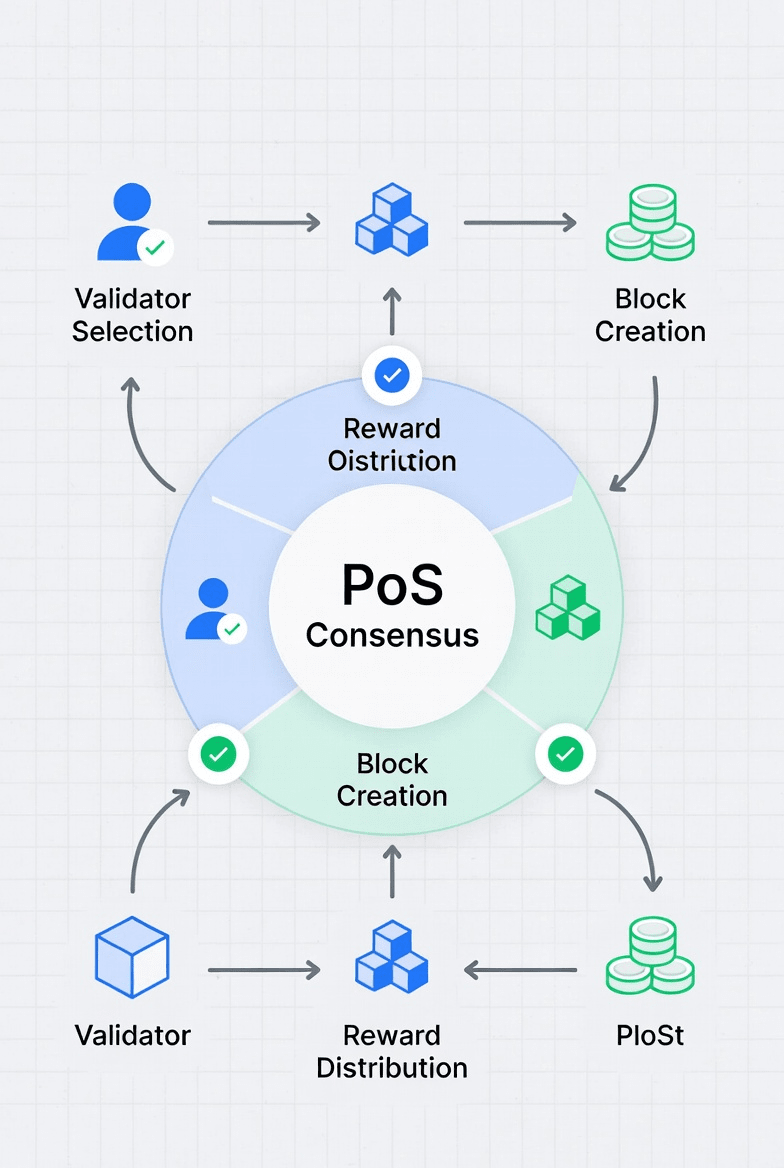
Transactions: Moonlight and Phoenix Explained
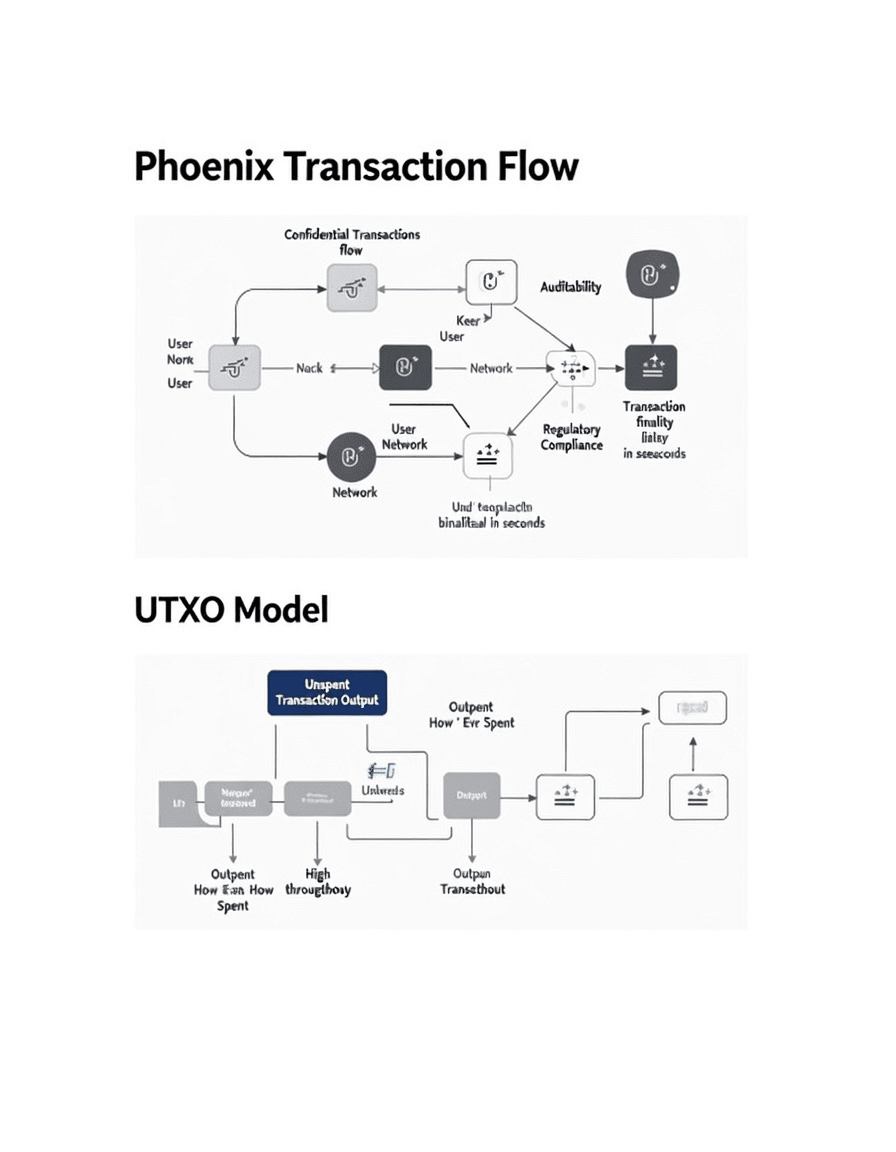
Transactions transfer DUSK, deploy/call contracts. Handled by transfer contract. Two models: Moonlight (transparent account) and Phoenix (UTXO, transparent/obfuscated).
Both ensure ownership, balance/fee integrity, no double-spend, no malleability.
Moonlight: Accounts with public keys, private for auth. Network tracks nonce/balance. Tx fields:from/to/value/nonce/deposit/data/gas_limit/price/signature. Checks: funds cover value/deposit/max gas, sig valid on hash, nonce next. Hash prevents malleability, nonce replays. On accept, update nonces/balances, refund unused gas/reverted amounts.
Security: sigs for unforgeability/malleability, public balances/network for balance/double-spend
Phoenix: Notes (UTXOs) in Merkle tree. Note public key from recipient public + random. Spend via nullifier from secret, added to list preventing reuse. Tree grows, nullifiers don't reveal note.
Notation: Jubjub curve G, generator G.
User keys: public (A,B), secret (a,b) with A=aG, B=bG; view (a,B).
Notes: type/com/enc/npk/R/enc_sender. Com commits value, enc decrypts with view. Npk = H(rA)G + B (R=rG). Enc_sender sender public.
Tx: root/nullifiers/new_notes/deposit/data/gas_limit/price/proof. Network verifies proof with public inputs (tx fields hash, max gas). Proof ensures nullifiers correct/unused, inputs cover outputs/deposit/max gas, new notes proper. On accept, addnullifiers/notes, process deposit/gas, new note for unused gas (sender public needed).
Note secret: nsk = H(aR) + b, npk = nskG.
Delegation: View keys for scanning (can't spend), sigs for proof gen (no compromise).
Security: Stealth addresses unlink, sigs/ZK unforgeable/malleable, nullifiers no double, ZK balance.
Phoenix transaction flow and UTXO model illustration:
Environmental Impact: Sustainable Design Principles
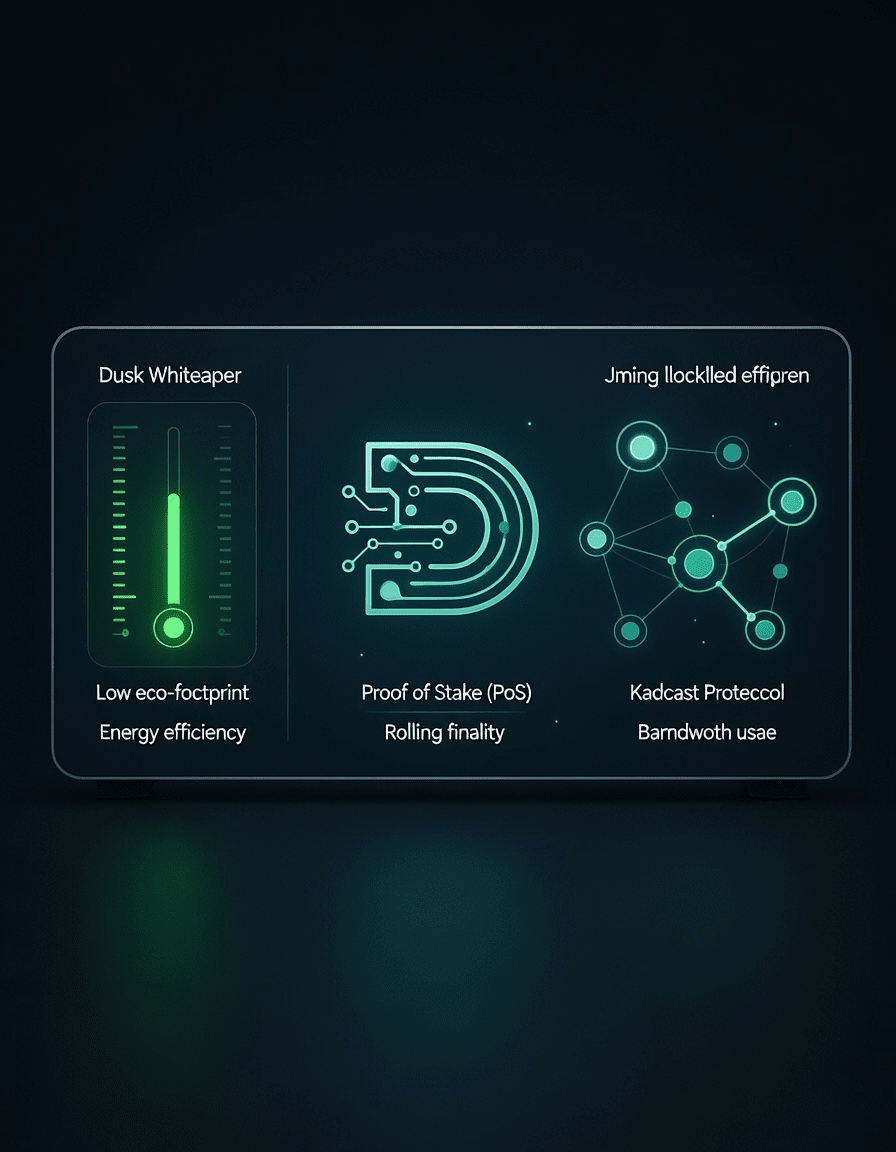
$DUSK minimizes eco-footprint while meeting finance demands, optimizing consensus, network, crypto.
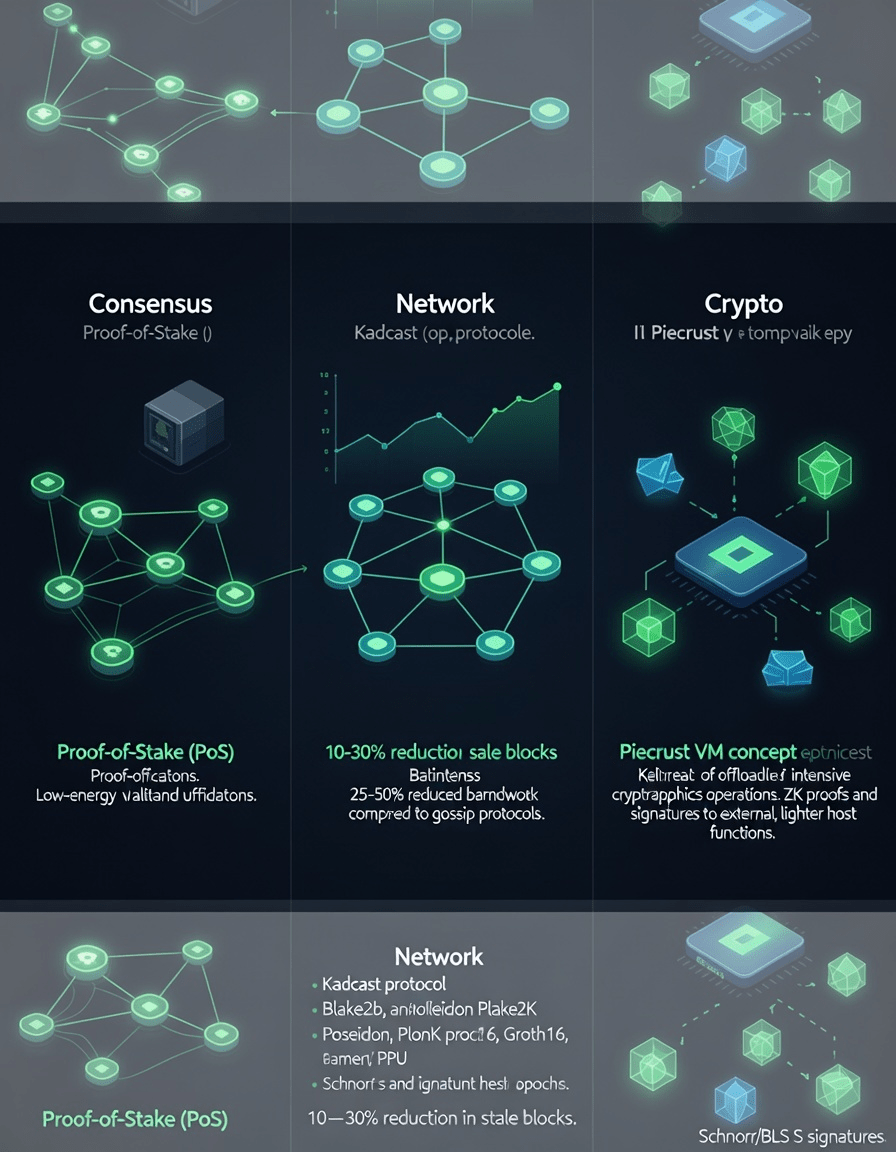
Consensus: SA PoS avoids PoW's energy puzzles. PoS secures via stakes, not compute; Ethereum's switch cut 99.95% energy. DS proportional selection efficient. Rolling finality cuts iterations, reducing redundancy.
Network: Kadcast structured, XOR-based reduces bandwidth 25-50% vs gossip/LibP2P, lowering node energy/data center load. 10-30% fewer stales saves validation power.
Crypto: Piecrust VM offloads intensive ops (ZK verify, sigs, hashes) to host functions, avoiding WASM's 45-255% slowdown, saving energy on proofs etc.
Blake2b/Poseidon hashes truncated. Proofs: PlonK/Groth16. Sigs: Schnorr/BLS single/multi.
Green blockchain concept and Energy-efficient PoS visual:
Implementation: Piecrust VM and Key Contracts
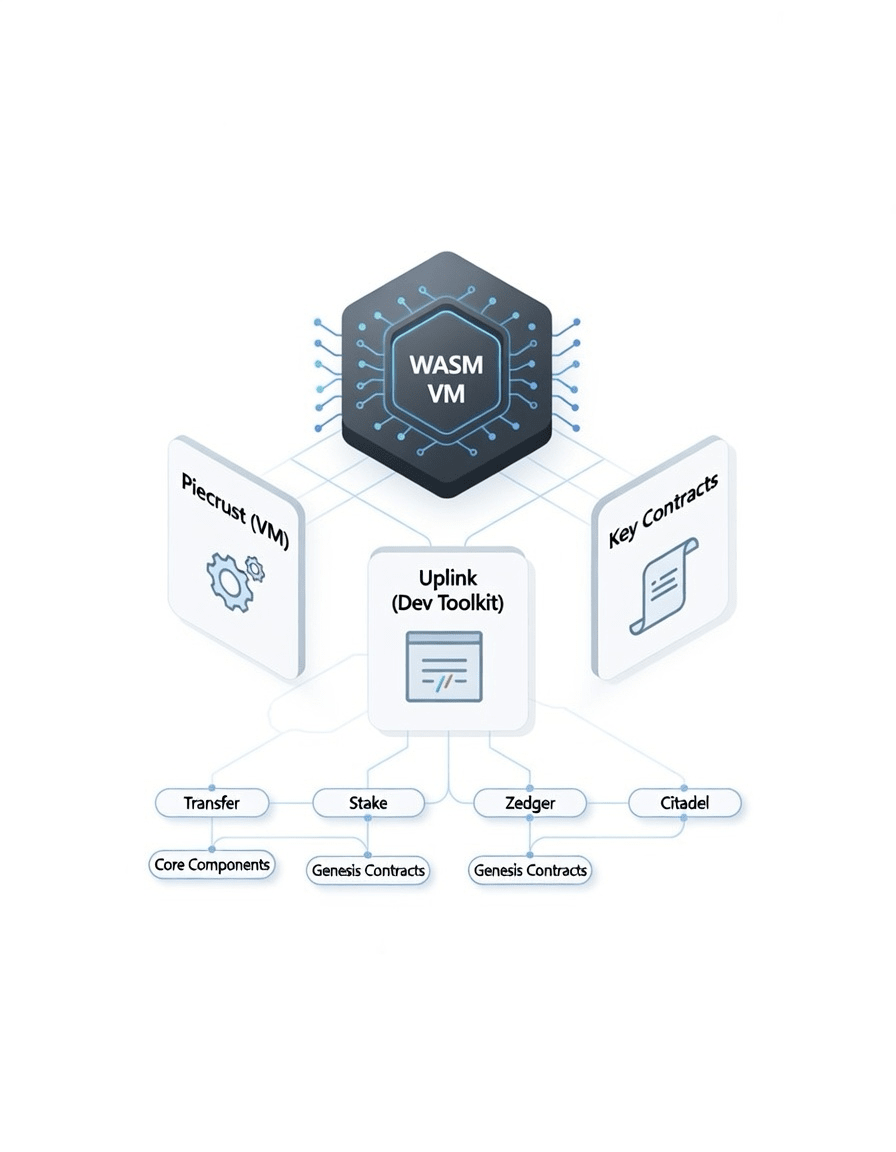
Piecrust VM executes compact WASM contracts securely/modularly. Core: piecrust (VM), uplink (dev toolkit). Rust-based, focuses portability/security/performance. Modular for extensions. Handles crypto securely.
Uplink simplifies compile/test/deploy, ensuring correctness/security pre-launch.
Genesis contracts at launch:
Transfer: Handles DUSK transfers/gas. Verifies tx, executes deploys/calls, deducts fees.
Stake: Manages staking for provisioners. Validates/locks min stake, handles unstake post-period. Applies rewards/penalties.
Others:
Zedger: For securities/RWAs, tokenized/native. Compliant/privacy via ZK/audits. Functions:
mint/burn/dividends/force transfers. Validates proofs, nullifies spent. Issuer force/auditability balances privacy/compliance.
Citadel: Manages licenses per Citadel protocol. Issues/validates/expires/revokes/renews. Ensures only valid holders perform actions.
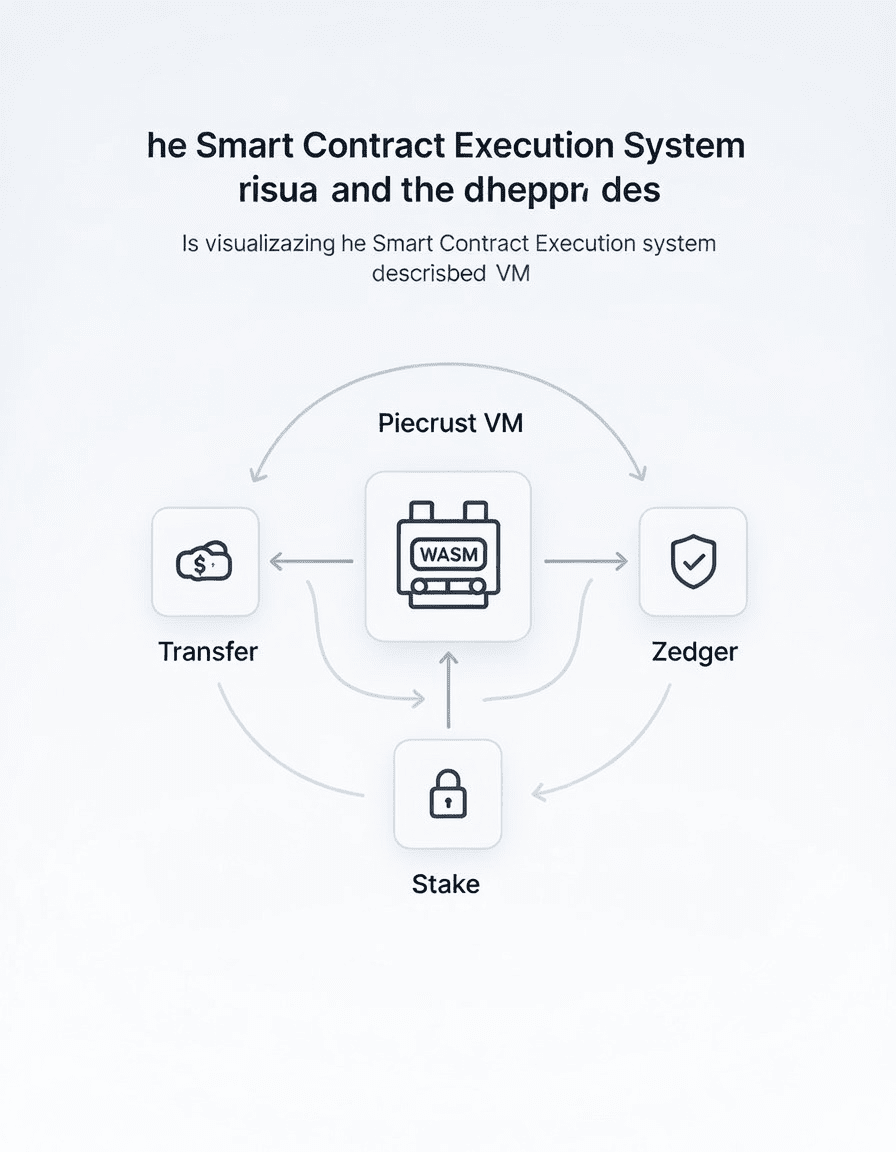
Smart contract execution and WASM VM diagram:
Conclusions: The Future of Compliant Blockchain Finance
Dusk redefines blockchain for finance with SA consensus, Phoenix privacy, Zedger contracts, delivering secure, scalable, private solutions aligned with regulations. It enhances traditional markets with decentralized efficiency.
Thoughts on $DUSK's innovations? Share below!


