


A quiet but profound transformation is underway in global finance. Stablecoins—once viewed as niche crypto instruments—now move trillions of dollars every year, powering remittances, trading, payroll, and cross-border commerce. They have proven their demand. What they have not yet been given is infrastructure worthy of their role.
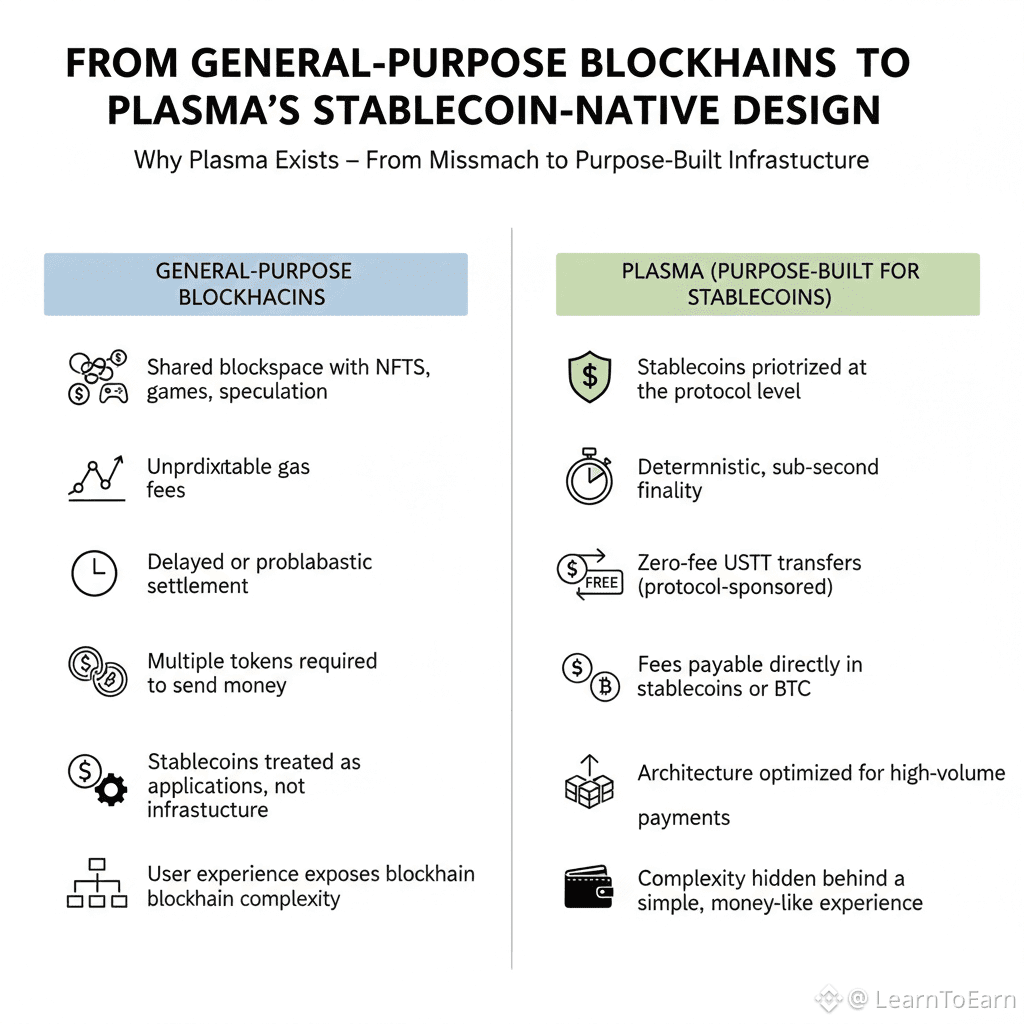
Most stablecoins still rely on general-purpose blockchains that were never designed for payments at global scale. These systems introduce friction where none should exist: unpredictable fees, delayed settlement, and confusing requirements to manage multiple tokens just to send money. As stablecoins move closer to everyday economic use, this mismatch becomes impossible to ignore.
Plasma is the response to that mismatch.
It is not another multipurpose blockchain competing for attention. Plasma is a Layer 1 blockchain engineered with a singular objective: to become the world’s dedicated settlement layer for stablecoins. Every design choice—technical, economic, and experiential—is optimized for one outcome: frictionless, global, always-on digital dollar payments.
A Simple Philosophy with Massive Implications
Plasma is built on one core belief: stablecoins should be treated as first-class citizens at the protocol level.
On most blockchains, stablecoins are just applications competing for blockspace alongside NFTs, games, and speculative activity. Plasma rejects this model entirely. Instead, it embeds stablecoin logic directly into the foundation of the network, ensuring that sending, receiving, and settling stable value is the most efficient action the chain can perform.
The goal is not to expose users to blockchain complexity, but to eliminate it.
A useful analogy is the evolution of web browsers. Early browsers exposed users to the internet’s complexity and limitations. Chrome succeeded by hiding that complexity behind speed, stability, and simplicity. Plasma aims to do the same for stablecoins—turning powerful but complex technology into an experience that feels natural, intuitive, and reliable.
An Architecture Designed for Payments, Not Experiments
Plasma’s performance advantage is not accidental. It is the result of a deliberately specialized architecture, built to handle the specific demands of high-volume money movement.
PlasmaBFT: Finality That Matches Real-World Commerce
At the core of the network is PlasmaBFT, a custom consensus mechanism derived from Fast HotStuff and optimized for pipelined execution.
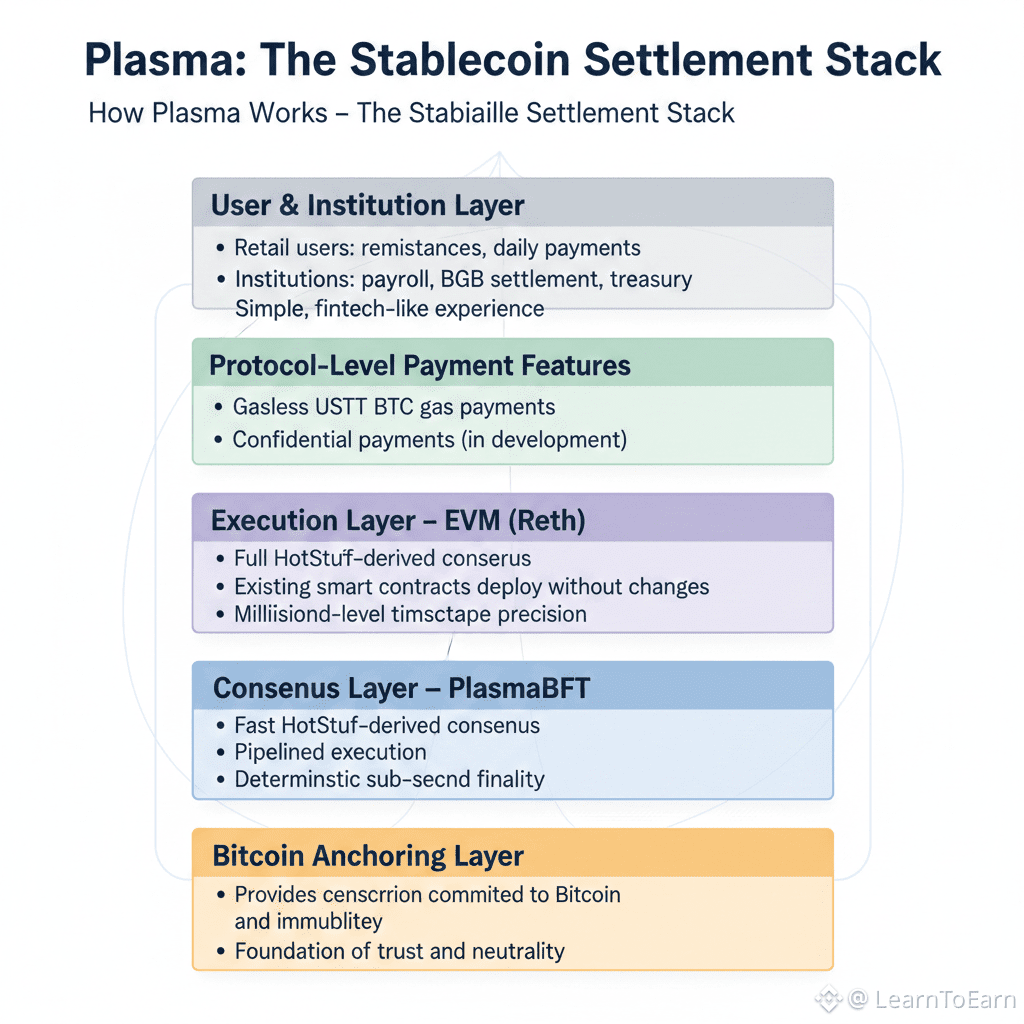
Rather than processing consensus steps sequentially, PlasmaBFT overlaps proposal, voting, and commitment phases. While one block is being finalized, the next is already in motion. This parallelism dramatically reduces idle time and latency.
The result is deterministic, sub-second finality. Transactions are not “likely” to settle—they are settled. For payments, this distinction matters. Merchants, businesses, and users cannot operate on uncertainty.
Plasma’s consensus is built to behave like financial infrastructure, not a probabilistic experiment.
EVM Compatibility Without Compromise
Adoption depends on builders, and Plasma removes friction at the developer level entirely.
With full Ethereum Virtual Machine compatibility powered by the high-performance Reth client, Plasma allows existing Ethereum smart contracts to deploy without modification. Wallets, tooling, and frameworks work immediately.
This means Plasma does not need to convince developers to learn new paradigms. It meets them where they already are, while offering an execution environment better suited to payment-heavy workloads.
Millisecond-level timestamp precision further enhances transaction ordering—an often overlooked but critical requirement for payment batching, payroll, and high-frequency settlement systems.
Bitcoin Anchoring: Neutral Security at the Base Layer
Plasma’s security model extends beyond its own validator set. The network periodically anchors its cryptographic state to the Bitcoin blockchain, inheriting Bitcoin’s unmatched censorship resistance and immutability.
Once Plasma’s state is committed to Bitcoin, it becomes effectively irreversible.
This anchoring is paired with a trust-minimized Bitcoin bridge that allows real BTC to enter Plasma as a programmable asset. Bitcoin becomes usable within smart contracts and payment systems without relying on centralized custodians.
For institutions and global users alike, this creates a powerful signal: Plasma is grounded in the most secure monetary network ever created.
Protocol-Level Features That Remove Real-World Friction
Performance alone is not enough. Plasma’s most important innovations live at the protocol level, where they directly improve the user experience.
Zero-Fee USDT Transfers
Plasma enables standard USDT transfers without requiring users to pay gas fees. A protocol-maintained paymaster sponsors the cost, making small payments and remittances economically viable for the first time. Safeguards such as rate limits and lightweight identity checks ensure sustainability.
Custom Gas Tokens
Users are not forced to hold Plasma’s native token for everyday activity. Transaction fees can be paid in whitelisted assets like USDT or Bitcoin, with conversion handled automatically. From the user’s perspective, sending money requires only the money itself.
Confidential Payments (In Development)
For enterprises, privacy is often the final barrier. Plasma is researching an opt-in confidential payment layer that shields transaction details while preserving auditability for compliance. This makes use cases like payroll, supplier payments, and B2B settlements viable without exposing sensitive business data.
Scalable Node Design and Aligned Incentives
Plasma separates consensus from data serving, allowing the network to scale efficiently under heavy demand. Validators secure the chain, while non-validator and RPC nodes handle application traffic and data access. This modularity allows the ecosystem to grow without compromising performance.
Economically, Plasma favors sustainability over punishment. Validators face reward reduction for poor performance rather than permanent loss of staked capital. This approach lowers risk for participants and aligns better with institutional expectations.
Real-World Impact Across Key Markets
Plasma’s design serves two groups that are already driving stablecoin adoption.
For individuals—especially in emerging economies—zero fees and instant settlement make stablecoins practical for daily life. Small payments, remittances, and savings no longer lose value to intermediaries.
For institutions, Plasma offers predictable costs, strong security guarantees, and compliance-ready tooling. Cross-border B2B payments, treasury management, and tokenized asset settlement become faster, cheaper, and more transparent.
In both cases, Plasma does not replace existing finance overnight. It quietly outperforms it.
Infrastructure, Not Hype
General-purpose blockchains introduced programmable money, but they were not designed to move value at global scale without friction. Plasma represents the next step in that evolution: infrastructure built specifically for money.
By giving stablecoins native priority, anchoring security in Bitcoin, and delivering a user experience that rivals modern fintech, Plasma is positioning itself as foundational infrastructure for the digital dollar economy.
It is not building another platform.
It is building the highway on which global value will move—fast, freely, and without friction.
Plasma: A $24 Million Conviction That Stablecoins Will Redefine Global Money
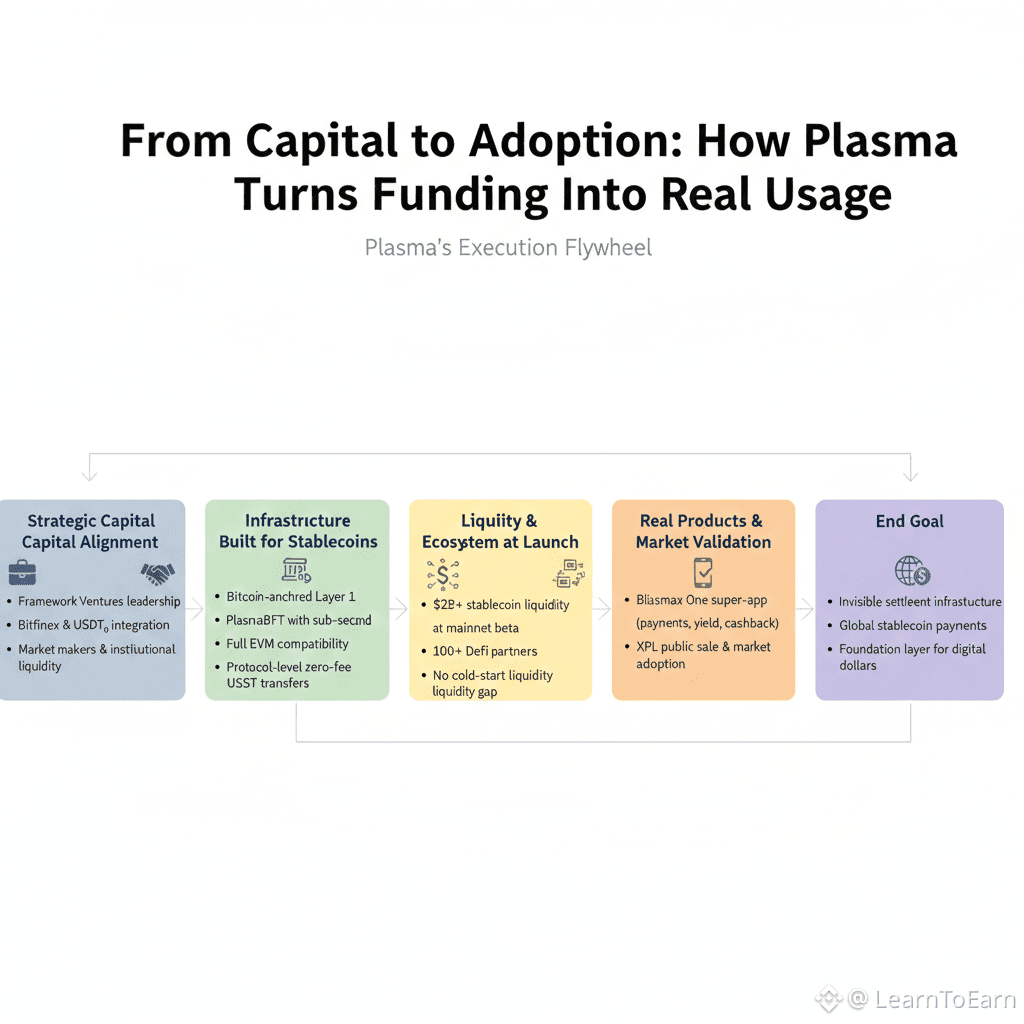
In a market crowded with “do-everything” blockchains fighting for attention, Plasma is making a far more deliberate bet—and it just convinced some of the smartest capital in crypto to back it. With a $24 million Series A led by Framework Ventures and Bitfinex, Plasma isn’t chasing trends. It’s aligning itself with a single, powerful thesis: stablecoins are no longer an experiment, they are the backbone of digital finance—and the world needs infrastructure designed specifically for them.
This funding round is not just a capital injection. It’s a signal that the industry is entering a new phase, one where stablecoins are treated less like tokens and more like global financial primitives.
Why This Round Matters More Than the Headline Number
On paper, $24 million is impressive. In context, it’s strategic.

Plasma’s total funding now exceeds $74 million, but more important than the amount is who wrote the checks. This round represents alignment with the core forces shaping the stablecoin economy—liquidity, market structure, and real-world usage.
Framework Ventures has built a reputation for identifying infrastructure before it becomes obvious. Their leadership in the round reflects confidence that Plasma’s design choices are not just novel, but necessary.
Bitfinex’s participation—alongside the USD₮₀ omnichain initiative—adds a different kind of weight. This is not a passive investment. It ties Plasma directly into the operational heart of USDT, the most widely used digital dollar on the planet. With USDT controlling roughly 70% of the stablecoin market, this relationship gives Plasma an immediate relevance most new Layer 1s spend years trying to achieve.
The broader investor list reads like a cross-section of global market plumbing: DRW/Cumberland, Flow Traders, IMC, Nomura, Bybit, and seasoned crypto funds like 6th Man Ventures. Add in angel investors such as Paolo Ardoino and Peter Thiel, and a clear pattern emerges—this isn’t speculative capital chasing hype. It’s infrastructure capital positioning early.
The Problem Plasma Is Actually Solving
Stablecoins already move trillions of dollars annually. They power remittances, on-chain trading, DeFi, and increasingly, real-world payments. Yet almost all of this activity runs on blockchains that were never designed for money at scale.
That mismatch is now impossible to ignore.
High and unpredictable fees make everyday payments impractical. Congested networks turn settlement into a waiting game. Some low-cost alternatives achieve speed by concentrating power, introducing trust assumptions that don’t belong in global finance. And across most chains, stablecoins remain second-class citizens—tokens living on top of systems built for something else.
Plasma starts from a different premise: if stablecoins are the product, the chain should be the factory.
A Blockchain Designed Around Money, Not Around Everything
Plasma’s architecture reflects a rare kind of discipline. Instead of optimizing for every possible use case, it optimizes relentlessly for one.
At its core, Plasma is a Bitcoin-anchored Layer 1, inheriting the security properties of the most battle-tested network in crypto. On top of that foundation, it runs PlasmaBFT, a high-performance consensus derived from Fast HotStuff, enabling sub-second finality—fast enough for real payments, not just trading.
Crucially, Plasma doesn’t ask developers to relearn the world. Full EVM compatibility means existing Ethereum tools, smart contracts, and wallets work out of the box. This choice lowers friction, accelerates adoption, and turns Plasma from a theoretical improvement into a practical alternative.
But the real differentiation lives at the protocol level.
Zero-fee USDT transfers aren’t a marketing gimmick—they remove the single biggest barrier to stablecoin payments at scale. Paying gas in stablecoins eliminates the cognitive and operational overhead that keeps non-crypto users out. Native Bitcoin integration opens the door to cross-asset financial flows that don’t rely on fragile wrapping schemes.
Together, these choices point to a chain that treats money movement as a first-class operation, not an afterthought.
What separates Plasma from many well-funded projects is speed to reality.
By September 2025, Plasma launched its mainnet beta with over $2 billion in stablecoin liquidity already in place, supported by more than 100 DeFi partners. This wasn’t organic luck—it was a deliberate strategy to avoid the cold-start problem that cripples new networks.
Product launches followed quickly. Plasma One, a neobank-style super-app, demonstrated how stablecoins could feel like a consumer financial product rather than a crypto tool—spending directly from a stablecoin balance, earning double-digit yields, and receiving cashback, all without exposing users to unnecessary complexity.
Bitfinex’s integration of USDT₀ deposits and withdrawals on Plasma closed the loop, providing a direct bridge between institutional liquidity and on-chain activity.
Even the market’s response to the XPL token reflected this momentum. A $50 million public sale at a $500 million fully diluted valuation, followed by an all-time high that pushed valuation past $1.4 billion, showed that demand extended beyond venture capital into the broader market.
Where Plasma Is Headed
Plasma’s ambition isn’t to win the Layer 1 narrative it’s to become invisible infrastructure.
The roadmap prioritizes regions where stablecoins already function as financial lifelines: Latin America, the Middle East, and other economies where access to dollar-denominated assets is both practical and necessary. From cross-border business payments to tokenized real-world assets, Plasma positions itself as the settlement layer beneath the next generation of digital finance.
In that sense, the $24 million raise is less about funding development and more about formalizing a coalition. Framework Ventures, Bitfinex, market makers, and global traders are aligning around a shared belief: stablecoins won’t reach their full potential on chains built for a different era.
Plasma isn’t trying to be everything. It’s trying to be the most reliable, efficient highway for digital dollars. And in a world moving steadily toward programmable money, that focus may prove to be its greatest advantage.
Plasma: The Dual-Track Infrastructure Rebuilding How Money Moves
Stablecoins have quietly become the most successful financial product in crypto history. They move trillions of dollars each year, power global remittances, anchor DeFi liquidity, and increasingly act as a digital extension of the U.S. dollar. Yet despite this scale, stablecoins have always lived on borrowed infrastructure—blockchains designed for experimentation, not payments.
This mismatch has created a fractured ecosystem. Tron dominates low-cost retail transfers but struggles with institutional trust. Ethereum remains the settlement layer for high-value DeFi, but its fees and congestion exclude everyday users. Between these extremes lies a massive, underserved middle: a need for infrastructure that is fast, neutral, secure, and built explicitly for money.
Plasma (XPL) emerges precisely at this inflection point. It is not a general-purpose Layer 1. It is a purpose-built stablecoin settlement network designed to serve two fundamentally different user groups at once—retail users who need frictionless payments, and institutions that demand security, compliance, and censorship resistance. Plasma’s core insight is simple but powerful: global finance doesn’t need another multipurpose blockchain; it needs a specialized monetary rail.
The Core Design Philosophy: One Network, Two Economic Realities
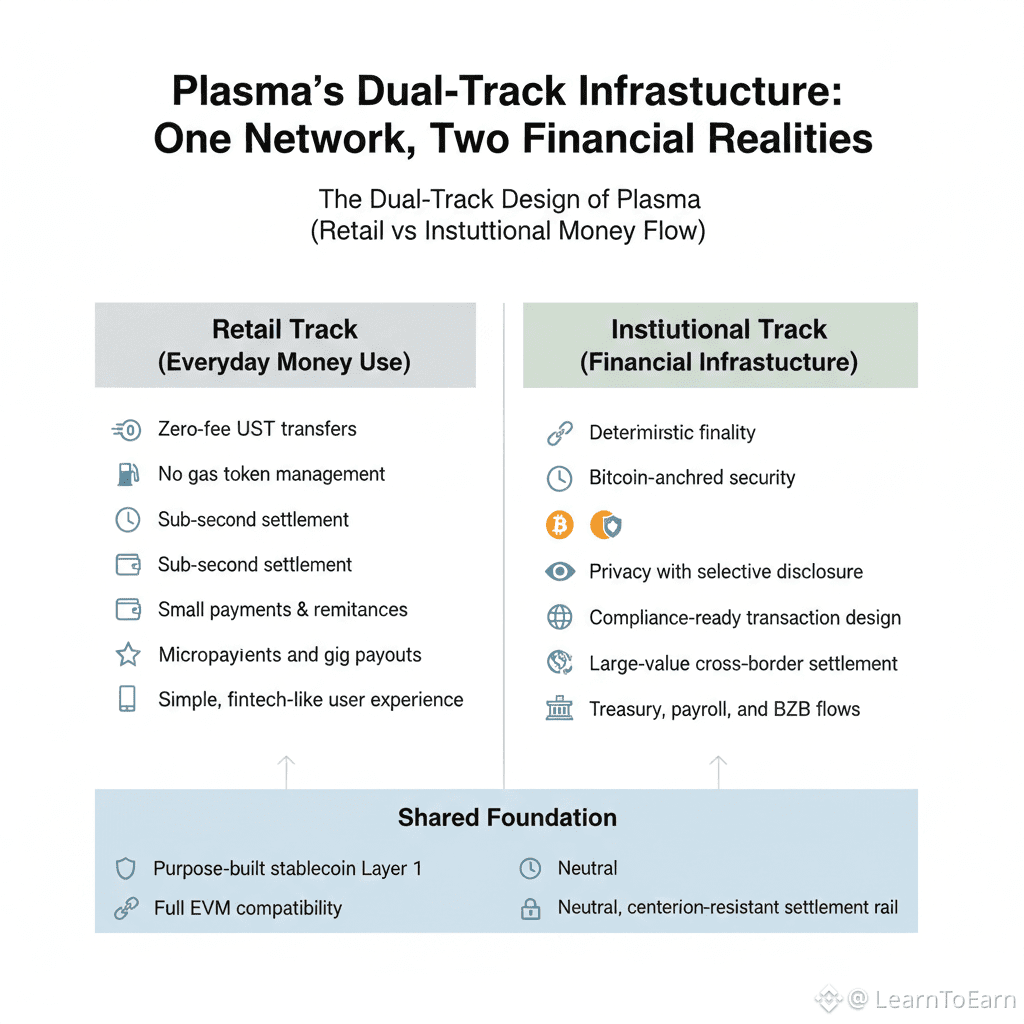
What makes Plasma distinctive is not a single feature, but its architectural intent. From the ground up, Plasma is designed as a dual-track system—one that optimizes for mass retail usage without compromising the standards required by institutions.
Retail finance and institutional finance operate under different constraints, but they intersect at stablecoins. Plasma treats this intersection not as a trade-off, but as a design problem to be solved at the protocol level.
The Engine Under the Hood: Infrastructure Optimized for Payments
Plasma’s technical stack reflects a narrow focus on settlement performance, predictability, and security—qualities that matter far more for payments than for general computation.
At the heart of the network is PlasmaBFT, a consensus mechanism derived from Fast HotStuff and tuned specifically for payment finality. Instead of optimizing for complex state transitions, PlasmaBFT prioritizes speed and determinism. The result is sub-second finality and thousands of transactions per second—settlement that feels instant, not probabilistic.
This matters because money behaves differently than code. A payment either settles or it doesn’t. Plasma is built to remove ambiguity from that experience.
To avoid ecosystem isolation, Plasma maintains full Ethereum Virtual Machine compatibility. Developers can deploy existing Ethereum contracts without rewriting code, using familiar tooling from day one. This choice eliminates the cold-start problem that plagues new chains and allows Plasma to inherit Ethereum’s developer mindshare while offering a fundamentally better environment for stablecoin use cases.
The most important security decision, however, is Plasma’s Bitcoin anchoring model. Plasma operates as a Bitcoin sidechain, periodically committing its state to the Bitcoin ledger. This anchoring gives Plasma a level of censorship resistance and settlement assurance unmatched by most Layer 1s—an essential property for institutions moving large sums across borders. In parallel, a trust-minimized bridge enables Bitcoin itself to become a programmable asset within the Plasma ecosystem, further strengthening its role as financial infrastructure rather than speculative tech.
Retail Track: Making Stablecoins Feel Like Money Again
For everyday users, Plasma removes nearly all the friction that has historically made crypto payments painful.
The most visible breakthrough is zero-fee USDT transfers. Through a protocol-level gas sponsorship mechanism, users can send stablecoins without holding or managing a separate gas token. This design choice seems small, but its implications are massive. It transforms stablecoins from a crypto product into a usable payment instrument.
This unlocks real-world use cases that were previously impractical:
Small remittances become viable again. Micropayments and gig-economy payouts can happen instantly. Users in inflation-prone regions can move and store dollar value without losing a meaningful percentage to fees. Combined with sub-second settlement, the experience begins to resemble modern fintech apps—without custodial risk or geographic limitations.
Plasma doesn’t try to educate users about blockchains. It simply removes the reasons they would need to care.
Institutional Track: Privacy, Compliance, and Settlement Integrity
Institutions face a different problem. Speed is important, but predictability, privacy, and regulatory alignment are non-negotiable.
Plasma addresses this through a roadmap focused on confidential yet compliant transactions. Rather than hiding activity off-chain, Plasma enables selective disclosure—encrypting sensitive transaction details while preserving auditability where required. This allows institutions to operate on a public blockchain without exposing strategic financial flows to competitors.
Regulatory alignment is treated as a structural feature, not an afterthought. As stablecoin legislation matures globally—particularly in the United States—Plasma positions itself as infrastructure that regulators can understand and institutions can trust. By supporting compliant, custodial stablecoins and embedding compliance tooling into the protocol layer, Plasma offers a predictable operating environment at scale.
Economically, Plasma separates user experience from value capture. Retail users benefit from zero-fee transfers, while the network captures value from institutional activity: priority settlement, large-scale mint and redemption flows, and network security via XPL staking. This asymmetry allows Plasma to subsidize adoption while maintaining long-term economic sustainability.
Early Market Signals and the Reality Check
Plasma entered the market with a clear goal: challenge Tron’s dominance in stablecoin settlement. Early traction was striking. Total value locked surged into the billions within days, and the network rapidly became one of the largest holders of USDT on-chain.
These numbers validate demand—but they are not the finish line.
Sustaining activity is harder than launching fast. Like every new network, Plasma must now convert liquidity into habit, usage into retention, and experimentation into real economic gravity. Daily activity has cooled from initial highs, highlighting the central challenge ahead: building durable, repeat usage rather than speculative inflows.
The next phase depends on execution—rolling out Bitcoin bridging at scale, delivering confidential transactions, and securing partnerships in regions where stablecoins are already essential infrastructure rather than optional tools.
Why Plasma Matters in the Bigger Picture
Plasma represents a broader shift in blockchain design. Instead of chasing maximum flexibility, it embraces specialization. Instead of promising everything, it promises to do one thing exceptionally well.
By combining Ethereum’s developer ecosystem, Bitcoin’s security guarantees, and a payment experience optimized for stablecoins, Plasma is attempting something rare: to unify retail and institutional finance on a single, neutral settlement rail.
Whether Plasma ultimately succeeds will depend on adoption, liquidity depth, and sustained execution. But its architecture reflects a deep understanding of how money actually moves—and how it needs to move in a world increasingly defined by digital dollars.
If stablecoins are the operating system of global finance, Plasma is trying to become the hardware they finally deserve.

