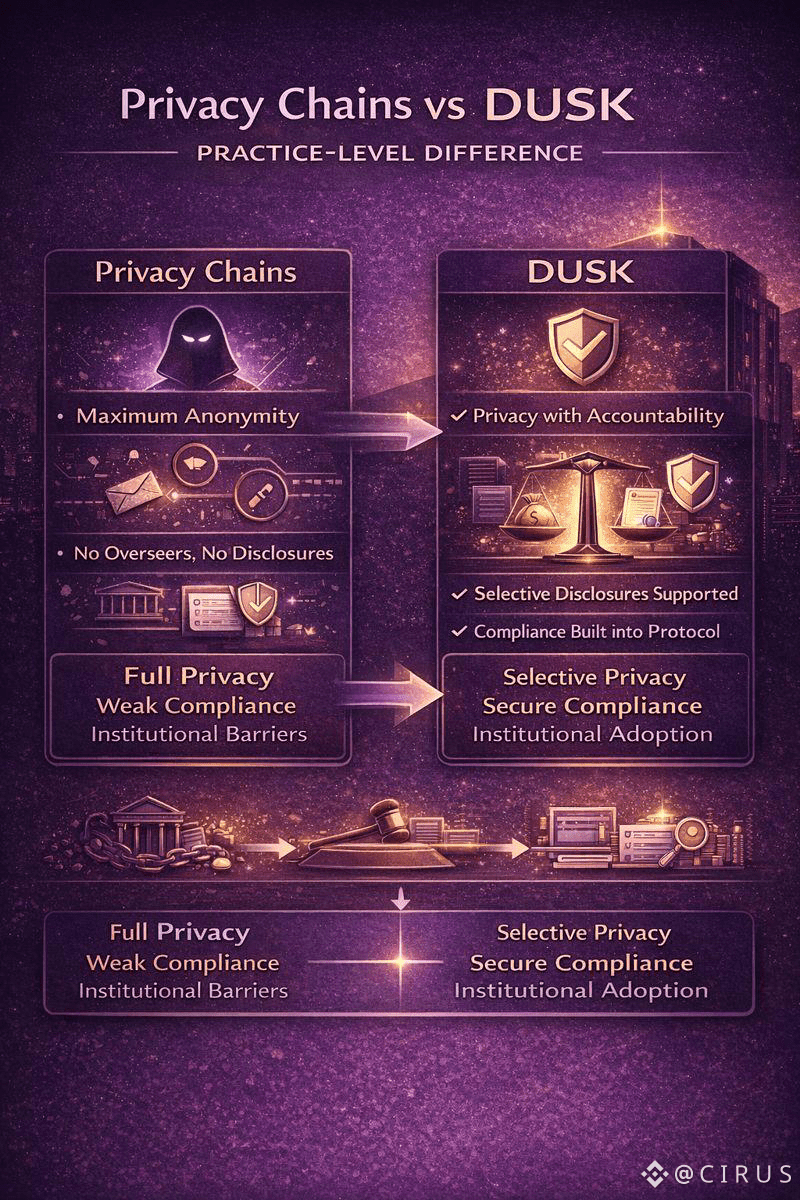
Most privacy chains sound similar on the surface. They talk about confidentiality, hidden balances, anonymous transfers, and zero-knowledge proofs. At a glance, DUSK can easily be grouped into that category. In practice, however, DUSK operates in a very different lane.
The difference is not in how much data is hidden. The difference is why it is hidden, who can still access it, and how that fits into real financial systems.
Privacy chains often start from the user. DUSK starts from the market.
The typical privacy-chain mindset
Most privacy-focused blockchains are designed to maximize individual anonymity. The core goal is to remove visibility entirely. Transactions are hidden from everyone. Ownership is obscured. Activity becomes untraceable by default.
This model works well for censorship resistance and personal privacy. It does not work well for regulated finance.
Why?
Because regulated markets do not need invisibility. They need controlled visibility.
Auditors must be able to verify records. Regulators must be able to investigate wrongdoing. Institutions must be able to prove compliance without revealing everything publicly.
Pure anonymity breaks these workflows instead of supporting them.
DUSK’s starting point is different
DUSK does not ask, “How do we hide everything?”
It asks, “How does finance already work, and how do we bring that on-chain without breaking it?”
In traditional finance, privacy exists alongside oversight. Ownership registries are private, not anonymous. Transactions are confidential, not unknowable. Audits happen regularly. Enforcement exists.
DUSK mirrors this structure.
Privacy on DUSK is not about disappearing. It is about limiting unnecessary exposure.
Privacy with accountability built in
This is where DUSK separates itself most clearly from other privacy chains.
On many privacy chains, once data is hidden, it is hidden forever. Recovering information requires extraordinary measures or off-chain agreements. This creates legal and operational risk.
DUSK avoids this by embedding accountability into the system itself.
Transactions can remain confidential while still being provable. Ownership can stay private while still being verifiable. Disclosures can happen when legally required, not by default.
This is exactly how regulated finance already operates.
Why this matters for real financial workflows
Consider three real-world workflows.
Shareholder management Companies cannot publish shareholder lists publicly. At the same time, they must provide accurate records to regulators and auditors. Most privacy chains fail here because they hide too much. DUSK supports private ownership with selective disclosure.
Institutional payments Corporate payments must remain confidential to avoid exposing counterparties and strategies. However, they must still be auditable. Full anonymity creates compliance risk. DUSK enables confidential settlement with enforceable records.
Asset issuance and lifecycle management Tokenized equities, bonds, or funds have long lifecycles. Compliance does not end at issuance. It continues through transfers, reporting, and audits. Privacy chains optimized for anonymity struggle to support this continuity. DUSK is designed for it.
Compliance is not an add-on in DUSK
Another key difference is how compliance is treated.
In most privacy chains, compliance lives outside the protocol. Applications handle it. Institutions rely on off-chain controls. The blockchain itself remains blind.
DUSK takes the opposite approach.
Compliance is assumed to exist. Therefore, the system is built to support it at the infrastructure level. This reduces friction, lowers operational risk, and makes real adoption possible.
Why “less privacy” is actually more useful
At first glance, DUSK may appear to offer less privacy than fully anonymous chains. In reality, it offers usable privacy.
Usable privacy means:
Data is protected from the public Oversight is preserved Rules remain enforceable Markets remain functional
For regulated finance, this balance is not a compromise. It is a requirement.
My take
DUSK stands apart from other privacy chains because it does not treat privacy as an end goal. It treats privacy as a condition for markets to function properly.
Instead of hiding finance from the world, DUSK makes finance compatible with the world it already lives in.
That practical realism is what turns privacy from a feature into infrastructure.