

Ethereum’s Push to Reclaim Self-Sovereignty by 2026
Ethereum co-founder Vitalik Buterin has outlined an ambitious roadmap aimed at restoring areas where the Ethereum ecosystem has lost ground in recent years. Looking ahead to 2026, Buterin promised meaningful progress in self-sovereignty, trust minimisation, privacy, and user control, signalling a renewed focus on Ethereum’s original principles.
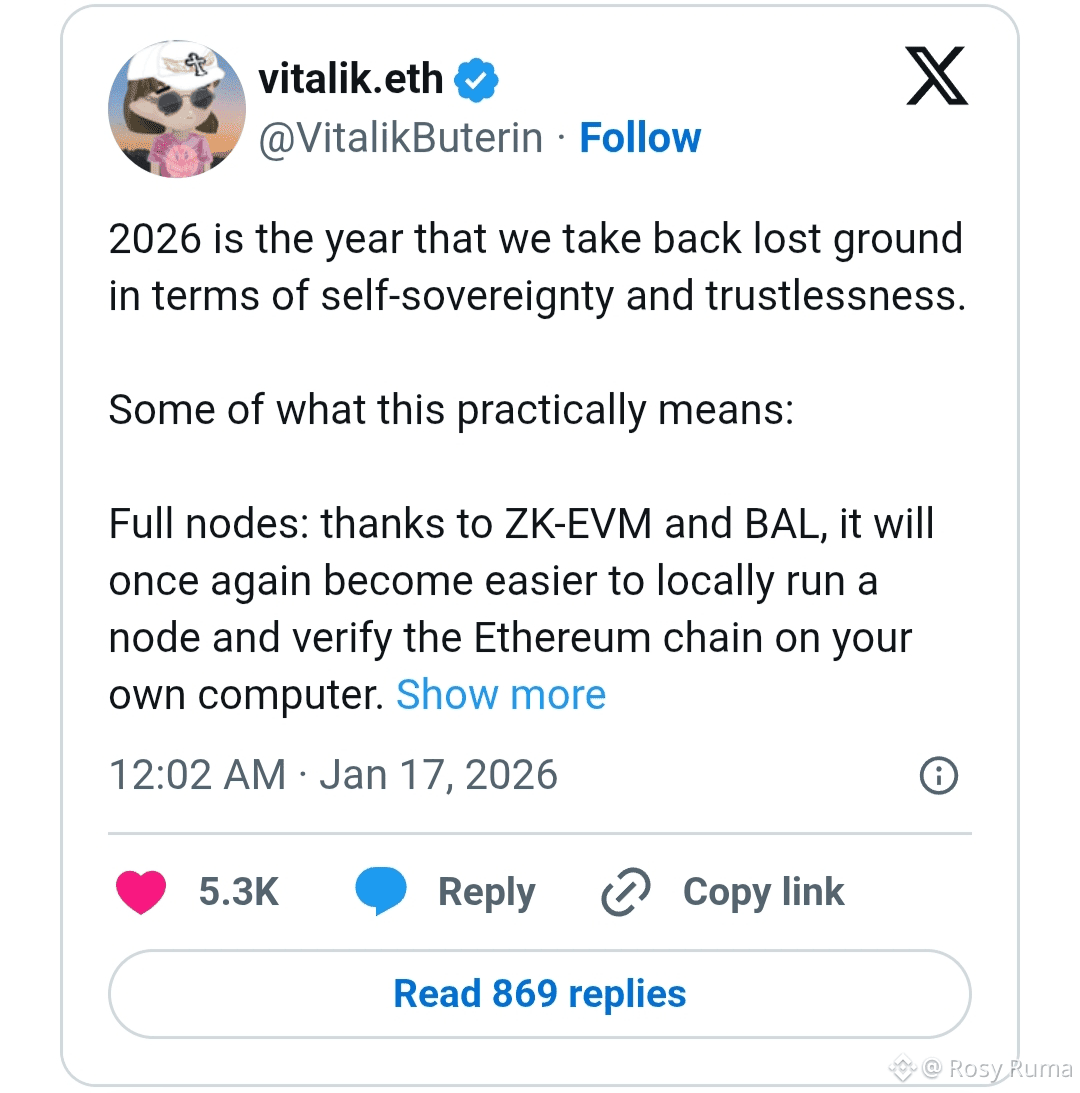
In a post on X, Buterin described 2026 as “the year of regaining lost ground”, particularly in areas where usability and decentralisation were previously compromised in pursuit of mass adoption.
⚙️ What “Regaining Lost Ground” Means in Practice
According to Buterin, the renewed direction will translate into several concrete upgrades across Ethereum’s infrastructure:
🔹 Full Nodes Made Easier
Advances such as ZK-EVM and BAL are expected to make running local Ethereum nodes far more accessible, allowing users to verify the blockchain directly on personal computers.
🔹 Helios Verification
Users will be able to independently verify data received from RPC endpoints instead of blindly trusting third-party providers.
🔹 ORAM & PIR Privacy Tools
These technologies will allow users to query blockchain data without revealing which data they are accessing — reducing the risk of surveillance and data monetisation by intermediaries.
🔹 Social Recovery Wallets & Time Locks
Future wallets will protect users from total fund loss if seed phrases are compromised, while preventing centralised platforms from freezing assets.
🔹 Privacy Without Complexity
Ethereum aims to support private payments directly from wallets, using the same interface as public transactions — removing friction between privacy and usability.
🔹 Censorship Resistance
Private transactions via the ERC-4337 mempool, along with upcoming native account abstraction (AA) and FOCIL, will reduce reliance on public broadcasters and increase resistance to censorship.
🔹 Decentralised App Interfaces
Greater use of IPFS-based, on-chain user interfaces will limit dependence on centralised servers that could go offline, censor access, or serve compromised front ends.
🧭 A Turning Point for Ethereum?
Buterin acknowledged that Ethereum has experienced what he described as “serious regression” in several key areas over the past decade. However, he stressed that the upcoming roadmap represents a decisive shift in philosophy.
“All value compromises Ethereum has made up to this point — every moment where one might wonder whether it was worth diluting itself so much for mass adoption — we will no longer make those compromises,” Buterin wrote.
While admitting that not all improvements can happen simultaneously, he said the planned upgrades would significantly strengthen Ethereum’s foundation and long-term credibility.
🌐 Beyond Survival — Toward Renewal
According to Buterin, the goal is not merely to preserve Ethereum’s current status, but to build an ecosystem that “deserves not only its current place in the universe, but much more.”
The roadmap aligns with broader efforts such as ZK-EVMs and PeerDAS, which are expected to play a central role in Ethereum’s next phase of scalability, privacy, and decentralisation.
