
Asset issuance on-chain is no longer a technical question. Tokens can be created easily. Smart contracts can automate distribution, settlement, and lifecycle management.
The real challenge lies elsewhere.
From what I’ve observed, the barrier for regulated asset issuance is not innovation. It is trust — specifically, how sensitive financial activity can exist on a public network without exposing participants, positions, or proprietary structures.
Most blockchains were not designed with this problem in mind.
On transparent chains, issuing regulated assets means accepting a trade-off. Either sensitive data is exposed to the public, or compliance is pushed off-chain through custodians, registries, and reporting systems that sit outside the protocol. In both cases, the blockchain becomes only partially responsible for the financial activity it hosts.
That is a structural limitation, not a feature gap.
@Dusk Foundation approaches regulated asset issuance differently by focusing on confidential settlement as a core primitive rather than an add-on.
Confidential settlement allows assets to be issued, transferred, and settled without revealing transactional details to the entire network. Balances, counterparties, and contract logic remain private by default, while still being cryptographically verifiable. This is not about obscurity. It is about controlled disclosure.
For regulated assets, this distinction is critical.
Issuers need to comply with jurisdictional rules, investor eligibility requirements, and reporting obligations. At the same time, they must protect commercially sensitive information and investor privacy. On most chains, these goals are at odds.
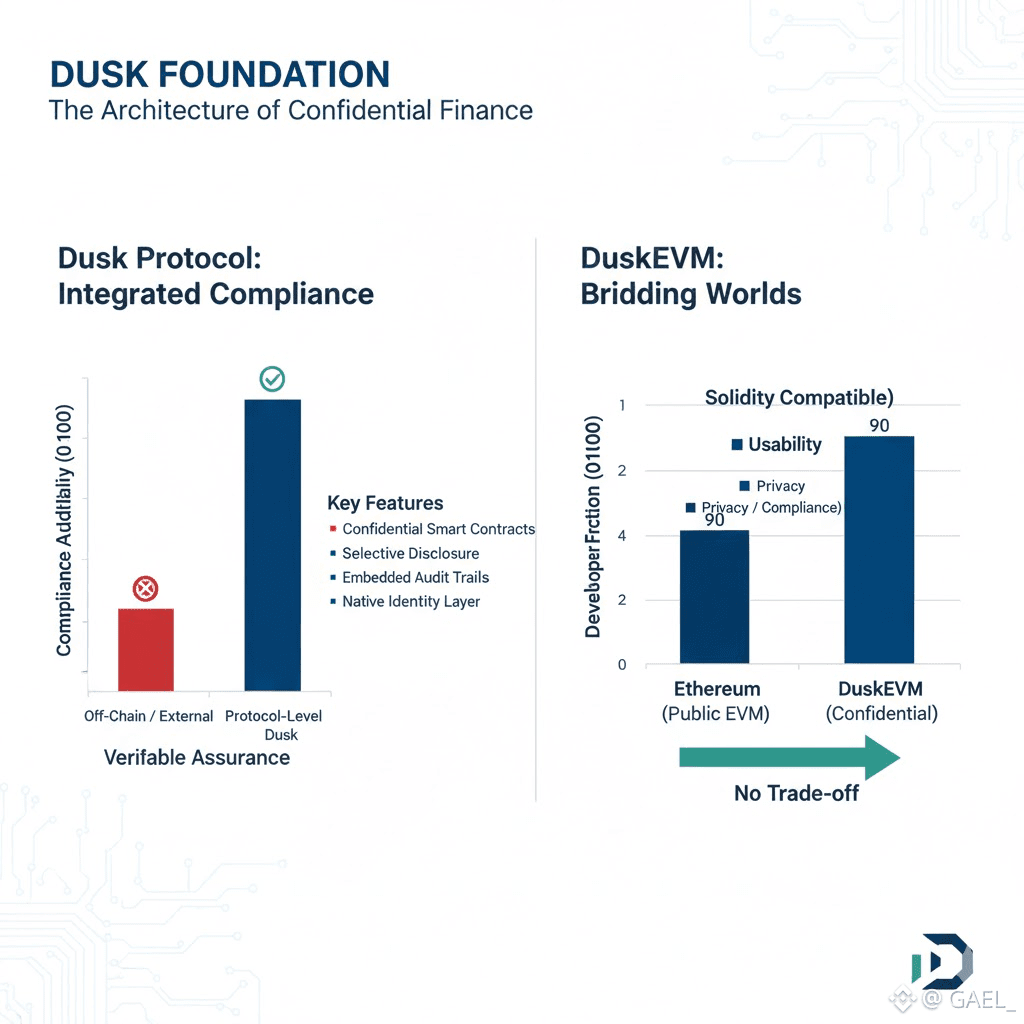
@Dusk resolves this tension by embedding compliance-aware logic directly into the protocol design.
Instead of relying on external systems to enforce rules, Dusk enables compliance conditions to operate alongside confidential execution. When disclosure is required — for audits, regulatory reviews, or legal processes — the system supports selective transparency without compromising the privacy of unrelated activity.
This creates a more coherent issuance lifecycle.
Assets do not need to leave the chain to be validated. Regulators do not need to trust off-chain reports alone. The network itself becomes a source of verifiable truth, while still respecting confidentiality constraints.
The role of DuskEVM further strengthens this model.
Issuers and developers can deploy familiar Solidity-based contracts while benefiting from a settlement layer designed for privacy-preserving finance. This lowers the barrier to entry for institutions that already understand Ethereum tooling but cannot accept Ethereum’s default transparency.
The result is not faster issuance for its own sake. It is safer issuance.
Tokenized securities, funds, and real-world assets can be structured with compliance logic that is enforceable, auditable, and native to the chain. Settlement occurs without broadcasting sensitive details, reducing both operational risk and information leakage.
What stands out is that @Dusk does not frame regulated issuance as an exception case. It treats it as a primary use case.
That signals a broader philosophy. Regulated finance is not something Web3 needs to “adapt to later.” It is something infrastructure must be built for from the start. Confidential settlement is not a workaround. It is a requirement.
By aligning privacy, compliance, and settlement at the protocol level, Dusk Foundation offers a framework where regulated assets can exist on-chain without inheriting the fragility of off-chain dependencies.
If tokenization is meant to move beyond experimentation, issuance must be designed for the realities of financial markets. @Dusk doesn’t promise fewer constraints. It offers infrastructure capable of handling them. And that is what makes confidential settlement more than just a feature — it makes it foundational.
