

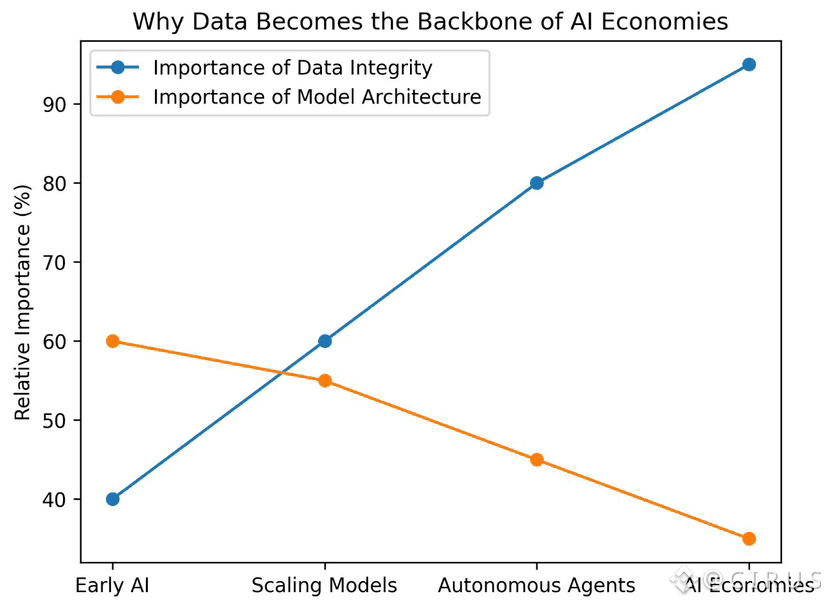
As AI systems move from tools to actors, the structure of the economy around them starts to change. We are no longer talking about models that answer questions on demand. We are talking about agents that negotiate, transact, optimize, and make decisions continuously. In that world, the most valuable input isn’t compute or algorithms. It’s trusted data.
This is where Walrus quietly becomes foundational.
Walrus is not positioned as an AI product. It doesn’t train models or run inference. Instead, it solves a deeper problem that every AI-driven economy eventually runs into: how to make data reliable, verifiable, and economically usable at scale, without central control.
• AI economies run on data, not prompts
In an AI-driven economy, value creation doesn’t come from one-off interactions. It comes from continuous feedback loops. Agents observe data, act on it, generate new data, and feed that back into future decisions. These loops only work if the data flowing through them can be trusted.
If training data can be manipulated, agents learn the wrong patterns.
If historical data can be rewritten, models lose accountability.
If datasets disappear or change silently, economic decisions become unstable.
Traditional storage systems were never designed for this. They assume trust in providers, mutable files, and off-chain coordination. That might be acceptable for human workflows. It breaks down when autonomous systems depend on data integrity to function correctly.
Walrus treats data as infrastructure, not as files.
• Verifiability as an economic primitive
One of the most important shifts Walrus introduces is turning verifiability into a first-class economic property.
When data is committed to Walrus, it gains a fixed identity. That identity doesn’t change unless the data itself changes. This means AI systems can reference datasets in a way that is provable, not assumed. If an agent claims it was trained on a specific dataset, that claim can be verified independently.
In an AI-driven economy, this matters because trust cannot rely on reputation alone. Agents interact at machine speed. They need cryptographic guarantees, not social ones.
Verifiable data becomes a shared reference point that multiple agents can coordinate around without negotiating trust each time.
• Data as an asset, not exhaust
Most digital economies treat data as exhaust. Users generate it, platforms capture it, and value accumulates at the center. AI economies invert this logic. Data becomes a productive asset that feeds intelligence, automation, and decision-making.
Walrus enables this shift by giving data persistence, versioning, and ownership structure. Datasets are no longer temporary inputs. They are durable assets with history.
This creates new economic behaviors. Data can be reused across models. Versions can be compared. Outcomes can be audited against the exact data that produced them. As a result, data producers gain leverage, not just participation.
• Coordination between agents without central platforms
A defining feature of AI-driven economies is that coordination happens between systems, not just between people. Agents need shared state to operate coherently. They need to agree on what data exists and what it represents.
Walrus provides that shared layer without becoming a gatekeeper.
Instead of relying on centralized platforms to host and validate datasets, Walrus allows agents to coordinate around data commitments. If multiple agents reference the same dataset, they are guaranteed to be talking about the same thing. If a dataset changes, that change is explicit and verifiable.
This reduces friction in agent-to-agent markets. It also reduces the power of intermediaries that traditionally control data access and validation.
• Incentives emerge naturally around reliable data
As AI systems become more autonomous, incentives shift toward data quality rather than data quantity. Bad data produces bad decisions at scale. Good data compounds value.
Walrus makes it possible to reward data that remains reliable over time. Because datasets are versioned and auditable, consumers can assess not just what data exists, but how it has evolved. That history becomes part of its value.
In an AI-driven economy, this leads to markets where:
* datasets compete on credibility
* contributors are rewarded for maintaining integrity
* manipulation becomes economically unattractive
Walrus doesn’t enforce these markets. It enables them by making the underlying data trustworthy.
From infrastructure to economic backbone
Calling Walrus a storage protocol misses the point. Storage is a feature. What Walrus actually provides is a neutral layer where data can support autonomous economic activity without central oversight.
As AI agents handle more decisions, the cost of unreliable data rises sharply. At the same time, the need for shared, verifiable datasets increases. Walrus sits exactly at that intersection.
It doesn’t dictate how AI economies operate. It ensures that whatever operates on top of it has a stable foundation.
• My take
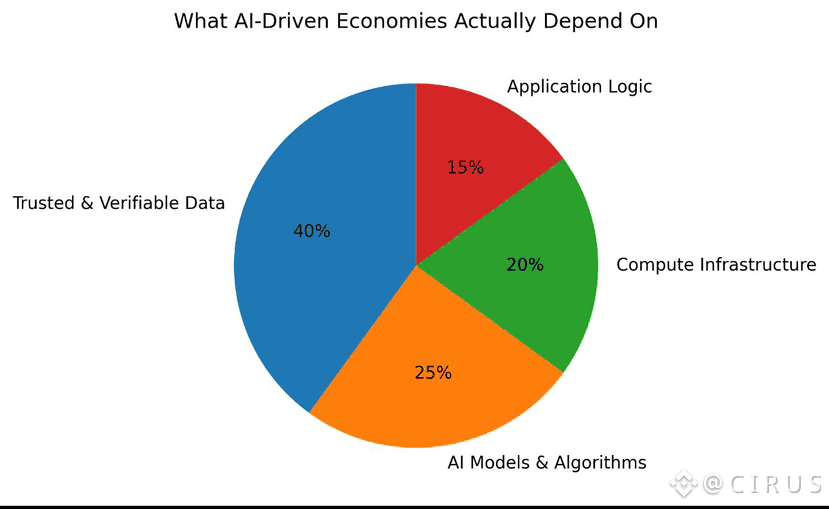
AI-driven economies will not fail because models are weak. They will fail if the data they depend on cannot be trusted.
Walrus addresses this problem before it becomes visible. By making data verifiable, persistent, and economically usable, it turns data into something AI systems can safely coordinate around.
That’s why Walrus isn’t just supporting AI. It’s quietly becoming part of the backbone that AI-driven economies will rely on.

