
Blockchains like to talk about execution. Speed, finality, throughput, composability. Entire ecosystems are built around making transactions cheaper and faster. But beneath all of that activity sits a quieter dependency that most chains still treat as an afterthought: data availability. Applications do not run on execution alone. They depend on files, histories, models, frontends, governance records, and long-lived state that must remain accessible long after a transaction is finalized. This is the problem blockchains keep avoiding. They execute deterministically on-chain, but outsource memory off-chain, hoping it stays online. Walrus exists precisely because hope is not an availability guarantee.
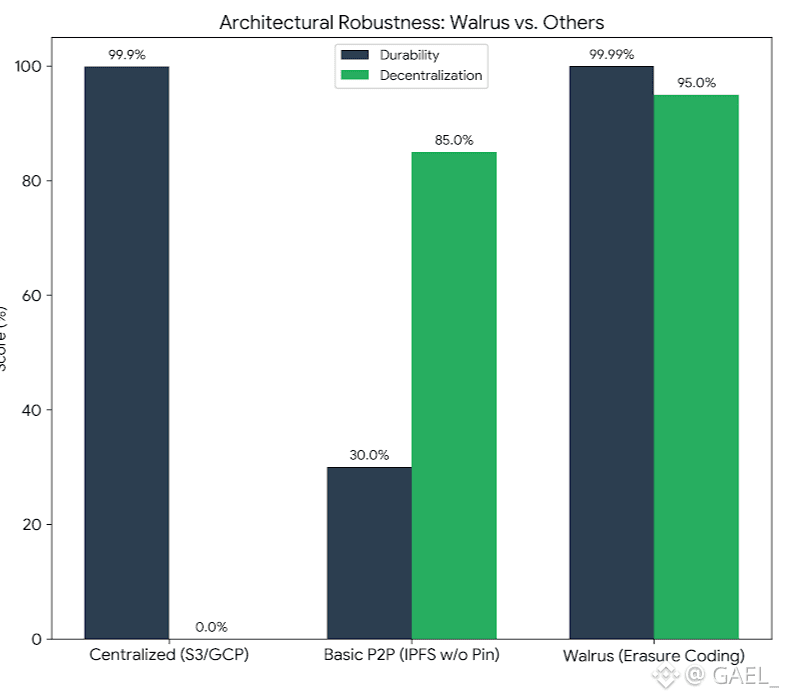
The core issue is not storage capacity. Web2 solved cheap storage years ago. The real issue is incentivized availability under failure. In decentralized systems, nodes leave, hardware fails, operators act selfishly, and attention moves on. Traditional storage designs either fully replicate data everywhere, which is prohibitively expensive at scale, or rely on partial replication schemes that silently break when enough nodes disappear. Walrus starts from a different assumption: churn is inevitable. Nodes will fail. Networks will decay. The system must survive that reality, not fight it.
@Walrus 🦭/acc is built around erasure coding as a first-class primitive, not an optimization. Data is split, encoded into fragments with redundancy, and distributed across the network such that only a subset is required to reconstruct the original content. This design fundamentally changes the economics of storage. Availability no longer depends on every node behaving correctly, only on enough of them doing so. The network can lose participants, experience outages, or even face adversarial conditions, and the data still survives. This is not theoretical resilience. It is mathematically enforced recoverability.
What makes @Walrus 🦭/acc distinct is how availability is enforced economically, not socially. Nodes are not trusted to store data because they are “good actors.” They are incentivized to do so because the protocol continuously verifies availability through cryptographic proofs. If a node fails to serve its assigned fragments, it loses rewards. If it does its job, it gets paid. Persistence becomes a market outcome, not a promise. Data lives because the network is rewarded for keeping it alive, block after block, epoch after epoch.
This model directly addresses a structural weakness across Web3. Most decentralized applications still rely on centralized pinning services, cloud buckets, or privately maintained databases for critical data. When teams run out of funding, lose interest, or simply disappear, the infrastructure quietly collapses. Frontends go offline. Historical records vanish. Governance memory erodes. From the user’s perspective, the protocol “dies,” even if the smart contracts are still technically deployed. Walrus is designed to outlive its creators. Storage does not depend on continuous human maintenance. It depends on protocol-level incentives that persist as long as the network exists.
Another key design choice is separation of execution and storage. @Walrus 🦭/acc does not try to turn blockchains into data warehouses. Instead, it allows execution layers to remain lean while offloading large, persistent data to a system purpose-built for availability. This avoids chain bloat without sacrificing verifiability. Data stored in Walrus can be referenced, verified, and relied upon by on-chain logic without forcing every byte onto the execution layer. It is an architectural correction, not an incremental upgrade.
Ultimately, @Walrus 🦭/acc reframes what decentralized storage is supposed to do. It is not about hosting files cheaply. It is about ensuring that data can be proven to exist, retrieved reliably, and survive long after hype cycles end. Blockchains avoided this problem because it is hard, unglamorous, and deeply infrastructural. Walrus tackles it head-on. And in doing so, it quietly solves one of the most critical bottlenecks holding decentralized systems back.

