
For years, decentralized storage has struggled with the same unresolved tension. Everyone agrees that data should live beyond centralized servers, but very few systems have figured out how to make long-term storage economically sustainable. Most networks either rely on short-term incentives, speculative participation, or goodwill that fades as soon as rewards decline. @Walrus 🦭/acc enters this space with a different economic assumption. Storage is not a one-time action. It is an ongoing responsibility. And ongoing responsibilities require ongoing incentives that are measurable, enforceable, and aligned with real behavior.
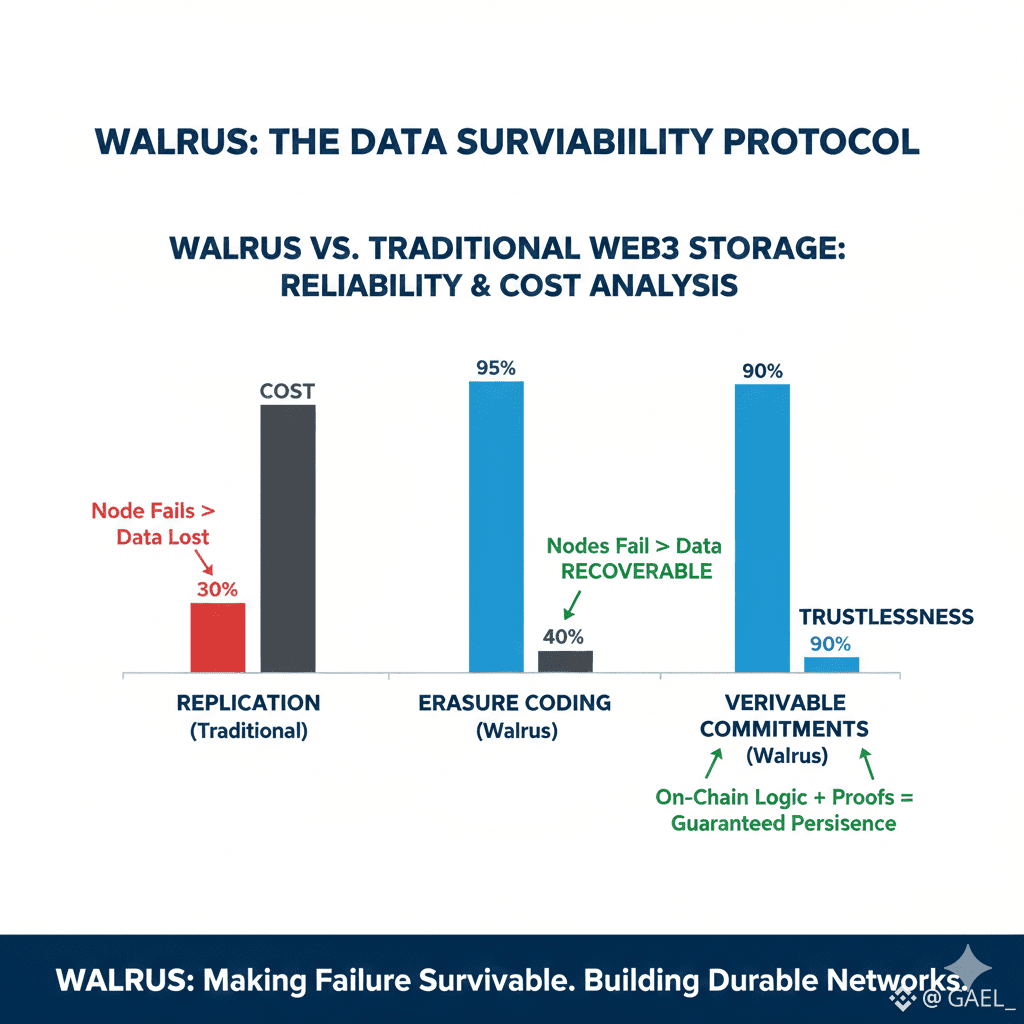
The core economic failure of earlier storage networks is that they reward participation more than performance. Nodes are paid for joining, staking, or briefly hosting data, but long-term availability is often assumed rather than proven. Over time, this creates decay. Nodes churn. Data fragments go missing. Availability becomes probabilistic, and applications quietly fall back to centralized backups. Walrus is explicitly designed to break this pattern by tying rewards directly to continuous proof of data availability.
In the @Walrus 🦭/acc model, storage is not something you provide once and forget. Nodes are required to demonstrate, again and again, that they still hold their assigned data and can serve it when requested. These cryptographic challenges transform storage into a verifiable service rather than a passive claim. Economic rewards flow only to nodes that remain honest and available over time. This shifts the entire incentive landscape. Reliability becomes more profitable than scale. Longevity matters more than hype-driven onboarding.
This approach fundamentally changes who participates in the network. Walrus favors long-term oriented operators over short-term speculators. Storage providers are not racing to maximize throughput or churn capital quickly. They are optimizing for durability, uptime, and predictable returns. In doing so, Walrus aligns decentralized storage economics with how real infrastructure behaves. Power grids, data centers, and networks succeed not because they are exciting, but because they are boringly reliable. Walrus applies that same logic to Web3 storage.
Another critical economic shift lies in how @Walrus 🦭/acc separates execution from memory. By positioning itself as an off-execution data layer, Walrus allows blockchains to avoid the hidden tax of on-chain storage bloat. Execution layers no longer need to internalize the full cost of long-lived data. Instead, they reference Walrus-backed data with verifiable availability guarantees. This creates a cleaner division of labor and a more honest pricing model. Computation is paid for as computation. Memory is paid for as memory.
The implications extend far beyond storage itself. Governance systems benefit because proposals, discussions, and historical records can be preserved without burdening the chain. AI systems gain access to stable datasets and models whose availability is economically enforced. RWA platforms can rely on historical documentation that remains accessible years later. In each case, Walrus does not just store data. It underwrites the economic trust that data will still exist when it is needed most.
What @Walrus 🦭/acc ultimately rewrites is the assumption that decentralized storage must always be fragile, expensive, or speculative. By anchoring incentives to continuous availability rather than momentary participation, it creates a market where persistence is the product. This is not a cosmetic improvement. It is a structural correction to one of Web3’s longest-standing weaknesses.
Decentralized systems fail when their memory fades. Walrus recognizes that economics, not ideology, determine whether data survives. By designing incentives around endurance instead of excitement, Walrus is building storage that does not just exist, but lasts.

