


The year 2025 has promised to be a turning point in the world of blockchain and cryptocurrencies with many new public chains launching and aiming to reshape the industry. One of the most hyped projects in this wave is Plasma, a blockchain project backed by stablecoin infrastructure. Plasma raised over $75 million during its initial fundraising and was immediately listed on major exchanges like Binance, Bybit, and OKX. But as time passed, things didn’t go as planned for its token, XPL. What began as a promising start quickly turned into a tale of disappointment with its price crashing by over 90%, from a high of $1.68 in late September to a current price of just $0.14. So, the big question now is, can Plasma escape this typical scenario where institutional investors make profits, and retail investors are left holding the bag?
The Tokenomics Problem: High FDV and Low Circulation
To understand why XPL has struggled, we have to look at its tokenomics, which are at the heart of the issue. The total supply of XPL is set at 10 billion tokens, but only 10% of these tokens, or 1 billion, were available for the public sale. The rest is allocated as follows: 4 billion tokens for ecological development, 2.5 billion for the project’s team, and 2.5 billion for early investors. On paper, these numbers may sound reasonable, but the problem lies in how these tokens are distributed and when they are unlocked.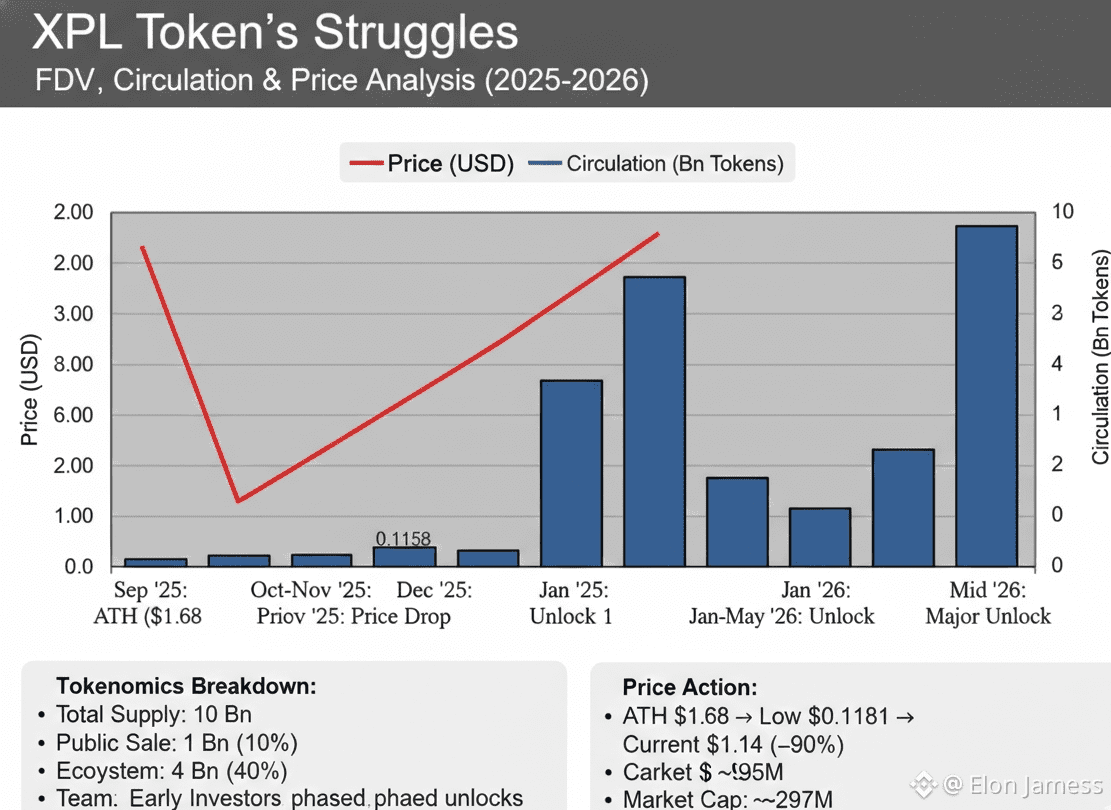
XPL’s circulation is currently quite low, with only around 2.05 billion tokens in the market, which is less than 21% of the total supply. This leaves a massive portion—around 79% of the tokens—locked and ready to be released at some point. The real issue, however, is the timing of these unlocks. Although the white paper specifies a one-year lock-up period for the project team and investors, and that tokens will be released over a two-year period after that, the reality is that the tokens for the team and investors won’t be unlocked until mid-2026. This means that when XPL first started circulating, most of the tokens were still held by the project’s team, developers, and early investors, creating a situation where retail investors had a tiny portion of the total supply.
To make matters worse, the unlocking process has already started, and it's creating selling pressure. For instance, on December 25th, 2025, nearly 89 million XPL tokens were unlocked, increasing the circulation from 1.96 billion to 2.05 billion. This may seem like a small increase, but it's just the beginning. The project is set to unlock similar amounts every month over the next year. If the price doesn’t rise, this continuous supply of new tokens will keep pushing the price down, causing immense selling pressure. In fact, given the current market cap of XPL at just $297 million, this new supply represents around $12.8 million in selling pressure every month. That’s over 4% of the market cap every month, which is a huge amount to deal with.
A Familiar Pattern: Price Drops and Community Discontent
Looking at XPL’s price performance paints a clear picture. Back in late September, XPL reached an all-time high of $1.68. This price surge came during a period filled with positive news—being listed on major exchanges, new ecosystem partners joining the project, and a sharp increase in the total value locked (TVL) in the network. However, despite these optimistic signs, the price started to fall in October and continued its downward trend, eventually reaching a historic low of $0.1158 in mid-December 2025. Although the price has slightly recovered to $0.14, this rebound is very small compared to the massive 90% drop.
In the community, there has been growing frustration. Some are calling XPL a "high FDV, low circulation" scam, where the project team inflates the price only to sell off their tokens, leaving retail investors to suffer. Others believe that the drop is mainly due to the exit of "mercenary capital"—investors who were simply looking for short-term profits, like those who jump into new projects for airdrops or staking rewards and sell as soon as their tokens unlock. While this explanation holds some weight, it isn’t the full picture. The real problem lies in the token’s design, which was never meant to benefit long-term holders.
The Ecosystem Growth Tokens and Centralized Control
One of the main issues with XPL’s tokenomics is the large chunk of tokens allocated for ecosystem growth. While it sounds good in theory—using 40% of the total supply for things like subsidizing gas fees, incentivizing developers, and supporting the network's protocol—how these tokens are spent is entirely under the control of the project’s team. There’s no transparency about how the tokens will be used, how much will be allocated at a time, or the pace at which they will be spent. This lack of control and transparency creates a situation where the project’s central team holds too much power, which contradicts the values of decentralized finance that the project claims to support.
The Lack of Demand for XPL and a Missed Value Capture Mechanism
Plasma’s problem is also compounded by the fact that there is little demand for XPL itself. While Plasma is designed to focus on stablecoin payments, most transactions—like those involving USDT—don’t require XPL for gas fees. This means that the demand for XPL is largely limited to non-stablecoin operations in DeFi protocols. However, this segment of the ecosystem is still small, meaning that XPL has yet to establish itself as an essential asset within the Plasma network.
On top of that, the white paper mentions a 5% annual inflation rate for staking rewards, but the staking system hasn’t been fully launched yet. Currently, only internal validating nodes are running, with no clear timeline for when staking will go live for the public. This lack of a functional staking system and the absence of a clear value capture mechanism for XPL are key reasons why the token’s price has struggled.
Lessons from XPL’s Decline: The Common Pitfalls of 2025 ICOs
The decline of XPL isn’t an isolated incident. Other projects launched around the same time, like Berachain and Initia, also saw similar crashes in their token prices. The reason behind these declines is largely the same: overvaluation, low circulation, and a rushed unlocking schedule. In each case, early investors who bought tokens at a low price pumped up the FDV through aggressive marketing, only to gradually exit as the token unlocked, leaving retail investors with massive losses.
Should the Big Investors Have Done More to Protect XPL?
Plasma’s backers are impressive, with high-profile firms like Founders Fund, Framework Ventures, and Bitfinex behind the project. These institutions have a lot of experience and capital, which makes it even more surprising that the price has crashed this dramatically. Given their involvement, you would expect them to have taken steps to protect the long-term health of the project and its token price. However, it appears that their main concern was likely to exit at the right price, rather than supporting the token in the long run.
What’s Next for XPL?
XPL’s future looks uncertain. The project team could buy back tokens to try to stabilize the price, but that would require a lot of capital and may not work in the long term. Another option is that Plasma could attempt to grow its ecosystem and drive real demand for XPL, but that would take time and there are no guarantees. Alternatively, the project could simply let the price continue to fall, as early investors can still make a profit even if the price keeps dropping.
Conclusion: Can XPL Turn Around?
XPL’s fate depends on whether Plasma can break free from the cycle of high FDV and low circulation that has plagued many other projects in 2025. Investors are becoming more aware of these risks, and the market is growing more cautious. The best advice for retail investors is probably to stay away for now and wait for the situation to calm down. XPL’s price has already dropped by 90%, but it’s still uncertain if it has truly hit bottom. Only time will tell if Plasma can turn things around, but in the meantime, caution is the best strategy.

