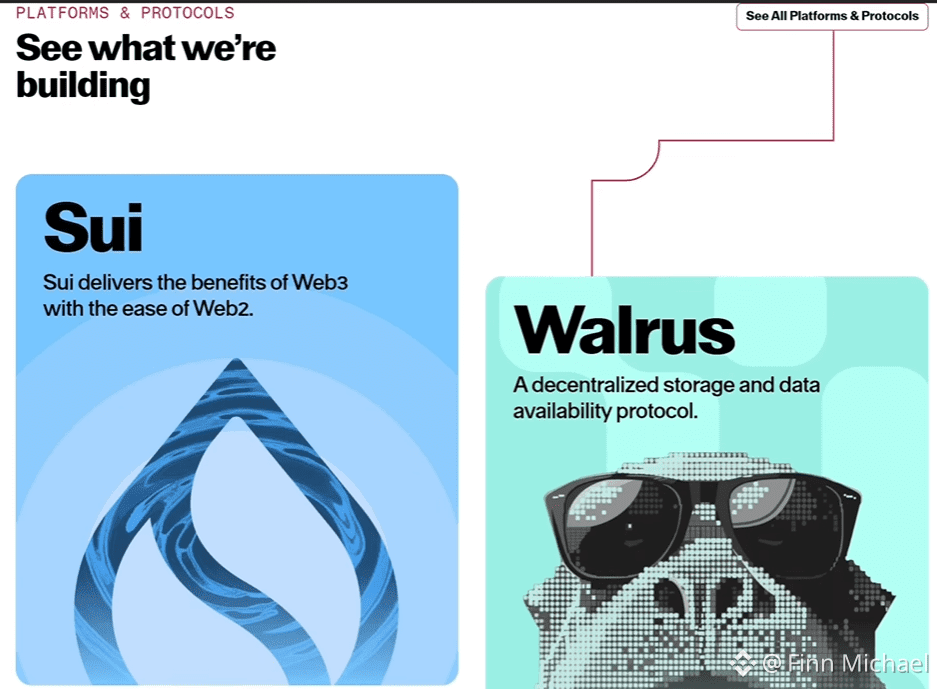
Walrus exists because modern digital systems quietly ask users to accept a fragile bargain. Data is easy to store and retrieve, but only as long as centralized providers remain available, cooperative, and aligned with user interests. When that alignment breaks, users often discover that control over their own data was never truly theirs. Walrus approaches this problem from an infrastructure perspective rather than a product one. It is a decentralized data storage and data availability protocol designed to support large-scale data needs without relying on trust in a single operator.
At its foundation, Walrus separates what blockchains do well from what they do poorly. Blockchains are effective at coordination, verification, and enforcing rules, but they are inefficient at storing large amounts of data. Walrus accepts this reality and builds around it. The Sui blockchain is used as the coordination layer, handling metadata, proofs, economic logic, and verification. The Walrus network itself stores the actual data in a decentralized way. This separation allows the system to scale storage capacity without degrading blockchain performance, a design choice that reflects practical engineering rather than idealism.
The choice of Sui as the base layer is driven by technical fit. Sui’s parallel execution model allows many operations to occur simultaneously, reducing bottlenecks as usage grows. Its object-based architecture maps cleanly to storage objects and access rules, while fast finality provides developers with predictable confirmation times. These properties reduce friction for builders and limit hidden failure points that often emerge in more congested environments.
Data within Walrus is not simply copied and distributed. Instead, the protocol relies on erasure coding, a technique that assumes failures are inevitable rather than rare. Files are split, mathematically encoded, and distributed across many independent storage nodes. Only a portion of these fragments is needed to reconstruct the original data. This reduces storage overhead, increases fault tolerance, and minimizes the risk that any single node can compromise data integrity or privacy. The system does not attempt to eliminate risk entirely. It reduces the impact of failure when it occurs, which is often the more realistic goal.
Blob storage further abstracts complexity away from applications. Large data objects are referenced through cryptographic identifiers, allowing applications to verify data existence and availability without directly managing storage logistics. For developers, this means fewer assumptions about where data lives and fewer dependencies on centralized services. For users, it reduces the number of invisible trust relationships embedded in the system.
Adoption of Walrus is driven primarily by builders rather than end users. Applications that require reliable off-chain data storage, such as decentralized finance platforms, media-heavy applications, and developer infrastructure tools, are natural early users. These builders tend to prioritize stability, predictable costs, and verifiable guarantees over rapid experimentation. Walrus grows alongside the Sui ecosystem, benefiting from shared tooling and architectural alignment. This kind of adoption is gradual and often understated, but it is typically more durable than attention-driven growth.
Institutional interest follows a different timeline. Enterprises and organizations move cautiously, especially when infrastructure is involved. Walrus aligns with their concerns by offering redundancy instead of single points of failure, verifiability instead of implicit trust, and reduced vendor lock-in. While adoption in this segment is slow, systems that meet these criteria often remain in use once they are integrated.
Developer behavior over recent years has shifted in noticeable ways. Storage is no longer treated as a neutral backend decision. Developers increasingly recognize that storage choices affect security, compliance, and long-term resilience. Walrus fits into this shift by presenting storage as a programmable and verifiable layer rather than an opaque service. Its success, however, depends heavily on developer experience. If complexity is well hidden behind clear interfaces and tooling, adoption can grow. If it is not, convenience will push developers back toward centralized alternatives, regardless of philosophical alignment.
The WAL token underpins the economic and governance layers of the protocol. Its role is functional rather than symbolic. Users pay for storage and retrieval. Storage providers stake WAL to participate and earn rewards for maintaining availability. Failures are penalized economically, creating accountability without requiring trust. Governance rights allow token holders to influence protocol parameters and upgrades, distributing responsibility for the system’s evolution. This design ties the token’s relevance to real network activity rather than purely speculative interest.
Despite its strengths, Walrus faces meaningful challenges. The decentralized storage space is competitive, and differentiation depends on reliability, cost efficiency, and ease of integration rather than ideology. Early-stage networks are particularly vulnerable to concentration risks and incentive imbalances. Distributed storage systems are also inherently complex, making performance issues harder to diagnose and resolve. Regulatory uncertainty adds another layer of risk, as interpretations of data responsibility vary across jurisdictions.
Looking forward, Walrus is likely to be evaluated quietly rather than dramatically. Near-term progress will be reflected in stable performance, growing stored data volumes, and continued developer usage. Over time, improvements in tooling and potential cross-chain integrations could broaden its relevance beyond a single ecosystem. In the long term, as modular blockchain architectures become more common, specialized storage protocols like Walrus may become essential infrastructure rather than optional components.
Walrus is not designed to attract attention for its own sake. It is designed to function under stress, to reduce the consequences of failure, and to align incentives where trust cannot be assumed. Its value will ultimately be measured not by visibility or speculation, but by whether developers continue to rely on it when reliability, data ownership, and long-term resilience matter most.