


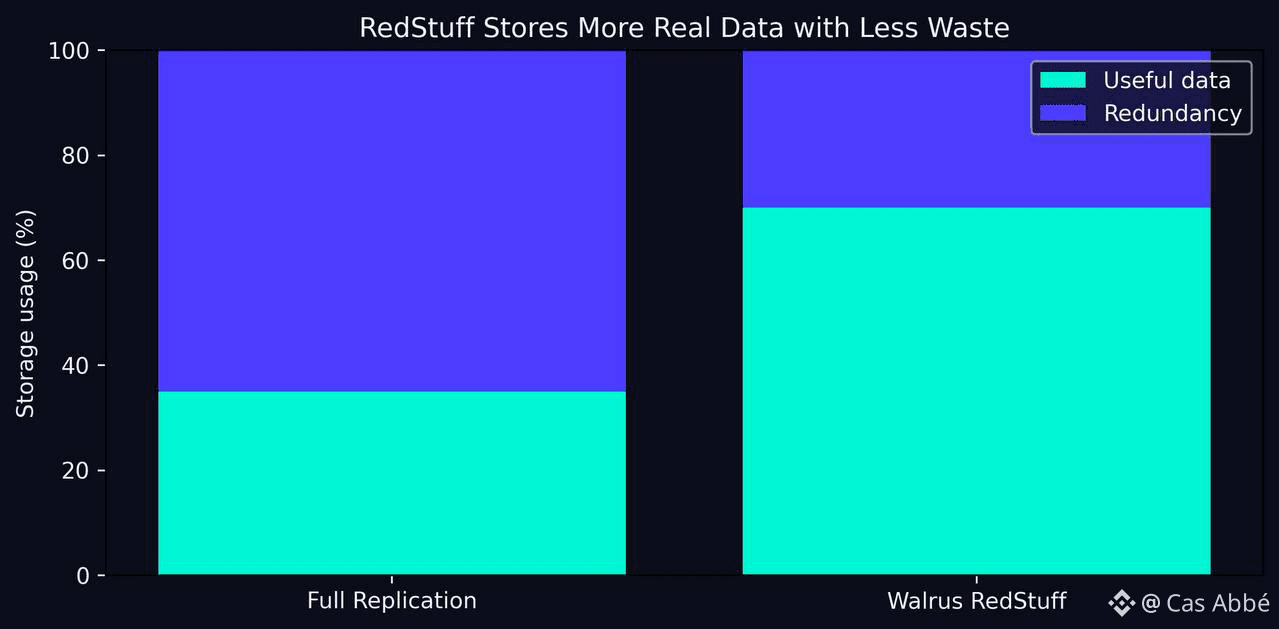
Among the largest innovations of Walrus is not flauntish, but it is in the encoding and storage of data on the network.
In conventional file storage systems, the complete copies of the files are stored in numerous places or employed are simple schemes which simply cannot be used in large and decentralized networks. Walrus is using a two-dimensional erasure-coding technique called Red Stuff that was created to address the inefficiencies of the earlier systems.
The thing Red Stuff does is to divide data into a mesh of small pieces (slivers and shards) and scatter them over the large number of nodes. When there are sufficient pieces, the original blob can be put back together, even when it has lost parts or some of its nodes are unavailable. It is as though you are doing a puzzle and only require a small part of the puzzle to see the complete picture.
Where previous erasure coding demanded a lot of computation and heavy mathematics, Red Stuff has been designed to support lightweight operations that are more bandwidth and fast. That is, it is not only that uploads and downloads are more reliable, but also that they are faster and less expensive than the older methods of decentralized storage. It is also able to reach redundancy at significantly lower waste: replication factor of 4-5x, rather than 10x or higher. This has the effect of enabling Walrus to compete with centralized cloud services in terms of cost, and retain decentralization.
Self-healing property of Red Stuff is another major strength. In case nodes go dead or begin to misbehave, as is the case with real networks, the system does not go haywire. It operates on the bits that remain and intelligent reconstruction algorithms to maintain data in-shape without having to fully regenerate the file. This causes Walrus to be resilient against uptime churn as well as malicious nodes attempting to impair service.
Considering decentralized storage such as construction of a house, most of the systems construct the same house everywhere (wasting space and cost). Red Stuff will rather put up many pieces of houses on many foundations, and you always can find enough pieces to live in comfort. This is the reason why Red Stuff becomes critical to Walrus delivering high availability, low overhead, and real resilience of big data files - and why developers can rely on it to serve applications that can not afford to stop.

