


Certainly, when discussing decentralized storage, one would like to begin with small items at first - NFT metadata, profile pictures, and small JSON files. However, the actual boundary of storage is far larger, and Walrus can respond to that fact.
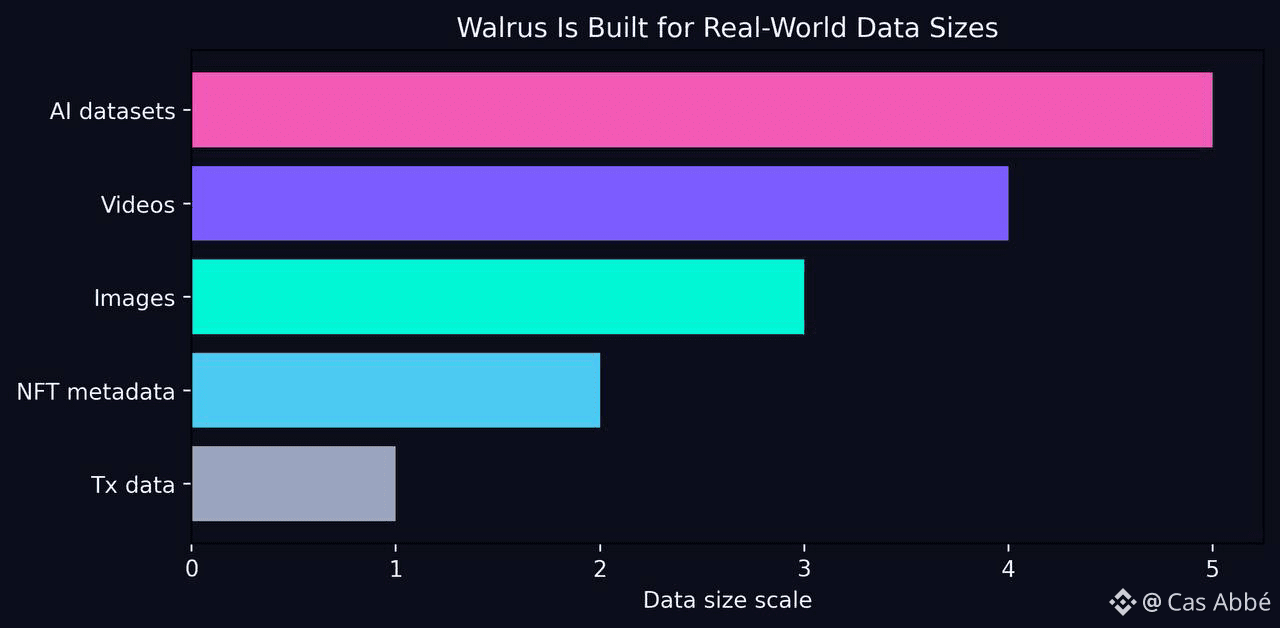
The internet is no longer a text and miniature files in themselves, it is now rich media, videos, 3D game materials, logs, backup systems, AI models and datasets. All these come under a category referred to as blobs; that is, big, unstructured binary data. Blockchains were not created to process such data in the first place. Their use is excellent in transactions, ownership proofs, and minor state updates but they are not efficient in locating large binary information. To that end, you require a storage solution that is scalable.
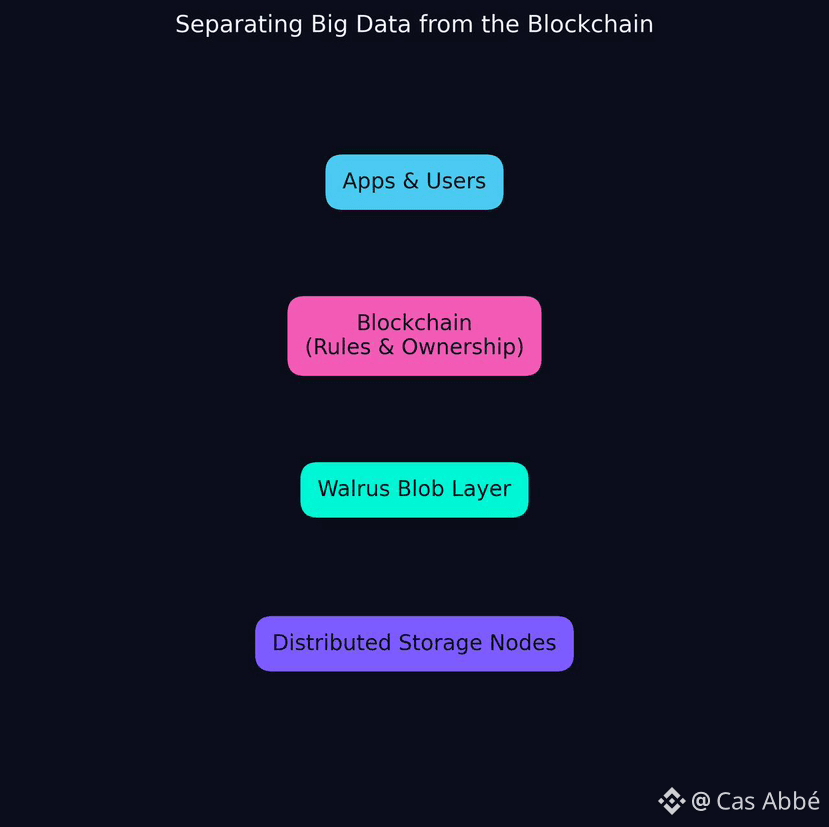
Walrus was built on the premise that Web3 apps (and, in particular, next-generation apps such as AI agents, games, and decentralized media platforms) require an actual, scalable data store that does not push them into centralized cloud providers once again. Walrus does not store heavy content on blockchain (which would be extremely expensive), but rather in a decentralized storage network and coordinates, verifies, and pays with the help of the Sui blockchain. It does not need to store your videos on the chain, it only stores pointers and storage proofs, much more efficient.
There are practical advantages of this design. In the case of a Web3 game, Sui smart contracts might be used to manage ownership, in-game logic, and transacting, and Walrus will manage all of the heavy game assets, including textures, soundtracks, maps, and player-owned content. Terabytes of video files uploaded by users could be stored on a video platform that did not have a centralized host. The training datasets, which can be limited only to gigabytes to terabytes, can be stored and read continuously by an AI application, which is virtually unfeasible to achieve with a purely blockchain system.
Since Walrus spreads data to a great number of machines worldwide and does not depend on one data center and provider, it is not vulnerable to single points of failure and possible censorship as well. This is the core of decentralization of availability of data, not only metadata. In this respect, Walrus is not merely a file storage; it provides the basis of large-scale decentralized applications that need significant data processing without reducing security, cost, or access to files.


