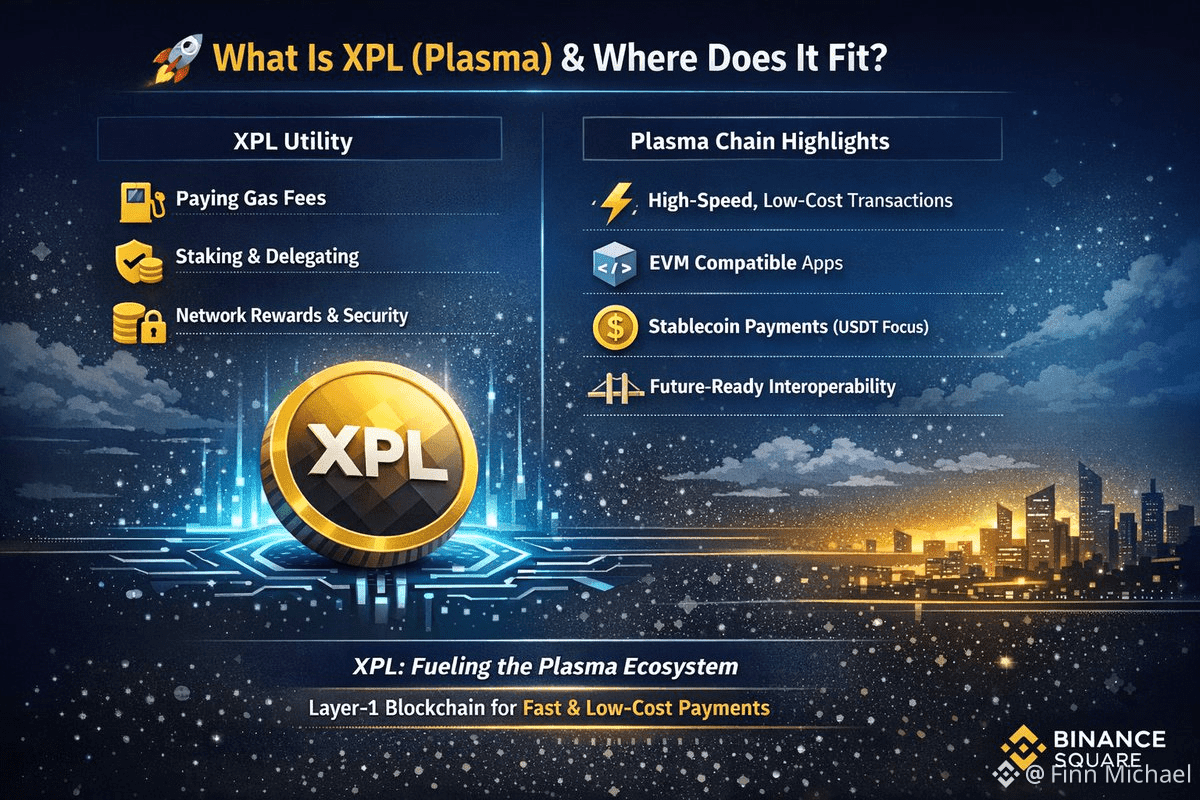
Most blockchains are built to impress. They chase flexibility, novelty, and broad narratives about reinventing everything at once. Plasma starts from a more grounded observation: for millions of people and an increasing number of institutions, crypto already has a clear and proven use case. It is moving dollars when traditional systems are slow, expensive, or unavailable. Stablecoins are no longer an experiment. They are daily tools. Plasma is shaped by that reality.
At its core, Plasma treats stablecoin settlement as a serious financial workload rather than a side effect of generalized smart contracts. The technical foundation reflects this mindset. By adopting full EVM compatibility through Reth, Plasma does not ask developers or institutions to relearn how blockchains work. It meets them where they already are. Existing Ethereum contracts, tooling, and operational habits carry over almost directly. This choice may seem conservative, but it matters. When real money moves at scale, familiarity reduces mistakes, and predictability builds trust.
Finality is handled with similar pragmatism. PlasmaBFT is designed to provide sub-second deterministic finality, which changes how the system feels to use. For a retail user sending USDT to family across borders, or for a payment processor settling balances between partners, waiting minutes for confirmation is not just inconvenient, it creates anxiety and operational friction. Fast finality reduces that tension. It makes the system feel closer to a payment network than a speculative platform, where transactions are something you rely on rather than watch nervously.
One of Plasma’s most human decisions lies in how it handles fees. Gasless USDT transfers and stablecoin-first gas remove a quiet but persistent source of frustration in crypto. Users no longer need to understand why they must hold a volatile token just to move digital dollars. Institutions no longer need to explain to compliance teams why transaction costs fluctuate with market sentiment. This design choice respects how people actually think about money. When you move dollars, you want to think in dollars, not in abstractions.
Security and neutrality are approached with the same awareness of real-world pressures. By anchoring parts of its security model to Bitcoin, Plasma acknowledges that financial infrastructure does not exist in a vacuum. Stablecoins sit at the intersection of technology, regulation, and geopolitics. Bitcoin anchoring raises the cost of censorship and revision, reinforcing the idea that Plasma aims to be neutral ground rather than a platform shaped by short-term interests. It is not a guarantee, but it is a signal of intent.
Adoption for a system like Plasma will never look loud. There may be no viral applications or speculative spikes that dominate social media. Instead, progress shows up quietly in transaction flows, backend integrations, and payment corridors where stablecoins are already essential. In high-adoption regions, Plasma’s value lies in reducing friction for people who already trust stablecoins more than local banking systems. In institutional contexts, it lies in making on-chain settlement feel boring in the best possible way.
Developers drawn to Plasma are often motivated by the same instinct. This is not a playground for experimental narratives. It is an environment for building payment rails, settlement layers, and financial infrastructure that must work every day. Because Plasma remains EVM-compatible, developers can focus on solving business problems rather than wrestling with new execution models. Over time, this encourages a developer ecosystem that values reliability and clarity over constant reinvention.
The economic design reinforces this tone. Fees and incentives are structured to prioritize stability and predictability. This may limit speculative upside, but it aligns with the needs of users who depend on stablecoins as tools, not bets. For them, the emotional trigger is not excitement, it is relief. Relief that costs are understandable, transactions are fast, and the system behaves consistently.
Plasma’s challenges are real and unavoidable. Operating close to stablecoins means operating close to regulation, issuer dependencies, and external constraints. Competition is also intensifying, as other chains adopt account abstraction and gas sponsorship features that reduce Plasma’s surface-level differentiation. The harder task is proving that a purpose-built settlement layer delivers lasting advantages when conditions become stressful rather than ideal.
Looking ahead, Plasma’s relevance depends on a simple question: do stablecoins continue their shift from crypto utility to global financial infrastructure? If they do, the need for chains that are calm, neutral, and specialized will only grow. Plasma does not promise a new financial world. It aims to quietly support the one that is already forming, where digital dollars move quickly, predictably, and without drama. In that restraint lies its most distinctive strength.