

One of the hardest problems in blockchain infrastructure is not launching a protocol, but evolving it without breaking trust. Many networks rely on informal coordination, social consensus, or disruptive forks to introduce change. Dusk Network takes a fundamentally different approach. Its white paper treats protocol evolution as an engineering discipline—one that must preserve continuity, predictability, and economic coherence even as the system grows more complex.
Dusk is built around the idea that rules must evolve without surprising participants. This begins with a clear separation between immutable protocol guarantees and adaptable operational parameters. Core invariants—such as state validity, execution correctness, and settlement guarantees—are designed to remain stable over time. Changes are applied only to components that have been intentionally designed to accommodate evolution, ensuring that upgrades do not retroactively alter the meaning of past actions.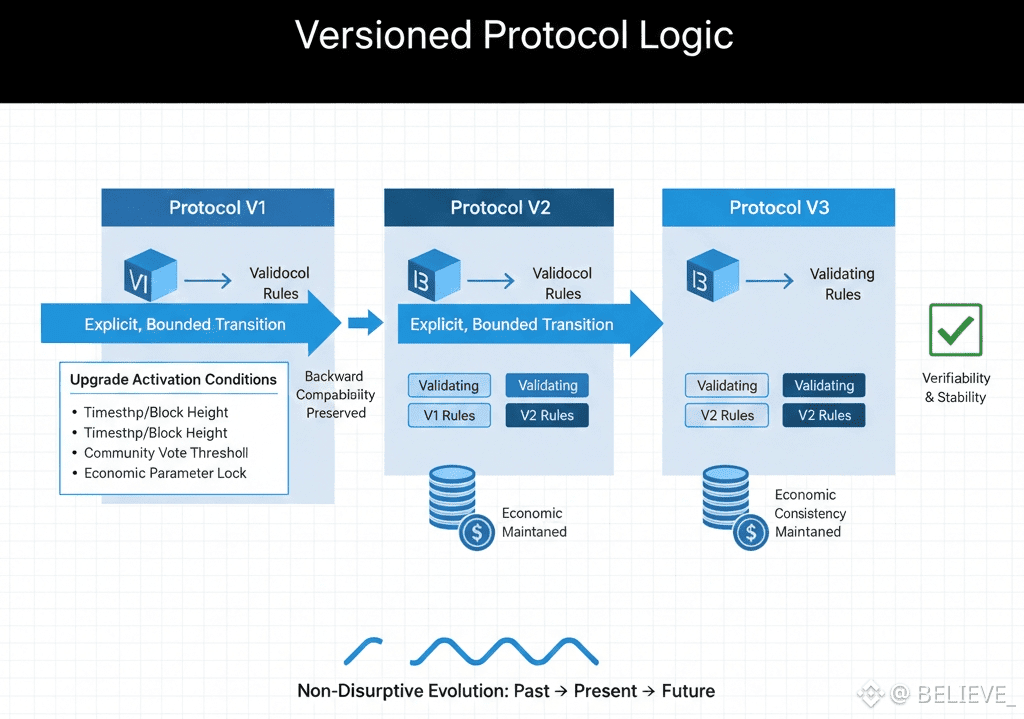
A key mechanism enabling this stability is versioned protocol logic. Instead of replacing rules wholesale, Dusk introduces new logic alongside existing rules, allowing the network to transition forward without invalidating historical assumptions. Nodes are never forced into ambiguous states where old and new interpretations conflict. Every transition is explicit, bounded, and verifiable at the protocol level.
This design has a profound impact on reliability. Applications built on Dusk are not exposed to sudden behavioral changes caused by upstream modifications. Developers can reason about future compatibility because the protocol itself enforces continuity. This sharply contrasts with systems where upgrades implicitly rewrite execution semantics, forcing downstream projects to react defensively.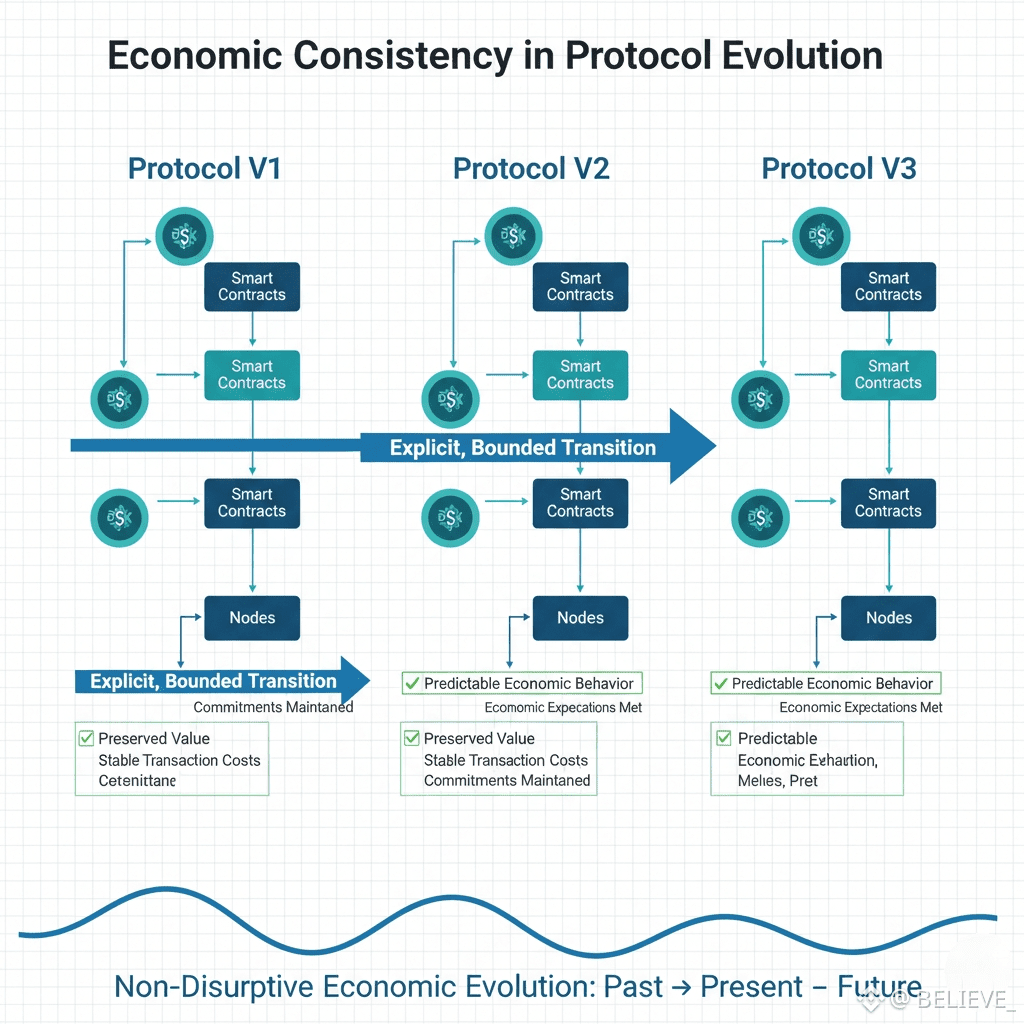
Another overlooked strength of Dusk’s evolution model is economic consistency. Changes to protocol behavior are structured so that they do not introduce hidden redistribution effects. The DUSK token remains a stable unit of account across protocol versions, ensuring that costs, commitments, and economic expectations do not drift unpredictably. This preserves trust not just in the technology, but in the economic contract between the network and its participants.
Dusk also avoids a common failure mode in blockchain upgrades: governance bottlenecks. Rather than concentrating change authority in ad hoc voting or emergency coordination, the protocol enforces upgrade paths through predefined activation logic. Nodes either meet the conditions for a new version or continue operating under the existing one without ambiguity. This reduces political risk and prevents fragmentation driven by subjective interpretation.
From a systems perspective, this approach treats a blockchain more like a long-lived operating system than a mutable application. Changes are staged, validated, and activated under controlled conditions. Backward compatibility is preserved where necessary, and breaking changes are isolated by design rather than imposed by force. This makes Dusk resilient not only to technical risk, but to social and economic shocks.
Importantly, protocol evolution on Dusk is observable. Participants can verify which rules are active, which transitions are pending, and which constraints apply at any given moment. There is no hidden roadmap encoded off-chain. The network’s behavior is self-describing, allowing independent actors to assess risk and compatibility without relying on privileged information.
This philosophy has long-term implications. As regulatory environments, application demands, and technical standards evolve, Dusk can adapt without eroding confidence. The network does not need to choose between stagnation and disruption. Instead, it advances through controlled, verifiable progression—preserving the integrity of both past and future states.
In conclusion, Dusk Network demonstrates that protocol evolution does not have to be chaotic or politically fragile. By engineering change as a first-class system property, Dusk creates a blockchain that can grow, adapt, and mature without compromising trust. This discipline positions Dusk not merely as a functional network today, but as infrastructure capable of remaining coherent and credible across decades of technological change.
